
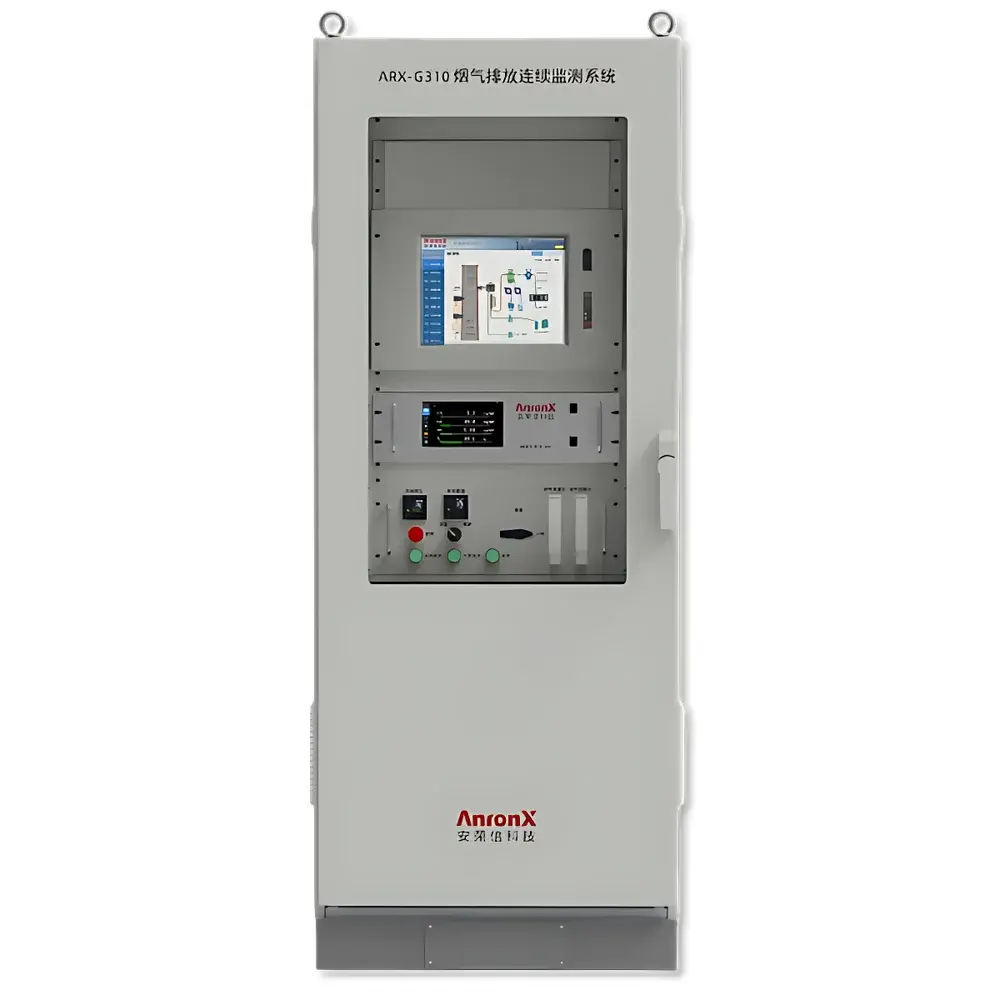
AnronX ARX-C200/ARX-G310 Continuous Emission Monitoring System (CEMS)
| Brand | AnronX |
|---|---|
| Origin | Jiangsu, China |
| Manufacturer Type | Authorized Distributor |
| Product Category | Domestic |
| Model | ARX-C200 / ARX-G310 |
| Instrument Type | Continuous Emission Monitoring System (CEMS) |
| Measurement Accuracy | ±2% of Full Scale (F.S.) |
| Response Time | ≤ 200 s |
| Measured Parameters | SO₂, NO, NO₂, O₂, Particulate Matter (PM), Flue Gas Temperature, Static Pressure, Flow Velocity, Relative Humidity |
Overview
The AnronX ARX-C200/ARX-G310 Continuous Emission Monitoring System (CEMS) is an integrated, regulatory-compliant solution engineered for long-term, unattended measurement of gaseous pollutants and physical flue gas parameters from stationary combustion sources. Designed in accordance with Chinese national emission standards (e.g., HJ 75–2017, HJ 76–2017) and aligned with international CEMS design principles, the system employs proven optical and electrochemical sensing technologies to deliver high reproducibility and operational stability under harsh industrial conditions. The ARX-C200 serves as the base platform for full-parameter monitoring, while the ARX-G310 variant integrates a UV differential optical absorption spectroscopy (UV-DOAS) analyzer capable of direct NO₂ quantification—eliminating reliance on catalytic NO-to-NO₂ converters and mitigating associated drift, calibration uncertainty, and consumable replacement cycles.
Key Features
- UV-DOAS-based gas analysis module (AGA1000-UV) for simultaneous, interference-resistant detection of SO₂, NO, NO₂, and O₂—no cross-sensitivity correction required for typical flue gas matrices.
- Direct NO₂ measurement capability in ARX-G310 configuration reduces dependency on molybdenum converter maintenance, lowering total cost of ownership and improving data continuity.
- High-temperature integrated sampling probe with built-in ceramic filter, automatic back-purge function, and on-line zero/span calibration port—designed for continuous operation at up to 200 °C flue gas temperature.
- Particulate matter monitoring via LSS2004 laser backscatter analyzer (CCEP-certified); optional configurations include LFS800 (extractive) or LSS2014 (in-situ) for site-specific particulate dynamics and stack geometry constraints.
- Flue gas parameter module supports concurrent measurement of temperature (±1 °C), static pressure (±10 Pa), velocity (±2% F.S.), and relative humidity (±3% RH) using calibrated APT2000 or UF2020 transmitters.
- Modular pneumatic architecture with solenoid valve manifold and stainless-steel sensor interconnects—minimizes risk of leakage, aging-related failure, and field downtime.
Sample Compatibility & Compliance
The ARX-C200/ARX-G310 is validated for use across coal-fired power plants, cement kilns, waste incinerators, and chemical process heaters emitting flue gas with dust loadings up to 10 g/m³ (dry basis), moisture content up to 20% v/v, and operating temperatures between 80 °C and 200 °C. All analyzers and sensors carry China Environmental Protection Product Certification (CCEP), confirming conformance with HJ/T 76–2007 and GB/T 16157–1996 requirements. System-level compliance includes support for data integrity protocols required by China’s National Monitoring Platform for Fixed Pollution Sources—including audit trails, electronic signatures, and tamper-evident storage per HJ 212–2017 communication protocol.
Software & Data Management
The embedded control software runs on a ruggedized industrial PC and provides real-time visualization of all measured parameters, alarm status, calibration logs, and diagnostic codes. It implements automated zero/span verification routines, drift compensation algorithms, and fault self-diagnosis per HJ 75–2017 Annex D. Data storage retains ≥180 days of second-level raw values and hourly averaged results with metadata (e.g., calibration timestamps, maintenance events). Export formats include CSV and XML; interfaces include RS-485 (Modbus RTU), Ethernet (TCP/IP), and OPC UA for integration with DCS, SCADA, or central environmental management systems. Audit trail functionality satisfies GLP-aligned recordkeeping expectations for regulatory reporting and third-party verification.
Applications
- Regulatory compliance monitoring for SO₂, NOₓ, PM, and opacity at coal- and biomass-fired boilers subject to provincial and national emission limits.
- Performance evaluation of flue gas desulfurization (FGD) and selective/non-selective catalytic reduction (SCR/SNCR) systems through synchronized upstream/downstream concentration profiling.
- Process optimization in cement rotary kilns and glass melting furnaces via real-time O₂ and temperature feedback loops.
- Stack testing support for environmental impact assessments (EIA) and periodic source testing under GB 13223–2011 and GB 16297–1996.
- Integration into enterprise-level environmental information platforms for centralized emissions accounting and sustainability KPI tracking.
FAQ
Does the ARX-G310 require a NO-to-NO₂ converter for nitrogen oxides measurement?
No—the ARX-G310 uses a UV-DOAS spectrometer with spectral resolution sufficient to resolve NO₂ absorption bands independently, enabling direct quantification without catalytic conversion.
Is the system compatible with China’s national emissions data reporting platform?
Yes—it fully supports HJ 212–2017 communication protocol, including data packet structure, encryption handshake, and acknowledgment mechanisms required for secure transmission to provincial and national environmental monitoring centers.
What particulate matter measurement principle does the LSS2004 employ?
The LSS2004 utilizes laser backscatter photometry at 650 nm wavelength, calibrated against gravimetric reference methods per HJ 836–2017 for low-concentration (<50 mg/m³) particulate monitoring.
Can the system operate in high-humidity flue gas without condensation-related errors?
Yes—the sampling probe and conditioning system incorporate heated sample lines (maintained at >120 °C), Nafion™ membrane dryers, and humidity-compensated algorithms to ensure stable baseline and minimal water vapor interference.
Is remote diagnostics and firmware update supported?
Yes—via secure VPN-enabled web interface, authorized personnel can access real-time instrument health metrics, download event logs, and deploy verified firmware updates without on-site intervention.
Related Products







