
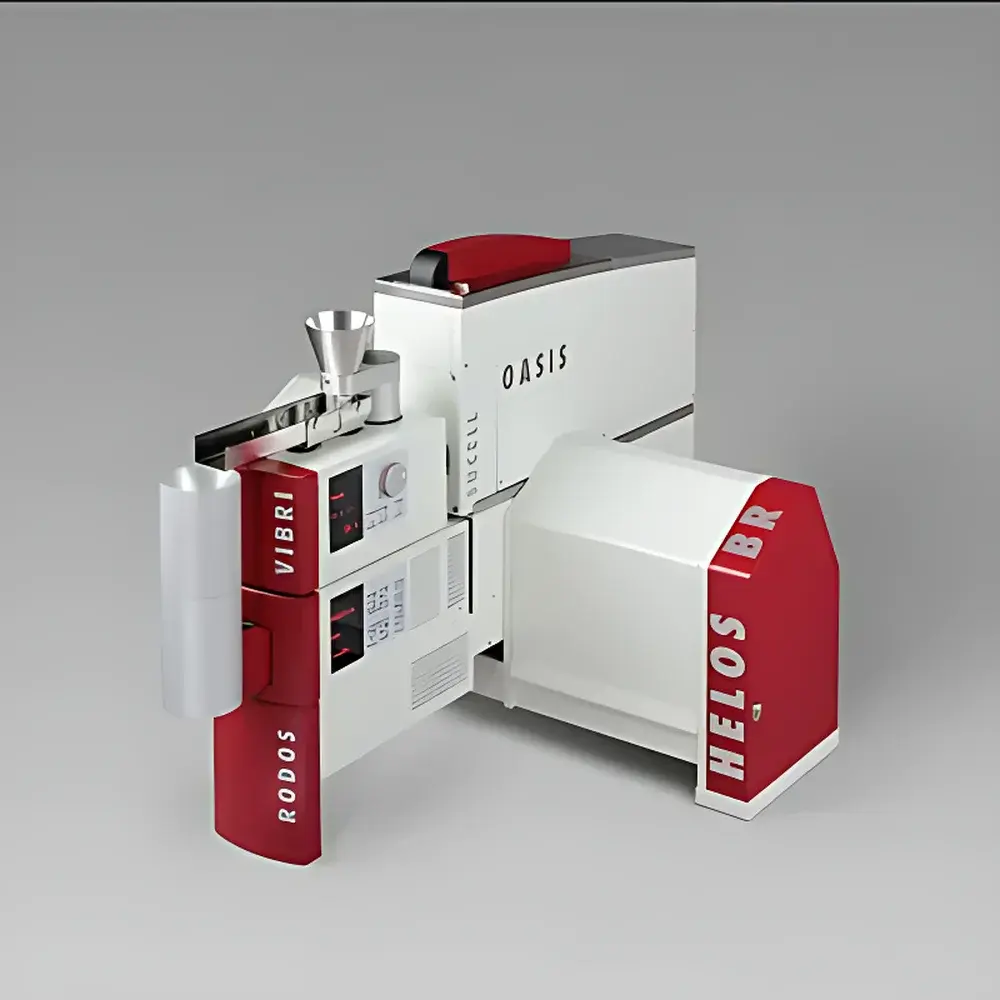
SYMPATEC HELOS & OASIS Fully Automated Dry/Wet Combined Laser Diffraction Particle Size Analyzer
| Brand | SYMPATEC |
|---|---|
| Origin | Germany |
| Manufacturer | SYMPATEC GmbH |
| Type | Laboratory Laser Particle Size Analyzer |
| Model | HELOS & OASIS |
| Dispersion Method | Dry and Wet |
| Measurement Range | 0.1–3500 µm |
| Repeatability | 0.04% |
| Measurement Time | <10 s |
Overview
The SYMPATEC HELOS & OASIS is a modular, high-precision laser diffraction particle size analyzer engineered for compliance with ISO 13320:2020 (Particle size analysis — Laser diffraction methods). It employs Fraunhofer diffraction and Mie theory-based optical modeling to deliver traceable, reproducible size distributions across a broad dynamic range—from fine submicron aerosols to coarse granular powders. Unlike conventional single-mode instruments, the HELOS platform integrates a universal optical bench with interchangeable dispersion modules, enabling seamless transition between dry powder and liquid suspension analysis without hardware reconfiguration. The core innovation lies in the OASIS dispersion system: a fully automated, dual-path architecture that unifies SYMPATEC’s proprietary RODOS dry dispersion technology and SUCELL wet dispersion technology into a single, software-synchronized unit. This design eliminates manual module swaps, minimizes operator intervention, and ensures measurement continuity across diverse sample types—critical for method transfer, QC batch release, and regulatory documentation.
Key Features
- Automated dry/wet dispersion switching in ≤5 seconds via software command or front-panel trigger—no tooling, no recalibration.
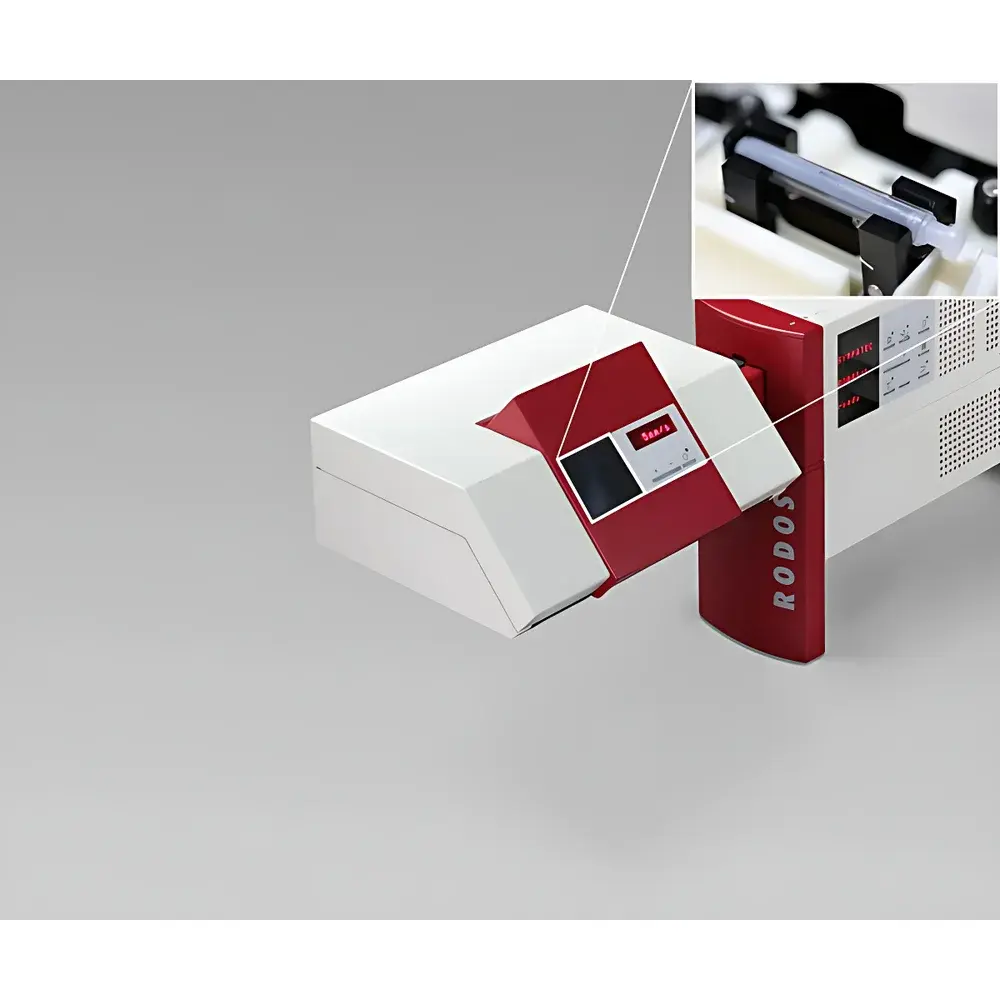
- RODOS dry dispersion module: features a hardened steel and tungsten carbide (WC) dispersion tube with optimized length-to-diameter ratio to maximize shear and collision energy; supports adjustable dispersing pressure (0.1–4 bar) and mg-level sample consumption.
- SUCELL wet dispersion module: closed-loop recirculation system with integrated 60 W ultrasonic generator (0–100% power control), dual mechanical stirrers, peristaltic pump, and real-time dispersion medium volume monitoring.
- Parallel optical path design minimizes particle re-agglomeration during dry measurement by eliminating confinement-induced turbulence.
- ASPIROS-compatible sealed sampling option for hazardous, toxic, or controlled-substance powders under inert atmosphere or negative pressure.
- Full system self-cleaning protocol with programmable rinse cycles, solvent compatibility validation, and residue detection alerts to prevent cross-contamination between samples.
- Stainless-steel construction throughout fluidic pathways and housing—certified for GMP-compliant environments and compatible with CIP/SIP validation protocols.
Sample Compatibility & Compliance
The HELOS & OASIS accommodates a wide spectrum of industrial and pharmaceutical materials: free-flowing and cohesive powders (e.g., lactose monohydrate, API excipients), aqueous/organic suspensions (e.g., TiO₂ dispersions, polymer emulsions), sprays (nasal/inhalation formulations), and slurries (battery cathode precursors, ceramic slips). Its measurement traceability aligns with ASTM E2918, ISO 13320, and USP . For regulated environments, the instrument supports 21 CFR Part 11-compliant audit trails—including user authentication, parameter change logs, electronic signatures, and immutable raw data archiving. All dispersion modules are designed to meet GLP/GMP requirements for method validation, including repeatability (≤0.04% RSD on D50), intermediate precision, and robustness testing per ICH Q5A and Q2(R2).
Software & Data Management
Operating on WINDOX 7 software, the system provides full workflow automation from method setup to report generation. WINDOX includes ISO-compliant reporting templates, customizable SOP-driven sequences, and built-in uncertainty estimation per GUM (Guide to the Expression of Uncertainty in Measurement). Raw scattering patterns are stored in vendor-neutral HDF5 format; processed results export to CSV, PDF, XML, or LIMS-integrated formats via OPC UA or RESTful API. Version-controlled method libraries enable secure sharing across global sites, while role-based access control enforces separation of duties in production QA environments. All data transactions—including calibration history, maintenance logs, and dispersion parameter records—are timestamped and cryptographically signed.
Applications
The HELOS & OASIS serves as a primary characterization tool in pharmaceutical development (inhalation formulation optimization, granulation endpoint determination), advanced materials manufacturing (metal AM feedstock qualification, battery electrode slurry homogeneity verification), and quality control laboratories across ceramics, pigments, catalysts, and food-grade powders. Its ability to generate statistically equivalent results across dry and wet modes—demonstrated in inter-instrument comparability studies using reference lactose standards—makes it ideal for bridging R&D scale-up, process validation, and commercial release testing. Case studies include real-time monitoring of milling endpoints in continuous manufacturing lines and stability assessment of nanoemulsions under accelerated storage conditions.
FAQ
Does the HELOS & OASIS require separate calibration for dry and wet modes?
No. The optical bench is invariant; only dispersion parameters (e.g., pressure, sonication time, flow rate) are method-specific. Calibration is performed once per optical configuration using NIST-traceable PSL or silica standards.
Can the system analyze samples with high aspect ratios or fibrous morphology?
Yes—provided dispersion energy is optimized to avoid fiber breakage. The RODOS module allows precise control over shear intensity, and WINDOX supports anisotropic shape factor analysis via multi-angle scattering deconvolution.
Is the SUCELL module compatible with non-aqueous solvents?
Yes. All wet-path components are chemically resistant to alcohols, acetone, THF, and other common organic media. Solvent compatibility must be verified per material safety data sheets prior to use.
How is data integrity ensured during long-term 24/7 operation?
WINDOX implements cyclic redundancy checks (CRC) on all raw detector frames, automatic backup to network-attached storage, and hardware watchdog timers that trigger safe shutdown upon communication loss.
What documentation is provided for regulatory submissions?
SYMPATEC supplies IQ/OQ/PQ protocols, 21 CFR Part 11 readiness reports, ISO 17025-accredited calibration certificates, and complete traceability matrices linking hardware IDs, firmware versions, and software build numbers.



