
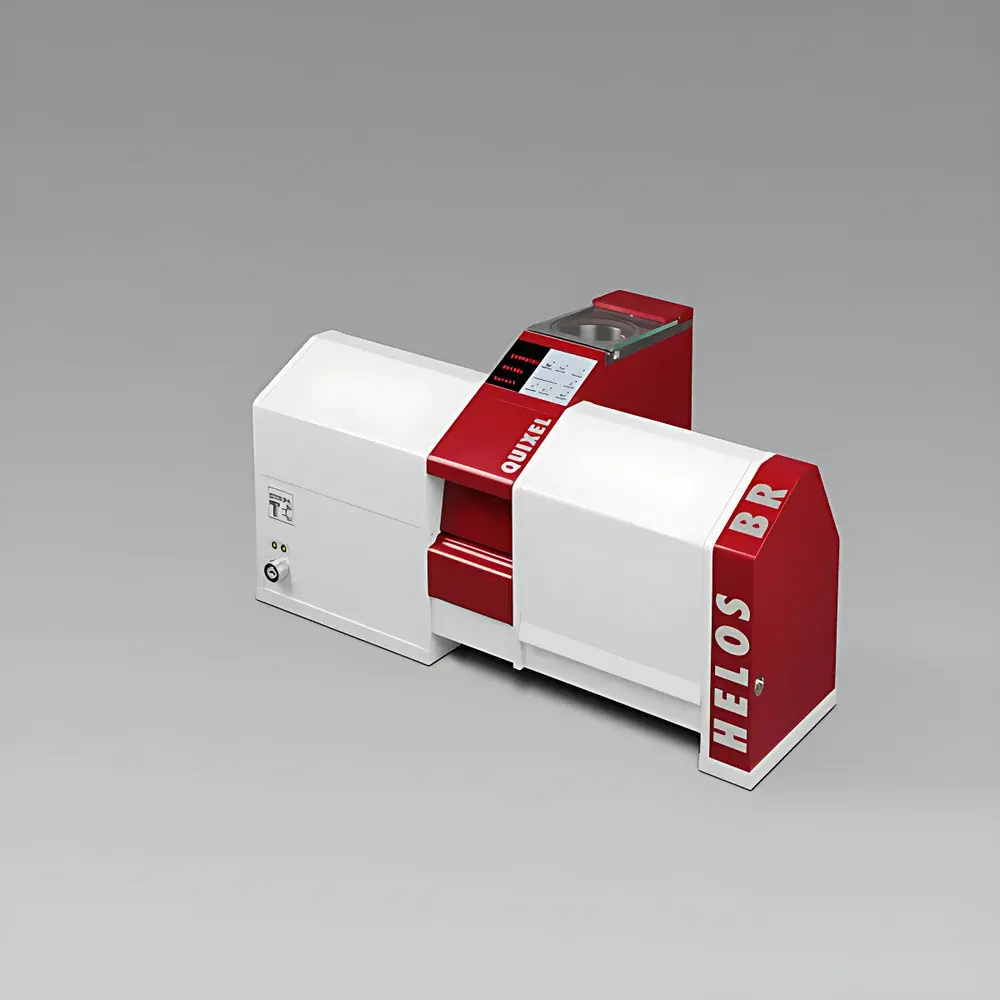
SYMPATEC HELOS/QUIXEL Advanced Wet-Dispersion Laser Diffraction Particle Size Analyzer
| Brand | SYMPATEC |
|---|---|
| Origin | Germany |
| Manufacturer | SYMPATEC GmbH |
| Instrument Type | Laboratory Laser Diffraction Analyzer |
| Dispersion Method | Wet Dispersion |
| Measurement Range | 0.1–3500 µm |
| Repeatability | <0.04% |
| Measurement Time | ≤10 s |
| Optical Model | Fraunhofer and Mie Theory |
| Maximum Obscuration | 50% |
| Dispersant Compatibility | Organic solvents, aqueous media, corrosive liquids |
| Ultrasonic Power | 60 W, continuously adjustable |
| Circulation Pump | Variable-speed centrifugal pump |
| Sample Volume | 250–1000 mL |
| Integrated Cleaning Cycle | Fully automated with liquid-level monitoring |
| Optional Temperature Control | Up to 100 °C |
Overview
The SYMPATEC HELOS/QUIXEL is a high-performance, fully automated wet-dispersion laser diffraction particle size analyzer engineered for precision, speed, and robustness in demanding laboratory environments. Based on the well-established HELOS optical platform—first introduced by SYMPATEC in 1996—the QUIXEL module represents a generational advancement in dispersion system architecture. Unlike conventional laser diffraction systems reliant on external tubing and multi-component circulation loops, the HELOS/QUIXEL integrates all fluidic pathways internally, eliminating dead volumes, reducing carryover risk, and enabling rapid sample turnover. Its measurement principle follows ISO 13320-compliant laser diffraction, supported by dual optical models: Fraunhofer approximation for coarse, opaque particles and rigorous Mie theory for fine, transparent, or refractive materials (with user-defined complex refractive index inputs). The system delivers statistically stable distributions across its full 0.1–3500 µm dynamic range, validated under GLP-aligned operational protocols.
Key Features
- Tubeless fluidic architecture: All dispersion, circulation, and cleaning channels are fully embedded within the instrument chassis—no external hoses, no flow-path disassembly required between measurements.
- Sub-10-second measurement cycle: From sample introduction to final distribution output, including optical acquisition, real-time background subtraction, and data inversion.
- High-obscuration tolerance: Stable analysis up to 50% obscuration enables direct measurement of concentrated suspensions without mandatory dilution—critical for emulsions, slurries, and high-solids formulations.
- Chemically resistant wet module: Constructed from PTFE, sapphire, and corrosion-resistant stainless steel; compatible with aggressive organic solvents (e.g., THF, acetone, xylene) and acidic/alkaline media.
- Intelligent dispersion control: 60 W ultrasonic generator with continuous amplitude adjustment, coupled with a variable-speed centrifugal pump (0–4000 rpm), ensures optimal deagglomeration without particle fracture.
- Automated thermal management: Optional Peltier- or heater-based temperature regulation (ambient to +100 °C) supports method development for thermally sensitive APIs, waxes, or phase-change materials.
Sample Compatibility & Compliance
The HELOS/QUIXEL accommodates a broad spectrum of sample types: aqueous and non-aqueous suspensions, oil-in-water and water-in-oil emulsions, mineral slurries, metal powders (including tungsten carbide and rare-earth alloys), ceramic precursors, pharmaceutical nanosuspensions, and food-grade colloids. Its design meets mechanical and electrical safety requirements per IEC 61010-1 and EMC compliance per EN 61326-1. Data integrity features—including electronic signatures, audit trails, and user-access-level controls—support alignment with FDA 21 CFR Part 11 and EU Annex 11 for regulated QC laboratories. Routine calibration verification follows ISO 22412 using NIST-traceable polystyrene latex standards.
Software & Data Management
Operation is governed by WINDOX 7 software—a modular, validation-ready platform compliant with GAMP 5 principles. It supports SOP-driven workflows with parameter locking, method versioning, and automatic report generation (PDF/CSV/XML). Raw scattering patterns are stored alongside processed distributions, enabling retrospective re-evaluation with updated optical models or refractive index values. Batch processing, statistical trend analysis (e.g., d10, d50, d90, span, relative width), and comparative overlay functions facilitate stability studies and supplier qualification. Data export interfaces include OPC UA and RESTful API for integration into LIMS and MES ecosystems.
Applications
The HELOS/QUIXEL serves as a reference-grade tool across industries requiring traceable, high-reproducibility particle sizing. In powder metallurgy and hardmetal production, it quantifies grain growth inhibition during sintering cycles. For catalyst manufacturers, it monitors pore-filling efficiency in supported metal oxides. In pharmaceutical development, it characterizes milled API batches and nanoemulsion droplet stability under shear. Cement producers use it to correlate Blaine surface area with volumetric distribution parameters. Cosmetics R&D leverages its organic-solvent capability for silicone-based emulsions and pigment dispersions. Geological labs apply it to sediment sorting analysis where high-density mineral fractions (e.g., ilmenite, magnetite) must be resolved without density-based separation artifacts.
FAQ
What dispersion media are compatible with the HELOS/QUIXEL?
Aqueous buffers, alcohols, ketones, esters, hydrocarbons, and halogenated solvents—provided material compatibility is verified for seals and wetted components.
Can the system measure samples above 1000 µm without sedimentation bias?
Yes. The high-flow circulation velocity (>3 m/s) and optimized cuvette geometry minimize gravitational settling during measurement, ensuring representative sampling up to 3500 µm.
Is Mie theory calculation validated for anisotropic or irregular particles?
Mie theory assumes spherical morphology; however, WINDOX provides shape-correction modules and empirical calibration routines for common industrial particulates (e.g., platelet clays, needle-like crystals) based on orthogonal characterization data.
How is system cleanliness verified between runs?
The integrated liquid-level sensor triggers a full rinse cycle using programmable solvent sequences; residual mass detection via baseline scattering intensity confirms cleaning efficacy before next analysis.
Does the instrument support IQ/OQ/PQ documentation packages?
Yes. SYMPATEC supplies vendor-qualified installation, operational, and performance qualification templates aligned with ISO/IEC 17025 and ASTM E2918 requirements.



