
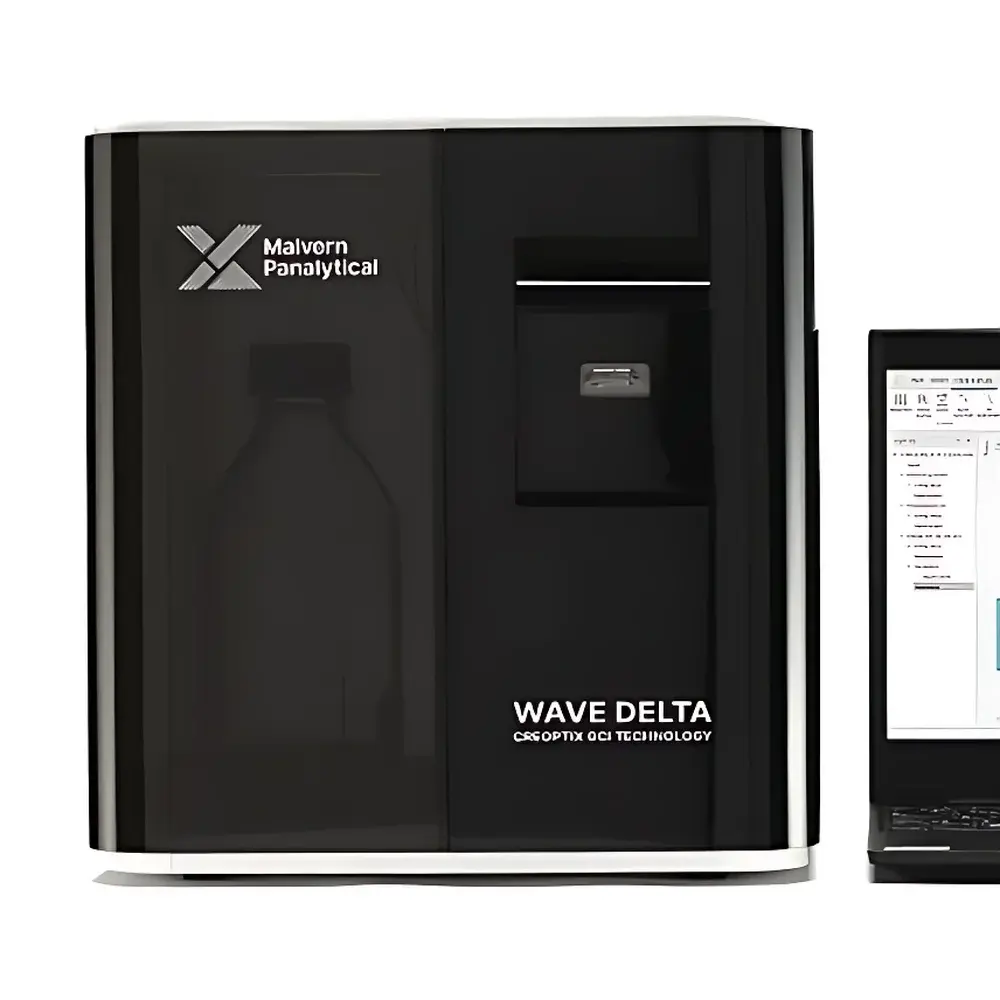
Malvern PANalytical WAVEdelta Grating-Coupled Interferometry (GCI) Molecular Interaction Analyzer
| Brand | Malvern PANalytical |
|---|---|
| Origin | Switzerland |
| Manufacturer Type | Original Equipment Manufacturer (OEM) |
| Import Status | Imported |
| Model | WAVEdelta |
| Instrument Principle | Grating-Coupled Interferometry (GCI) |
| Channel Configuration | Multi-channel |
| Detection Range | pM to mM |
| Sample Format Support | Dual microplate carriers (96-well or 384-well, standard or deep-well) or 48-position 1.5 mL vial rack |
| Injection Volume | < 450 µL (typical: 100 µL) |
| Assay Duration | 0–120 h |
| Temperature Control Range | 4 °C – 45 °C |
Overview
The Malvern PANalytical WAVEdelta is a high-performance, label-free molecular interaction analyzer engineered for precise real-time quantification of biomolecular binding kinetics, affinity, concentration, and conformational dynamics. It employs proprietary Grating-Coupled Interferometry (GCI), an optical biosensing technology that measures minute changes in the refractive index near a functionalized sensor surface with exceptional signal fidelity. Unlike surface plasmon resonance (SPR), GCI generates an evanescent field confined strictly at the chip–liquid interface, extending the effective interaction path length and minimizing bulk refractive index noise. This architecture delivers sub-pg/mm² baseline noise (<0.015 pg/mm² RMS) and enables robust detection across six orders of magnitude in analyte concentration (pM to mM). Acquired by Malvern PANalytical in 2022, the WAVEdelta integrates Creoptix’s Swiss-engineered GCI platform with industrial-grade thermal stability, microfluidic reliability, and enterprise-ready software infrastructure — making it suitable for regulated environments including GLP- and GMP-aligned workflows.
Key Features
- Label-free, real-time monitoring of association and dissociation phases with time resolution sufficient to resolve fast off-rates (koff > 10 s−1)
- Patented anti-clogging microfluidic cartridge design compatible with crude lysates, membrane proteins, liposomes, VLPs, and whole cells — reducing sample pre-purification burden
- Dual independent sample handling modules supporting simultaneous operation of microplates (96-/384-well, standard or deep-well) and 48-position vial racks
- Precise temperature control from 4 °C to 45 °C (±0.1 °C stability) for thermodynamic profiling and assay reproducibility
- Automated fluidics with <450 µL total injection volume per cycle (typically 100 µL), minimizing reagent consumption and carryover risk
- Modular hardware architecture enabling unattended operation for up to 120 hours — ideal for long-duration kinetic or equilibrium titration experiments
Sample Compatibility & Compliance
The WAVEdelta accommodates diverse biologics and synthetic ligands without labeling requirements: small molecules (<500 Da), peptides, monoclonal antibodies, recombinant proteins, oligonucleotides, glycans, lipids, lipid nanoparticles (LNPs), bacteriophages, virus-like particles (VLPs), and even intact mammalian cells. Sensor chips are chemically customizable (amine-, thiol-, streptavidin-, Ni-NTA-, or hydrophobic coupling) to support covalent or affinity-based immobilization strategies. The system meets key regulatory expectations for analytical instrument qualification: full audit trail logging (21 CFR Part 11 compliant), electronic signature support, IQ/OQ documentation templates, and traceable calibration protocols aligned with ISO/IEC 17025 and ICH Q5E guidelines. All firmware and software updates undergo version-controlled release validation per GxP standards.
Software & Data Management
WAVEcontrol™ software provides an integrated, wizard-driven environment for experimental design, data acquisition, global fitting, and reporting. It includes built-in models for 1:1, bivalent analyte, heterogeneous ligand, and mass transport-limited interactions — all solved via nonlinear regression with confidence interval estimation. Raw sensorgrams are stored in vendor-neutral HDF5 format; processed datasets export to CSV, Excel, or GraphPad Prism-compatible formats. Advanced features include batch processing of multi-plate runs, inter-run normalization, reference subtraction, and automated outlier detection. Data integrity safeguards include role-based access control, immutable audit trails, and encrypted local database storage — fully compliant with FDA 21 CFR Part 11 and EU Annex 11 requirements.
Applications
The WAVEdelta supports quantitative characterization across early- and late-stage biopharmaceutical development: epitope binning of therapeutic antibodies, off-rate screening for developability assessment, stoichiometry analysis of multivalent complexes, concentration determination of unstable antigens, and real-time monitoring of conformational shifts induced by cofactors or pH changes. In academic research, it enables rigorous investigation of transient protein–protein interactions in signaling cascades, host–pathogen recognition mechanisms, RNA–protein binding thermodynamics, and allosteric regulation in enzyme families. Its broad dynamic range and low non-specific binding background make it particularly valuable for studying low-abundance targets in native-like matrices — such as serum-spiked samples or detergent-solubilized membrane preparations.
FAQ
What distinguishes GCI from SPR in terms of sensitivity and noise performance?
GCI achieves lower baseline noise (<0.015 pg/mm²) due to its planar waveguide geometry and extended evanescent field path length, resulting in higher signal-to-noise ratio and improved detection limits for low-concentration analytes.
Can the WAVEdelta be used for kinetic analysis of membrane proteins solubilized in detergents or nanodiscs?
Yes — the anti-fouling microfluidic design and customizable chip surfaces support stable immobilization and reliable kinetics measurement of detergent-purified GPCRs, ion channels, and other challenging membrane-associated targets.
Is method transfer between WAVEdelta instruments supported?
Yes — standardized calibration procedures, identical fluidic routing, and version-controlled software ensure consistent assay performance across installations, facilitating multi-site studies and regulatory submissions.
Does the system support kinetic analysis under physiological temperature conditions?
Yes — the precision temperature module maintains setpoints from 4 °C to 45 °C with ±0.1 °C stability, enabling physiologically relevant binding studies at 37 °C or controlled cold-chain characterization at 4 °C.
How is data integrity ensured during long-duration (e.g., 120 h) unattended runs?
Continuous environmental monitoring (temperature, pressure, flow rate), automatic error logging, real-time data streaming to secure local storage, and hardware-triggered emergency shutdown protocols ensure data continuity and traceability throughout extended assays.




