
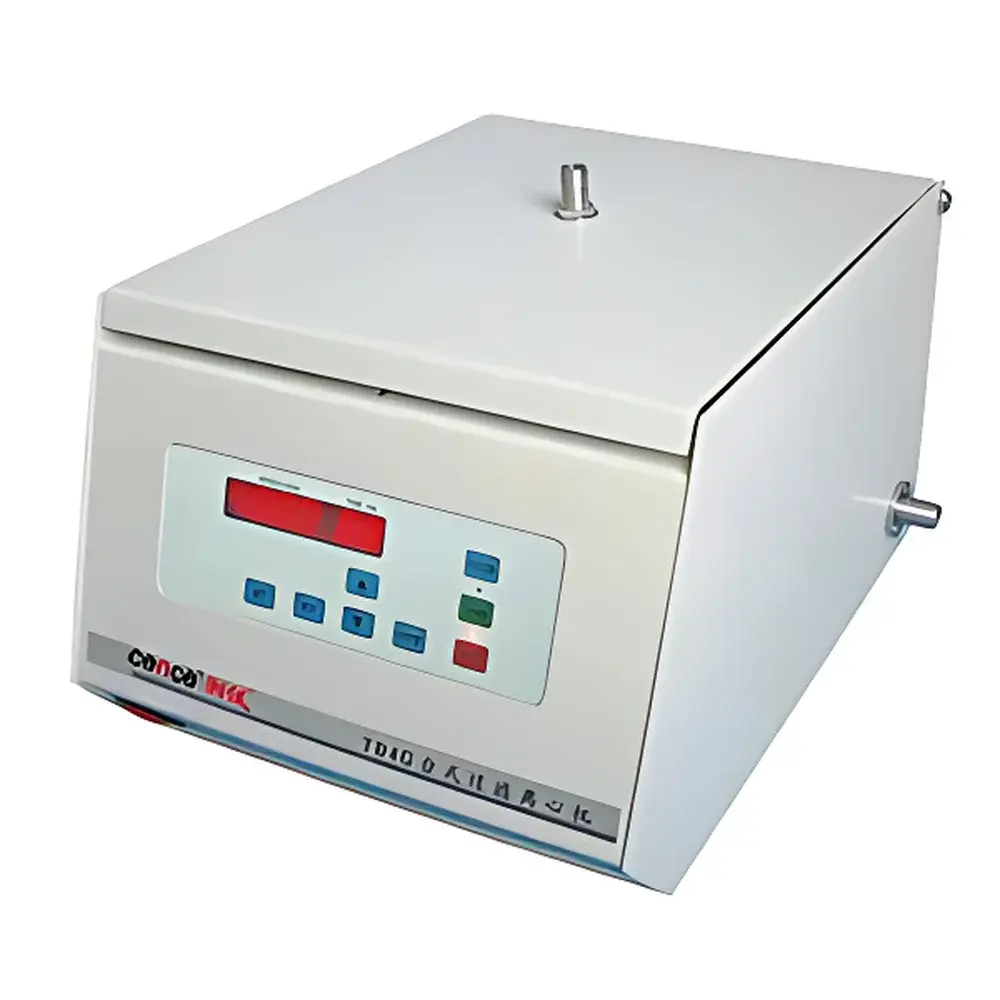
Xiangyi TD4G Benchtop Filtration Centrifuge
| Brand | Xiangyi |
|---|---|
| Origin | Hunan, China |
| Manufacturer Type | Direct Manufacturer |
| Product Category | Domestic |
| Model | TD4G |
| Instrument Type | Benchtop Centrifuge |
| Speed Class | Low-Speed Centrifuge (≤4000 rpm) |
| Function | General-Purpose Filtration Centrifuge |
| Configuration | Fixed-Angle Rotor |
| Separation Tier | Cellular & Bacterial Pellet Recovery |
| Maximum Capacity | 10 L/h (continuous feed rate) |
| Maximum Speed | 4000 rpm |
| Maximum RCF | 3800 × g |
| Dimensions | 380 × 400 × 330 mm |
| Drive System | Brushless DC Motor |
| Control System | Microprocessor-Based Digital Control |
| Rotor & Chamber Material | Stainless Steel (AISI 304) |
| Lid Seal | Silicone Rubber Gasket |
| Sterilization Compatibility | Autoclavable components, chemical disinfection (e.g., 70% ethanol, 0.5% sodium hypochlorite), UV-compatible interior |
Overview
The Xiangyi TD4G Benchtop Filtration Centrifuge is an engineered solution for solid–liquid separation in laboratory-scale bioprocessing, where continuous or semi-continuous filtration-based centrifugation is required. Unlike conventional sedimentation centrifuges, the TD4G integrates a dynamic filtration mechanism—utilizing centrifugal force to drive liquid phase through a replaceable filter medium while retaining particulate matter (e.g., microbial cells, yeast aggregates, or precipitated biomolecules) on the filter surface. This operational principle aligns with ASTM D2974–22 (Standard Test Methods for Moisture, Ash, and Organic Matter of Peat and Other Organic Soils) and ISO 11265:2021 (Soil quality — Determination of particle-size distribution), adapted for controlled biological suspensions. Designed for routine use in QC labs, fermentation monitoring, and downstream sample preparation, the TD4G delivers reproducible separation performance at low rotational energy input, minimizing shear-induced damage to fragile biological matrices.
Key Features
- Brushless DC motor ensures stable speed regulation, extended service life (>20,000 h MTBF), and zero carbon dust emission—critical for ISO Class 5–7 cleanroom-adjacent environments.
- Microprocessor-controlled digital interface supports programmable run profiles (time, speed, acceleration/deceleration ramps) with real-time RPM and RCF display.
- Stainless steel (AISI 304) rotor chamber and fixed-angle rotor provide corrosion resistance against organic solvents, mild acids, and alkaline buffers commonly used in extraction workflows.
- Silicone rubber sealing gasket maintains positive pressure integrity during operation and withstands repeated thermal cycling between ambient and 80°C sterilization cycles.
- Modular filtration architecture accepts standard polypropylene or nylon mesh filter bags (included), compatible with pore sizes ranging from 5 µm to 100 µm—enabling customizable retention thresholds per application.
- Compact footprint (380 × 400 × 330 mm) allows integration into biosafety cabinets or laminar flow hoods without compromising ergonomic access or airflow dynamics.
Sample Compatibility & Compliance
The TD4G accommodates aqueous suspensions, fermentation broths, cell lysates, crude plant extracts, and polymer emulsions. It is validated for separation of Gram-negative and Gram-positive bacterial cultures (E. coli, Bacillus subtilis), yeast (S. cerevisiae), and mammalian suspension cells (CHO, HEK293) at densities up to 10⁸ CFU/mL. All wetted parts comply with USP for plastic components and meet EU Directive 2006/42/EC (Machinery Safety). The unit supports GLP-compliant documentation via optional RS-232 output for audit trail recording; firmware logs include date/time stamp, rotor ID, speed setpoint, actual RCF, and total runtime—facilitating traceability under FDA 21 CFR Part 11 when paired with validated third-party data acquisition software.
Software & Data Management
While the TD4G operates as a standalone instrument with embedded firmware, its RS-232 serial port enables bidirectional communication with host PCs running Windows/Linux-based lab information systems (LIMS) or custom Python/Node.js control scripts. Raw operational metadata—including start/stop timestamps, speed deviation (<±15 rpm at 4000 rpm), and thermal drift (<0.5°C over 30 min)—can be exported in CSV format. No proprietary software installation is required; configuration files are editable via ASCII text protocol. For regulated environments, users may implement electronic signature workflows using compliant middleware (e.g., LabArchives ELN or Thermo Fisher SampleManager LIMS) to satisfy ALCOA+ data integrity principles.
Applications
- Harvesting microbial biomass prior to lysis or chromatographic purification in biomanufacturing pilot studies.
- Rapid clarification of herbal extract filtrates in natural product research, reducing downstream clogging in HPLC autosamplers.
- Pre-concentration of viral vectors or exosomes from conditioned media—preserving integrity via low-shear filtration rather than high-g sedimentation.
- Removal of catalyst residues (e.g., Pd/C, Raney Ni) from pharmaceutical reaction mixtures during API intermediate isolation.
- Soil microbiome sample preparation: separating clay-bound bacteria from supernatant for subsequent DNA extraction and 16S rRNA sequencing.
FAQ
What types of filter bags are supplied with the TD4G?
Standard polypropylene filter bags with nominal pore sizes of 25 µm and 50 µm are included. Custom pore sizes (5–100 µm) and chemically resistant materials (PTFE-coated nylon, PVDF) are available upon request.
Can the TD4G be operated inside a biosafety cabinet?
Yes—the unit’s acoustic noise level is ≤58 dB(A) at 1 m distance, and its compact dimensions allow placement under standard Class II A2 cabinet sashes without airflow disruption.
Is rotor balancing required before each run?
Yes. The fixed-angle rotor requires symmetrical loading (even mass distribution across opposing positions) to maintain mechanical stability at 4000 rpm. An imbalance detection algorithm triggers automatic shutdown if vibration exceeds ISO 1940–1 G2.5 tolerance limits.
Does the TD4G support temperature-controlled operation?
No. The TD4G is a non-refrigerated system. For thermolabile samples, pre-chill the rotor and samples to 4°C prior to loading, and limit run duration to ≤15 minutes to minimize heat accumulation.
How is cleaning and maintenance performed?
After each use, wipe down the chamber and rotor with 70% isopropanol. The silicone gasket and filter bag housing are removable for ultrasonic cleaning in neutral detergent. Annual calibration of speed accuracy (traceable to NIST standards) is recommended.



