
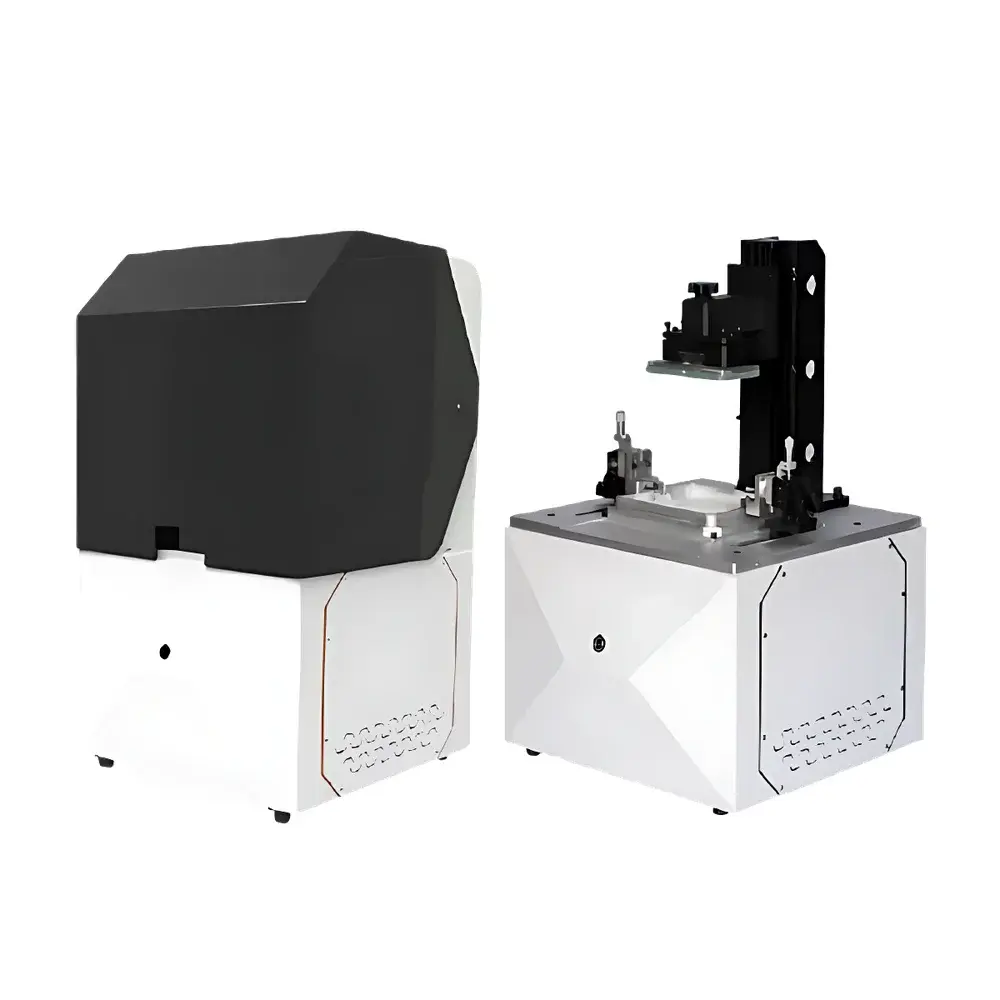
Junjin J²-D100T-CERAMICS Lift-Based DLP Ceramic 3D Printer
| Brand | Junjin |
|---|---|
| Origin | Guangdong, China |
| Manufacturer Type | Authorized Distributor |
| Country of Origin | China |
| Model | J²-D100T-CERAMICS |
| Build Volume | 96 × 54 × 150 mm |
| Compatible Materials | Photopolymer Resins, Alumina (Al₂O₃), Zirconia (ZrO₂), Silica (SiO₂), Barium Titanate (BaTiO₃), Lead Zirconate Titanate (PZT), Hydroxyapatite (HA), Metal Oxides, Silicon Nitride (Si₃N₄), Silicon Carbide (SiC), Bioactive Glasses |
Overview
The Junjin J²-D100T-CERAMICS is a lift-based digital light processing (DLP) ceramic 3D printer engineered for high-precision additive manufacturing of functional ceramic components. Unlike bottom-up vat photopolymerization systems that rely on peel separation, this system employs a top-down lift mechanism—where the build platform ascends after each layer exposure—minimizing interfacial stress and enabling robust handling of highly loaded ceramic slurries with viscosities up to 10–50 Pa·s. The optical engine integrates a high-resolution DLP projector (≥1920 × 1080 pixels) with UV output centered at 385 nm, optimized for photoinitiator activation in ceramic-loaded resins. Designed for laboratory-scale prototyping and small-batch fabrication, the system supports direct digital-to-part workflows without tooling, delivering dimensional accuracy within ±25 µm (XY) and ±30 µm (Z) across its full build envelope of 96 × 54 × 150 mm. Its architecture prioritizes repeatability, mechanical stability, and controlled atmosphere compatibility during post-processing integration.
Key Features
- Lift-based DLP architecture eliminates resin tank deformation and layer delamination risks common in bottom-up systems when printing high-solid-content ceramic suspensions.
- Modular resin management system accommodates as little as 10 mL of slurry per print job—reducing material waste and enabling rapid formulation screening.
- Automated, unattended operation: once loaded, the system executes full builds with real-time layer validation, motor position feedback, and UV dose monitoring.
- Thermally stabilized build chamber (±0.5 °C) minimizes thermal drift during extended prints, critical for maintaining green-body integrity in multi-hour ceramic builds.
- Interchangeable build platforms with customizable surface treatments (e.g., PEI-coated, siliconized glass) support adhesion control for diverse ceramic systems including hydroxyapatite and SiC.
- Integrated environmental monitoring: onboard sensors log ambient temperature, humidity, and UV lamp intensity for GLP-compliant process documentation.
Sample Compatibility & Compliance
The J²-D100T-CERAMICS is validated for use with a broad spectrum of ceramic feedstocks dispersed in proprietary or third-party photopolymerizable carriers. These include aqueous and non-aqueous suspensions of alumina, zirconia, silica, hydroxyapatite, barium titanate, PZT, silicon nitride, silicon carbide, and bioactive glasses. All materials must meet minimum solids loading thresholds (typically ≥40 vol%) and possess rheological profiles compatible with DLP layer recoating (yield stress < 100 Pa; viscosity < 50 Pa·s at 1 s⁻¹). The system complies with IEC 61000-6-3 (EMC emission standards) and IEC 60950-1 (safety requirements for electrical equipment). While not certified to ISO 13485 or FDA 21 CFR Part 11 out-of-the-box, its audit-ready logging framework—including timestamped parameter records, user access logs, and firmware version tracking—supports validation under GLP, GMP, and ISO/IEC 17025 quality management systems.
Software & Data Management
Controlled via Junjin’s CeramLink™ v3.x software suite, the printer supports STL, 3MF, and native CAD import with automatic support generation, lattice optimization, and slice parameter tuning (exposure time, lift speed, dwell duration). All print jobs are assigned unique identifiers and stored with metadata including material lot number, operator ID, calibration history, and environmental logs. Export options include CSV-formatted process data and encrypted PDF reports compliant with ALCOA+ principles (Attributable, Legible, Contemporaneous, Original, Accurate, Complete, Consistent, Enduring, Available). Remote monitoring is available via secure HTTPS interface; local network deployment ensures data residency compliance for institutional IT policies.
Applications
This system serves research laboratories and pilot production facilities engaged in advanced ceramics development. Typical use cases include: fabrication of microfluidic ceramic substrates with sub-100 µm channel fidelity; rapid iteration of piezoelectric transducer geometries for ultrasonic sensing; production of patient-specific hydroxyapatite scaffolds for bone tissue engineering studies; and prototyping of SiC-based heat exchanger components for high-temperature fluid dynamics testing. It is also employed in academic settings for teaching ceramic AM fundamentals, including green-body handling, debinding kinetics analysis, and sintering shrinkage correlation modeling.
FAQ
What post-processing steps are required after printing?
All printed parts require thermal debinding (typically 0.5–2 °C/min ramp to 600 °C in air or N₂) followed by pressureless or hot-isostatic sintering. Exact profiles depend on material composition and green density.
Can the system be integrated with automated debinding or sintering furnaces?
Yes—CeramLink™ supports Modbus TCP and OPC UA protocols for bidirectional communication with industrial furnace controllers.
Is technical support available for material formulation optimization?
Junjin provides application engineering consultation for slurry rheology adjustment, photoinitiator selection, and green strength enhancement—subject to NDA and collaborative agreement.
Does the printer support multi-material printing?
No—it is a single-vat, single-material platform. Multi-material capability requires sequential printing with manual resin replacement and recalibration.
What maintenance intervals are recommended for the optical module?
The DLP projector and UV LED array are rated for ≥10,000 hours; routine cleaning of the quartz window and alignment verification are advised every 200 print hours or quarterly, whichever occurs first.



