
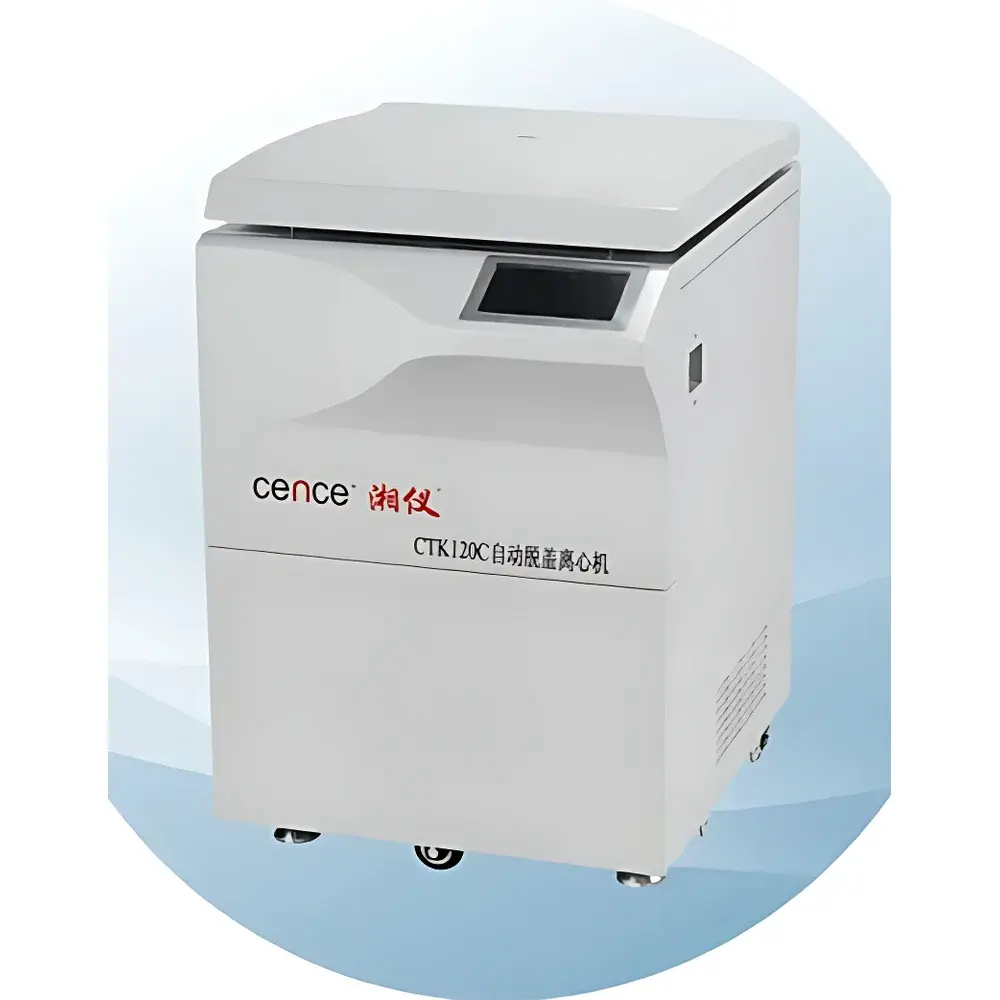
Xiangyi CTK120C Automated Cap-Removal Centrifuge
| Brand | Xiangyi |
|---|---|
| Origin | Hunan, China |
| Manufacturer Type | Direct Manufacturer |
| Product Category | Domestic |
| Model | CTK120C |
| Instrument Type | Floor-Standing Centrifuge |
| Speed Class | Low-Speed Centrifuge (max. 4000 rpm) |
| Function | General-Purpose Centrifuge with Integrated Cap Removal |
| Configuration | Horizontal Rotor System |
| Maximum Capacity | 120 vacuum blood collection tubes (4 × 30) |
| Maximum Speed | 4000 rpm |
| Maximum RCF | 3370 × g |
| Dimensions (W×D×H) | 560 × 660 × 850 mm |
| Cap-Removal Compatibility | 75 mm and 100 mm tube lengths |
| Cap-Removal Success Rate | >90% |
| Drive System | AC Frequency-Controlled Motor |
| Control Interface | Touch Panel with Large LCD Display |
| RCF Auto-Calculation | Yes |
| Vibration Damping | Optimized Passive Damping System with Auto-Balancing Capability |
| Safety Interlock | Electromagnetic Door Lock with Real-Time Monitoring (prevents start if lid is unlatched |
Overview
The Xiangyi CTK120C Automated Cap-Removal Centrifuge is a purpose-engineered floor-standing instrument designed for high-throughput clinical laboratories processing vacuum blood collection tubes (VBCTs). Unlike conventional low-speed centrifuges requiring manual cap removal post-spin—introducing risks of sample re-mixing, aerosol generation, operator exposure, and workflow bottlenecks—the CTK120C integrates synchronized centrifugation and automated cap extraction in a single, validated operational cycle. Its core mechanism operates on a dual-stage principle: first, precise horizontal rotor acceleration to 4000 rpm (3370 × g) ensures optimal serum/plasma separation per CLSI H18-A3 and ISO 15189 requirements; second, a pneumatically actuated, position-sensing cap-lift module engages each tube individually after deceleration, applying calibrated axial force to disengage the rubber or plastic stopper without lateral torque or tube deformation. This eliminates human intervention during the critical post-centrifugation phase, directly supporting biosafety Level 2 (BSL-2) compliance and reducing hands-on time by up to 65% in routine hematology workflows.
Key Features
- Integrated cap-removal system with >90% success rate across 75 mm and 100 mm vacuum blood collection tubes (e.g., BD Vacutainer®, Greiner Bio-One Vacuette®)
- AC frequency-controlled motor delivering ±10 rpm speed accuracy and rapid acceleration/deceleration profiles (0–4000 rpm in ≤15 s; 4000–0 rpm in ≤22 s)
- Horizontal swing-out rotor accommodating four 30-position buckets (total 120 tubes), engineered for balanced load distribution up to 20 g mass asymmetry
- Real-time RCF calculation and display based on actual rotor radius and instantaneous speed—no manual lookup required
- Dual-stage passive damping architecture incorporating elastomeric isolators and dynamic counterbalance compensation, achieving <0.5 mm/s² residual vibration at full speed
- Electromagnetic door interlock with continuous position monitoring: centrifuge remains inert until lid seal is verified; automatic emergency halt triggered within 80 ms if lid displacement exceeds 2 mm during operation
- Touch-based HMI with 7-inch capacitive LCD, supporting multi-language UI (English, Spanish, French, Arabic), user-defined protocols, and audit-trail-enabled session logging
Sample Compatibility & Compliance
The CTK120C is validated for use with standard 13 × 75 mm and 13 × 100 mm vacuum blood collection tubes containing EDTA, heparin, citrate, serum separator gel (SST), and plasma preparation tubes (PPT). It meets IEC 61010-1:2010 safety requirements for laboratory equipment and complies with electromagnetic compatibility standards EN 61326-1:2013. While not certified under FDA 21 CFR Part 11, its electronic log system supports ALCOA+ data integrity principles (Attributable, Legible, Contemporaneous, Original, Accurate, Complete, Consistent, Enduring, Available) when deployed in GLP/GMP-aligned environments. The rotor assembly conforms to ISO 15189:2022 clause 5.3.2 for equipment qualification, including mechanical stability testing under maximum load and thermal cycling validation (-10 °C to +40 °C ambient range).
Software & Data Management
The embedded firmware includes protocol storage for up to 99 user-defined methods, each configurable with spin time, speed ramp profile, brake intensity, and cap-removal delay (0–120 s post-deceleration). All operational events—including start/stop timestamps, rotor ID, speed/RCF history, door status transitions, and cap-removal attempt logs—are timestamped and stored locally in non-volatile memory for ≥12 months. Data export is supported via USB 2.0 (CSV format) or optional RS-485 Modbus RTU interface for integration into LIS/HIS platforms. Audit trails are immutable and include operator ID (via optional RFID badge reader), firmware version, and checksum-verified log integrity flags.
Applications
- Routine serum and plasma separation in clinical chemistry, immunoassay, and coagulation testing workflows
- Pre-analytical automation in core labs handling >500 VBCTs/day, minimizing pre-analytical errors linked to manual cap handling (CLSI GP44-A5)
- Biobanking operations requiring consistent, low-shear separation prior to aliquoting or cryopreservation
- Point-of-care satellite labs where space-constrained floor-standing design and single-operator usability are critical
- Research settings involving longitudinal blood biomarker studies demanding traceable, reproducible sample processing
FAQ
What tube types and sizes are supported for automated cap removal?
The CTK120C accommodates standard 13 mm diameter vacuum blood collection tubes with lengths of 75 mm and 100 mm, including those with rubber stoppers, plastic caps, and push-top designs.
Does the instrument support rotor calibration and performance verification?
Yes—each rotor carries a unique ID tag; the system prompts users to perform annual speed verification using an external tachometer and records results with operator signature and date stamp.
Can the cap-removal module be disabled for non-VBCT applications?
Yes—the cap-removal sequence is programmable and can be bypassed via software setting, allowing standard centrifugation-only operation.
Is remote monitoring or service diagnostics available?
Basic diagnostic codes are displayed on the HMI; advanced remote troubleshooting requires local technician access—no cloud connectivity or vendor telemetry is implemented.
What maintenance intervals are recommended?
Lubrication-free rotor bearings require no scheduled greasing; biannual inspection of door seal integrity, damping mounts, and cap-lift actuators is advised per the maintenance logbook included with shipment.



