
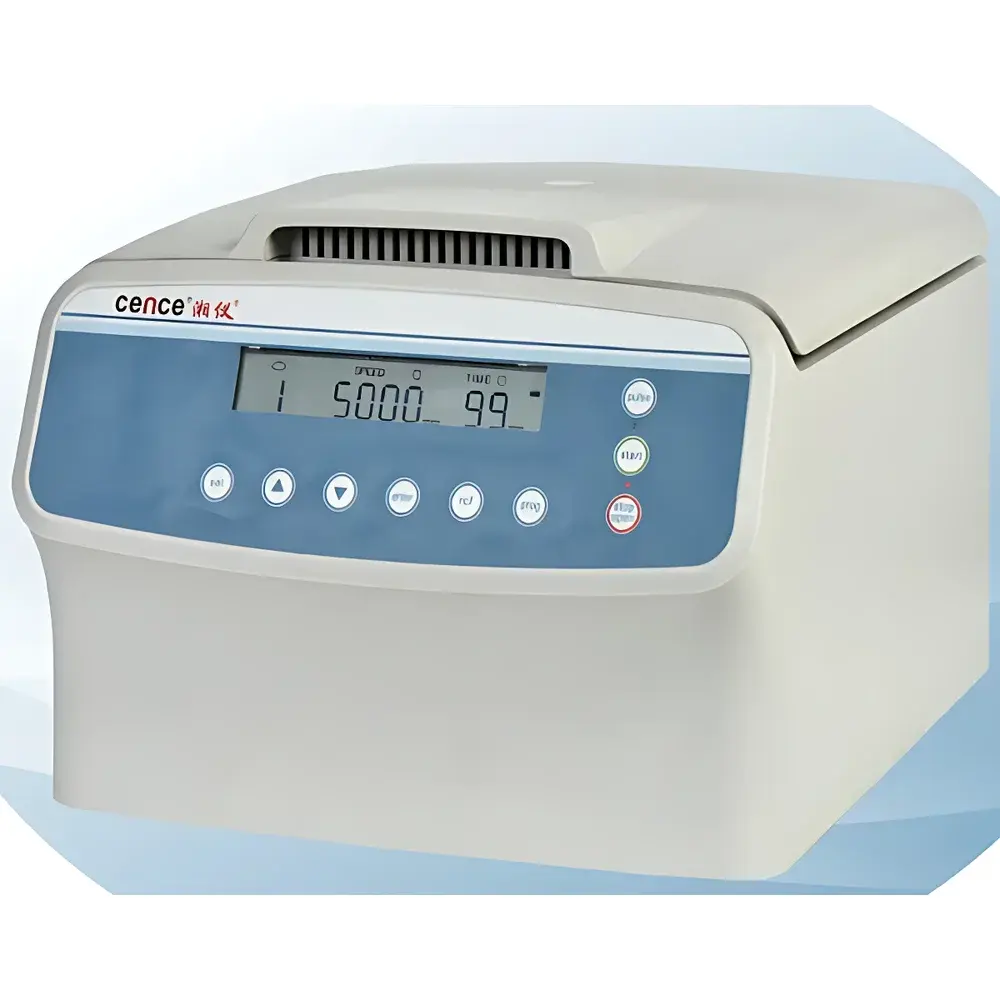
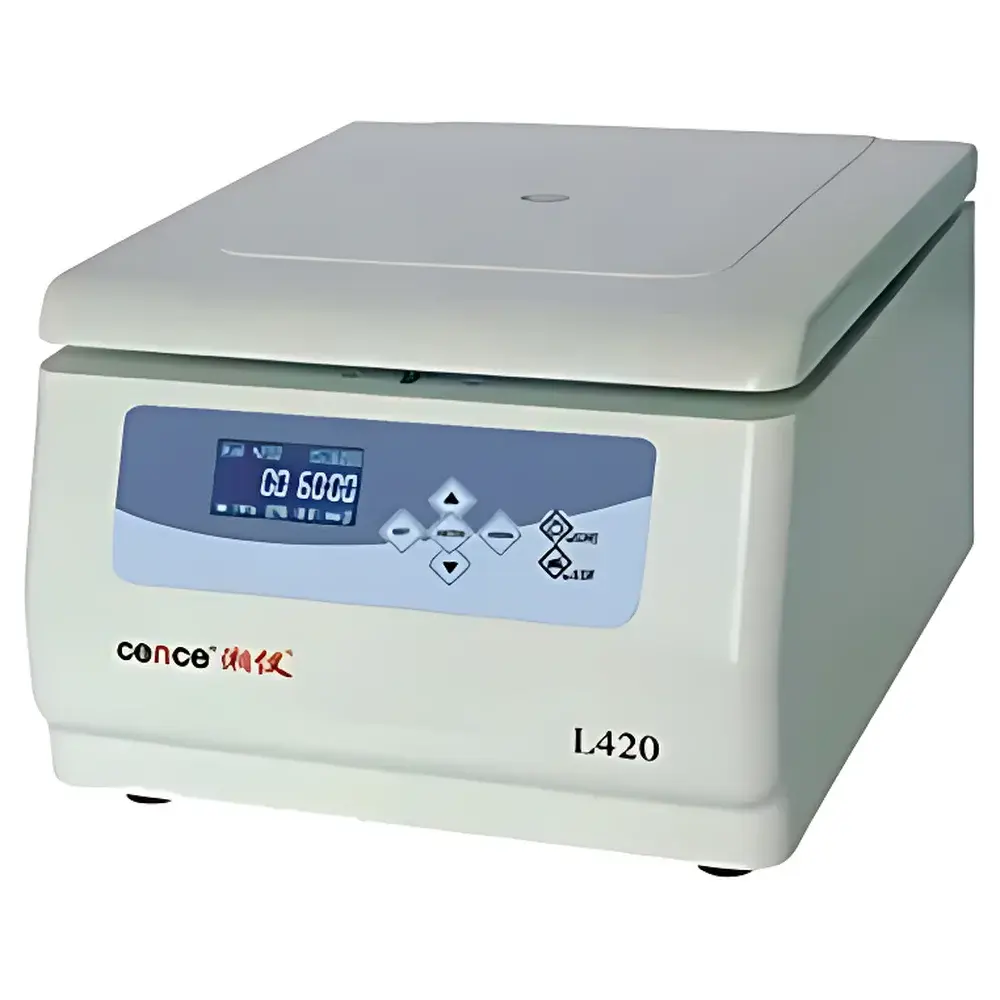
Xiangyi L420-A Benchtop Low-Speed Centrifuge
| Brand | Xiangyi |
|---|---|
| Origin | Hunan, China |
| Manufacturer Type | Direct Manufacturer |
| Product Category | Domestic |
| Model | L420-A |
| Instrument Type | Benchtop Centrifuge |
| Speed Class | Low-Speed Centrifuge (max. 4200 rpm) |
| Function | General-Purpose Centrifuge |
| Configuration | Horizontal Rotor Centrifuge |
| Separation Level | Cellular & Bacterial Pelletization |
| Max Capacity | 12 × 20 mL |
| Max Speed | 4200 rpm |
| Max RCF | 2760 × g |
| Dimensions (L×W×H) | 380 × 500 × 300 mm |
| Weight | 19 kg |
| Speed Accuracy | ±30 rpm |
| Timer Range | 1–99 min |
| Noise Level | ≤65 dB(A) |
| Power Supply | AC 220 V ±22 V, 50/60 Hz, 5 A |
| Power Consumption | 250 W |
| Rotor Compatibility | Horizontal rotor with interchangeable stainless-steel buckets and adapters for 0.5–50 mL tubes |
| Programmable Methods | Up to 50 user-defined protocols |
| Safety Features | Electronic lid lock, automatic imbalance detection & shutdown, real-time RCF calculation, soft-start/soft-stop, touch interface with LCD display |
Overview
The Xiangyi L420-A is a benchtop low-speed centrifuge engineered for routine separation tasks in clinical laboratories, blood banks, and biomedical research facilities. It operates on the principle of sedimentation under centrifugal force—accelerating particle settling based on density, size, and shape differences in liquid suspensions. Designed specifically for applications requiring gentle yet reliable pelleting of cells, platelets, erythrocytes, bacteria, and other particulates without structural damage, the L420-A delivers consistent performance at rotational speeds up to 4200 rpm and relative centrifugal forces (RCF) up to 2760 × g. Its horizontal rotor architecture supports high-volume processing across diverse tube formats—including 12 × 20 mL conical tubes—and ensures uniform heat distribution and mechanical stability during extended runs. Constructed with a fully stainless-steel rotor assembly and one-piece molded housing, the unit meets essential durability and corrosion-resistance requirements for daily clinical use.
Key Features
- Microprocessor-controlled operation with brushless DC motor for enhanced torque consistency, reduced maintenance, and extended service life.
- Intuitive touch-panel interface with backlit LCD display showing real-time parameters: speed (rpm), RCF, time remaining, and error codes.
- Automatic RCF calculation function—eliminates manual conversion errors and supports standardized protocol documentation.
- Integrated active balancing system with precision vibration-damping mounts; detects and compensates for minor load imbalances before initiating acceleration.
- Electromechanical lid interlock mechanism: prevents start-up unless door is fully closed; halts rotation immediately if opened mid-run or if abnormal vibration exceeds threshold limits.
- Soft-start and soft-stop profiles minimize sample resuspension and protect delicate biological pellets during deceleration.
- One-touch “pulse” mode enables rapid, short-duration centrifugation for quick supernatant removal or washing steps.
- Ergonomic lid design requiring minimal actuation force—self-latching upon light pressure, reducing operator fatigue during high-throughput workflows.
- Pre-programmable storage for up to 50 custom methods, including speed, time, acceleration/deceleration ramp rates, and rotor-specific calibration offsets.
Sample Compatibility & Compliance
The L420-A accommodates a broad range of primary and secondary sample containers via its modular horizontal rotor system. Standard configurations include buckets for 4 × 50 mL, 12 × 15 mL, 8 × 10 mL, and 16 × 5 mL tubes, as well as adapter sets supporting dual-layer arrangements (e.g., 12 × 2 × 1.5 mL or 12 × 2 × 0.5 mL). All rotor components are manufactured from medical-grade stainless steel (AISI 304), compliant with ISO 13485 material specifications for in vitro diagnostic equipment. The device conforms to IEC 61010-1:2010 safety standards for laboratory electrical equipment and meets electromagnetic compatibility (EMC) requirements per EN 61326-1. While not certified for GMP or FDA 21 CFR Part 11 environments out-of-the-box, its programmable audit trail functionality—via optional data export logs—supports GLP-aligned recordkeeping when integrated into validated lab information management systems (LIMS).
Software & Data Management
The L420-A features embedded firmware capable of storing and recalling 50 user-defined protocols with full parameter retention—including speed, time, ramp profiles, and rotor identification. Although it lacks network connectivity or PC-based control software, all operational data (start/stop timestamps, total run cycles, fault logs, and executed method IDs) can be exported via USB interface to external storage devices for traceability. Each protocol includes configurable safety locks (e.g., password-protected editing, read-only mode) to prevent unauthorized modification in shared-lab settings. Exported CSV files contain ISO 8601-formatted timestamps and RCF values calculated using the standard formula: RCF = 1.118 × 10⁻⁵ × r × N² (where r = rotor radius in mm, N = rotational speed in rpm), ensuring metrological transparency and alignment with CLSI EP05-A3 verification guidelines.
Applications
- Clinical hematology: separation of whole blood into plasma, buffy coat, and packed red cells for transfusion preparation or diagnostic assays.
- Microbiology: harvesting bacterial cultures (e.g., E. coli, S. aureus) for downstream DNA extraction, staining, or antibiotic susceptibility testing.
- Cell culture labs: pelleting adherent and suspension mammalian cells prior to lysis, cryopreservation, or passaging.
- Veterinary diagnostics: processing serum, urine, and CSF samples for biochemical analysis or pathogen isolation.
- Pharmaceutical QC: clarifying crude fermentation broths or buffer-exchanged protein solutions prior to filtration or chromatography.
- Education and training: teaching fundamental centrifugation principles in undergraduate life science laboratories due to its intuitive interface and robust mechanical design.
FAQ
What is the maximum relative centrifugal force (RCF) achievable with the L420-A?
The L420-A achieves a maximum RCF of 2760 × g at its top speed of 4200 rpm with the 12 × 20 mL horizontal rotor configuration.
Does the L420-A support rotor auto-recognition?
No—rotor selection must be manually confirmed by the user prior to run initiation; however, RCF values are automatically recalculated based on entered rotor radius.
Can this centrifuge be used for clinical diagnostics under ISO 15189 accreditation?
Yes—when operated within defined validation protocols (including preventive maintenance logs, periodic speed calibration, and documented cleaning procedures), the L420-A satisfies key technical requirements for pre-analytical sample preparation under ISO 15189:2022 Clause 5.3.
Is the stainless-steel rotor autoclavable?
The rotor body and buckets are autoclavable at 121 °C for 20 minutes; however, adapters containing polymer components (e.g., polypropylene inserts) require separate validation for steam sterilization compatibility.
How does the automatic balancing system respond to significant load imbalance?
Upon detecting vibration exceeding 0.5 mm/s RMS during acceleration, the unit pauses, displays an E03 error code, and requires manual re-balancing before resuming—preventing mechanical stress or rotor deformation.



