
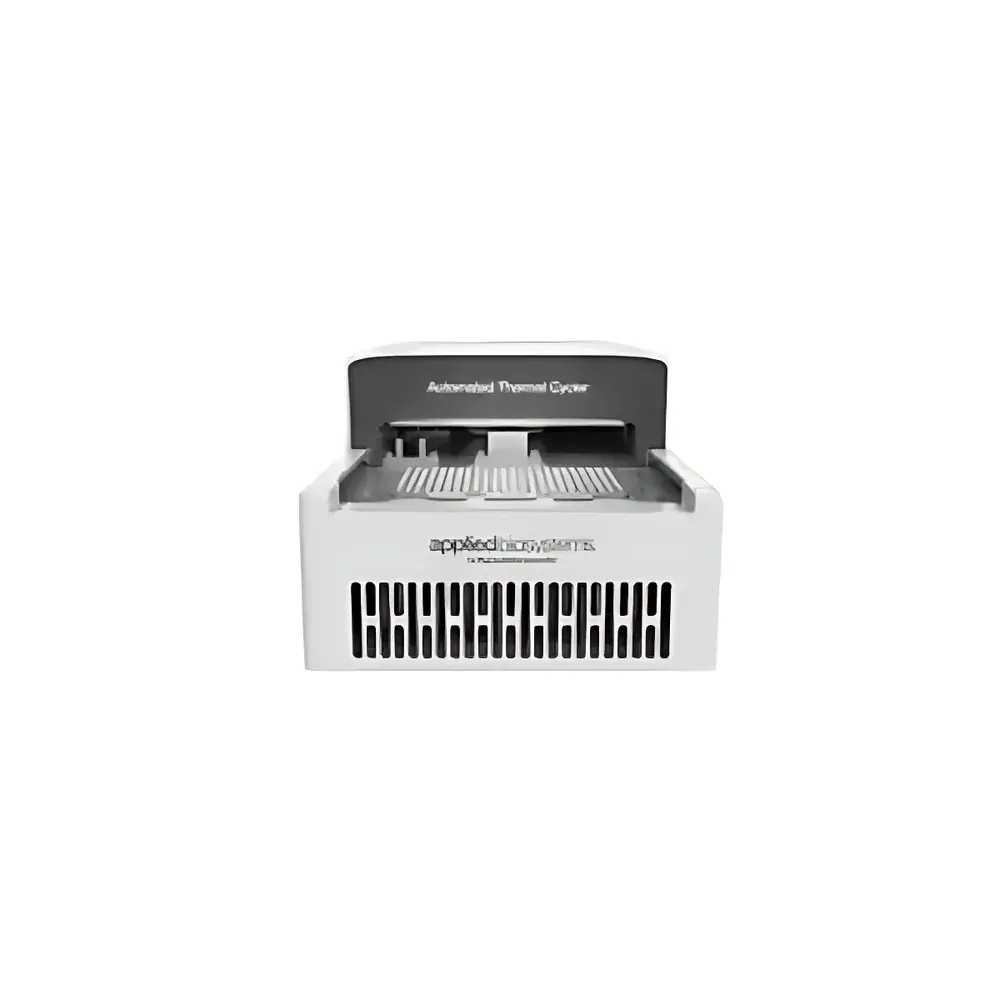
Thermo Fisher Automated Thermal Cycler (ATC)
| Brand | Thermo Fisher |
|---|---|
| Origin | Shanghai, China |
| Manufacturer Type | Authorized Distributor |
| Product Category | Domestic |
| Model | Thermo Fisher Automated Thermal Cycler (ATC) |
| Pricing | Upon Request |
| Instrument Type | Standard PCR Thermal Cycler |
| Automation Interface | SiLA Rapid Integration™-Compliant |
| Software | Free PC-Based Control Suite |
| Plate Compatibility | Full-skirted and half-skirted 96-well plates |
| Thermal Lid | Motorized forward-sliding lid with pressure-optimized contact |
| Sample Handling | Integrated plate ejection mechanism for positional repeatability |
| Integration Ready | Pre-validated APIs for robotic arm coordination |
Overview
The Thermo Fisher Automated Thermal Cycler (ATC) is an engineered platform for high-throughput, walk-away PCR execution in regulated and automated laboratory environments. Designed around the fundamental principles of precise thermal cycling—rapid ramping, accurate temperature uniformity across the block, and reproducible denaturation–annealing–extension kinetics—the ATC delivers consistent amplification performance while serving as a native node within modern lab automation architectures. Unlike conventional standalone thermal cyclers, the ATC integrates directly into liquid handling workflows via standardized communication protocols, eliminating manual plate transfer and reducing operator-dependent variability. Its architecture adheres to the SiLA (Standardization in Lab Automation) Rapid Integration™ specification, enabling deterministic command-response behavior with robotic arms, stackers, and deck management systems. The instrument operates with a motorized, forward-sliding thermal lid that applies calibrated downward force to ensure optimal thermal coupling with 96-well reaction plates—minimizing evaporation and condensation artifacts during extended cycling protocols.
Key Features
- SiLA Rapid Integration™-compliant interface with documented RESTful and WebSocket APIs for deterministic command sequencing and real-time status reporting.
- Motorized thermal lid with position-sensing feedback loop ensures repeatable contact pressure and thermal seal integrity across full- and half-skirted 96-well plates.
- Integrated plate ejection mechanism guarantees sub-millimeter positional repeatability—critical for reliable robotic pick-and-place operations.
- Standalone PC software included at no cost, supporting full instrument control, protocol editing, cycle monitoring, and log export without automation infrastructure.
- Compact footprint (W × D × H: 28 × 42 × 25 cm) optimized for integration into benchtop automation decks or enclosed robotic workcells.
- Pre-validated driver modules available for Beckman Coulter Biomek i7/i5/FXP/NXP/4000, Hamilton VANTAGE/STAR/NIMBUS, Hudson Robotics SOLO/PlateCrane EX/SciClops, and Thermo Scientific Orbitor/Spinnaker/F7/Momentum platforms.
Sample Compatibility & Compliance
The ATC supports standard ANSI/SLAS-format 96-well PCR plates, including full-skirted polypropylene plates commonly used in qPCR and NGS library prep, as well as half-skirted variants compatible with certain robotic gripper geometries. No adapter trays or custom fixtures are required. From a regulatory perspective, the instrument’s firmware architecture supports audit-trail-enabled operation when deployed under GLP or GMP conditions. While the ATC itself is not FDA 510(k)-cleared as an IVD device, its control software and API logging capabilities align with data integrity expectations outlined in FDA 21 CFR Part 11 for electronic records and signatures—provided system-level validation is performed by the end user. All firmware updates undergo version-controlled release testing per ISO/IEC 17025 traceability requirements.
Software & Data Management
The included Windows-based desktop application provides local instrument control, protocol import/export (CSV/XML), real-time temperature graphing, and event-triggered logging (lid open/close, cycle start/end, error codes). All session data—including timestamps, setpoints, actual block temperatures, and user-initiated actions—are written to timestamped, immutable .csv files with SHA-256 checksums. When integrated into automation frameworks, the ATC exposes a documented REST API endpoint (/api/v1/cycle, /api/v1/status, /api/v1/plate) supporting JSON payloads. Command responses include HTTP status codes, transaction IDs, and millisecond-accurate execution timestamps—enabling synchronization with LIMS or ELN systems. No cloud connectivity or telemetry is enabled by default; all communications remain on-premise unless explicitly configured by the system administrator.
Applications
- High-volume clinical screening workflows where PCR must be sequenced with upstream nucleic acid extraction and downstream detection steps.
- Automated NGS library preparation pipelines requiring thermal cycling between enzymatic fragmentation, end-repair, A-tailing, and indexing ligation steps.
- QC/QA laboratories performing stability-indicating PCR assays under cGMP-compliant documentation practices.
- Core facilities deploying shared robotic workcells across multiple research groups—where instrument scheduling, usage logging, and protocol versioning are centrally managed.
- Method development labs optimizing annealing temperatures and extension times prior to full automation rollout—using the same instrument in both standalone and integrated modes.
FAQ
Is the ATC compatible with non-SiLA automation platforms?
Yes—while SiLA Rapid Integration™ is the primary interface standard, Thermo Fisher provides technical support to co-develop custom drivers with third-party automation vendors upon request.
Does the ATC support gradient PCR or fast-cycling protocols?
No—the ATC is designed exclusively for standard thermal cycling profiles; it does not implement block gradient functionality or sub-1-second ramp rate optimization.
Can the included software be deployed on virtual machines or thin clients?
The desktop application requires a physical Windows 10/11 installation with direct USB or Ethernet access; virtualized environments are unsupported due to timing-critical USB device enumeration requirements.
What level of validation documentation is provided for GxP environments?
Thermo Fisher supplies a Firmware Design Specification, Factory Acceptance Test (FAT) report, and API Reference Manual—all suitable as foundational documents for user-performed IQ/OQ/PQ validation.
Is remote firmware update capability available?
Firmware updates must be performed locally via USB drive using signed binaries; network-based updates are intentionally disabled to maintain air-gapped security compliance in regulated labs.





