
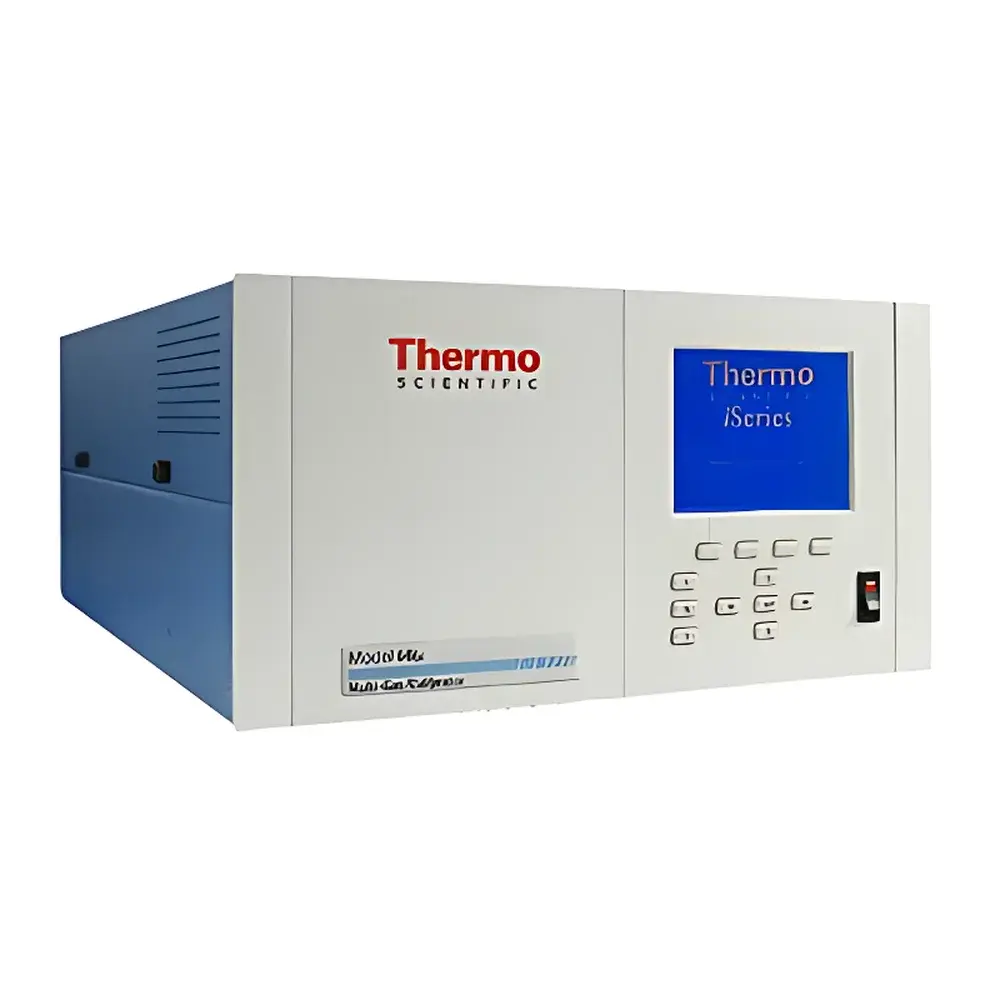
Thermo Scientific 146i Multi-Gas Calibration Analyzer
| Brand | Thermo Fisher |
|---|---|
| Origin | USA |
| Model | Thermo Scientific 146i |
| Instrument Type | Online Calibrator |
| Target Gases | SO₂, NO₂, H₂S, NH₃, O₃, NO |
| Response Time | <60 s |
| Flow Measurement Accuracy | ±2% of reading or ±1% of full scale (whichever is lower, 20–100% FS) |
| Flow Linearity | ±0.5% of full scale |
| Flow Repeatability | ±2% of reading or ±1% of full scale (whichever is lower, 20–100% FS) |
| Zero Air Flow Options | 5, 10 (standard), or 20 SLPM |
| Span Gas Flow Options | 50, 100 (standard), or 200 SCCM |
| Permeation Oven Temperature Control | 30, 35, or 45 °C ±0.1 °C |
| Ozone Generator Output | 1 ppm @ 6 SLPM (stability & repeatability compliant with U.S. EPA requirements) |
Overview
The Thermo Scientific 146i Multi-Gas Calibration Analyzer is an EPA-compliant, rack-mounted, online calibration standard designed for automated, traceable gas concentration generation in ambient air quality monitoring networks. It operates on the principle of dynamic dilution—precisely metering certified span gases or vapor-phase analytes from permeation devices into ultra-pure zero air to produce stable, NIST-traceable calibration standards across multiple target species. Engineered for continuous unattended operation in regulatory-grade monitoring stations, the 146i supports dual-path calibration protocols required by U.S. EPA 40 CFR Part 58 and EU Directive 2008/50/EC. Its architecture integrates gravimetrically characterized permeation ovens, a high-stability ozone photolysis source, and a dual-stage mass flow control system—all synchronized via embedded real-time firmware to ensure metrological integrity under varying environmental conditions.
Key Features
- Dynamic multi-gas calibration capability for SO₂, NO₂, H₂S, NH₃, O₃, and NO using interchangeable permeation tubes and gas-phase titration modules
- Integrated ozone generator delivering 1 ppm O₃ at 6 SLPM with stability ≤±1% over 24 hours—validated per U.S. EPA EQOA-01-001 performance criteria
- Triple-range mass flow controllers (zero air: 5/10/20 SLPM; span gas: 50/100/200 SCCM) with accuracy certified to ±2% of reading or ±1% of full scale (20–100% FS)
- Permeation oven temperature regulated to ±0.1 °C at user-selectable setpoints (30 °C, 35 °C, or 45 °C), ensuring consistent vapor pressure-driven analyte release rates
- Flash-memory-based data logging with timestamped audit trail for all calibration events, flow readings, temperature setpoints, and system diagnostics
- Remote accessibility via Ethernet (TCP/IP) with support for Modbus TCP and SNMP protocols—enabling integration into SCADA and central data acquisition systems
Sample Compatibility & Compliance
The 146i is compatible with EPA-certified permeation tubes (e.g., AccuStandard, VICI Metronics) and NIST-traceable primary standard gases. All generated calibration standards comply with U.S. EPA Performance Specifications (PS) for calibration analyzers (PS-1, PS-2, PS-3, PS-12), ISO 12039:2002 (ambient air—determination of sulfur dioxide), and EN 14625:2012 (ambient air—determination of nitrogen dioxide). The instrument’s flow measurement subsystem is calibrated per ISO 6145-7 (gas mixtures—preparation by dynamic volumetric methods) and meets GLP data integrity requirements per FDA 21 CFR Part 11 when operated with validated software configurations.
Software & Data Management
The 146i runs on embedded Linux-based firmware with a web-enabled configuration interface accessible via HTTPS. Calibration sequences—including multi-point linearity checks, zero/span drift verification, and dynamic range validation—are programmable via XML-based method templates. All operational parameters, sensor outputs, and alarm states are logged with UTC timestamps and stored locally for ≥30 days. Export formats include CSV and XML for ingestion into LIMS or EPA AIRS platforms. Audit trails record user login/logout, parameter changes, and calibration execution history—supporting full traceability during regulatory audits.
Applications
- Primary calibration of continuous emission monitoring systems (CEMS) and ambient air quality analyzers (e.g., 42i, 43i, 48i series)
- Field verification of analyzer linearity and response time per EPA Method 205.2 and ISO 11222
- Multi-gas interference testing for cross-sensitivity evaluation in electrochemical and optical detection platforms
- Support of QA/QC programs mandated under U.S. EPA Ambient Air Monitoring Program (AAMP) and European EEA Air Quality Reporting Guidelines
- On-site validation of ozone photolysis efficiency and NO₂ conversion efficiency in chemiluminescence analyzers
FAQ
What calibration gases can the 146i generate without external cylinders?
The 146i generates O₃ and NO₂ internally via gas-phase titration; SO₂, H₂S, and NH₃ require certified permeation tubes installed in the thermostatically controlled oven.
Does the 146i meet U.S. EPA equivalency requirements for calibration transfer standards?
Yes—the 146i satisfies EPA EQOA-01-001 and EQOA-02-001 for ozone and NO₂ calibration generators, and its flow metrology is traceable to NIST SRM 2715a.
Can the 146i be integrated into an existing Teledyne API or Horiba data acquisition network?
Yes—via Modbus TCP or analog 4–20 mA outputs (optional), with configurable scaling and alarm thresholds aligned to host system protocols.
Is firmware update capability available remotely?
Yes—secure OTA updates are supported through authenticated HTTPS sessions with SHA-256 signature verification.
What maintenance intervals are recommended for long-term metrological stability?
Permeation tubes require annual re-certification; ozone lamp replacement every 12 months; mass flow sensors recalibrated biannually per ISO/IEC 17025-accredited procedures.







