
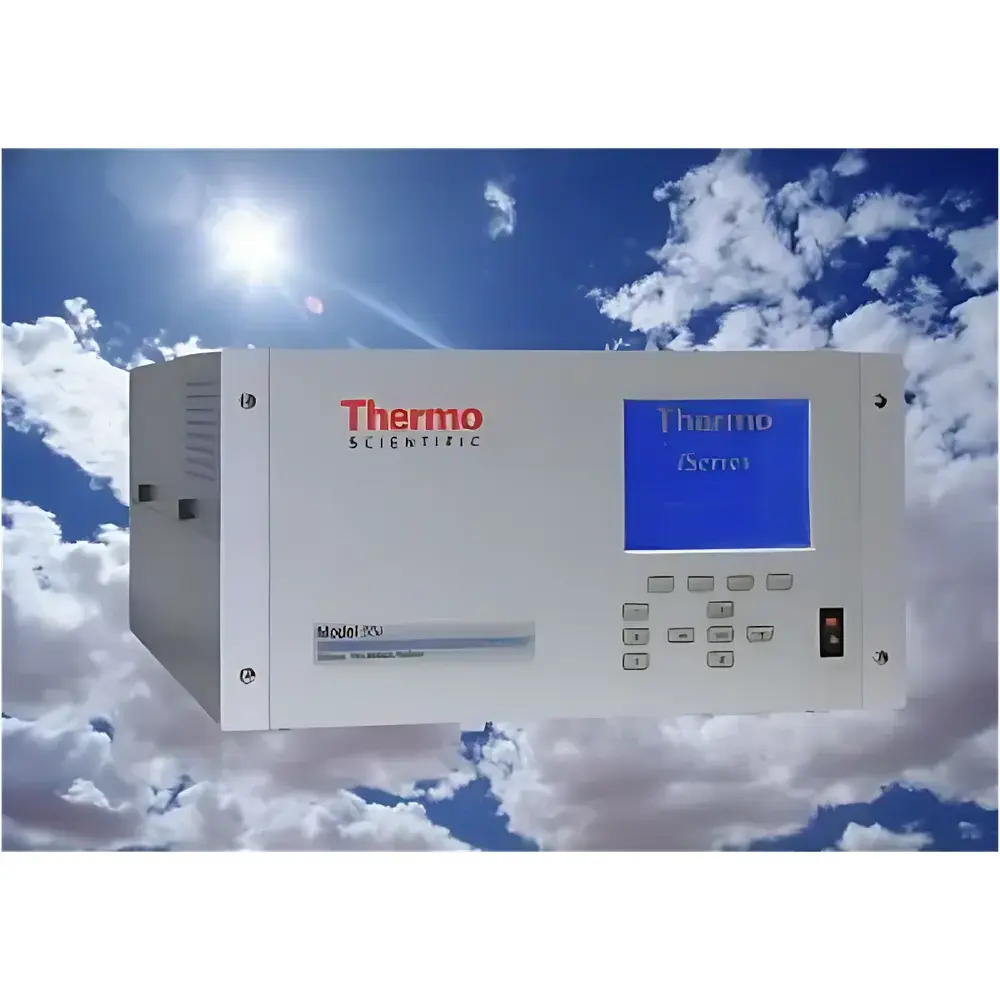
Thermo Fisher Scientific 55i Methane and Total Non-Methane Hydrocarbons (NMHC) Analyzer
| Brand | Thermo Fisher Scientific |
|---|---|
| Origin | USA |
| Model | 55i |
| Detection Principle | Back-Flush Gas Chromatography with Flame Ionization Detection (GC-FID) |
| Measurement Range Options | 0–5 / 50 / 500 ppm, 0–10 / 100 / 1000 ppm, 0–20 / 200 / 2000 ppm, or 0–50 / 500 / 5000 ppm (as propane-equivalent NMHC) |
| LOD (300-s avg) | 0.050 ppm for CH₄ and NMHC |
| Zero Noise | 0.025 ppm RMS |
| Response Time (t₉₀) | ~70 s |
| Precision | ±2.0% of reading or ±50 ppb (whichever is greater) |
| Linearity | ±2% of span (10–100% full scale) |
| Sample Flow Rate | ≥0.5 L/min |
| Carrier Gas | N₂, 25–50 mL/min |
| Hydrogen Fuel Gas | 25–50 mL/min (or 100–150 mL/min H₂/He blend) |
| Air for FID | 275–350 mL/min |
| Operating Temperature | 15–35 °C |
| Power | 100–240 VAC ±10%, 50/60 Hz, 420 W |
| Dimensions | 42.5 × 21.9 × 58.4 cm (W×H×D) |
| Weight | 27.2 kg |
| Data Output | Analog (0–20/4–20 mA), RS232/RS485, TCP/IP, 10 relay status channels, power-fail indicator |
| Digital Inputs | 16-bit standard |
| Analog Inputs | 8–10 V (optional) |
| Internal Storage | Flash memory |
| Connectivity | Ethernet port for remote control, data export, and firmware updates |
Overview
The Thermo Fisher Scientific 55i Methane and Total Non-Methane Hydrocarbons (NMHC) Analyzer is a dedicated, laboratory-grade gas chromatographic system engineered for regulatory-compliant, continuous ambient air monitoring of methane (CH₄) and non-methane total hydrocarbons. Unlike conventional total hydrocarbon analyzers that infer NMHC by subtracting methane from total hydrocarbon (THC) measurements—a method vulnerable to error amplification in high-CH₄ environments—the 55i employs a true back-flush GC-FID architecture to directly quantify NMHC with high specificity and metrological integrity. The instrument separates methane from C₂+ hydrocarbons on a proprietary high-temperature stable column operating at 150–200 °C, ensuring complete recovery of low-volatility compounds and immunity to oxygen interference. Methane elutes first under carrier gas flow and is measured independently by the flame ionization detector (FID); the eight-port valve then actuates to back-flush retained C₂–C₁₂ hydrocarbons onto the same detector for NMHC quantification. This dual-detection sequence occurs within a single 70-second cycle, enabling concurrent sampling and analysis without dead time.
Key Features
- True direct NMHC measurement via back-flush gas chromatography—eliminates subtraction-based uncertainty
- Automated FID ignition and real-time flame status monitoring with fail-safe shutdown logic
- Programmable auto-zero and auto-span calibration routines compliant with EPA Method 25A and EN 12619 requirements
- Integrated particulate filter (0.5 µm) upstream of the sample loop, minimizing column fouling and extending maintenance intervals
- i-Series platform architecture: embedded Ethernet interface (TCP/IP), flash-based data logging (≥30 days at 1-min resolution), and remote web-based configuration
- High-resolution graphical display with context-sensitive soft keys for rapid field operation and diagnostic access
- Modular analog and digital I/O: standard 16-bit digital inputs; optional 8–10 V analog inputs; configurable 4–20 mA outputs per species
Sample Compatibility & Compliance
The 55i is validated for unattended operation in ambient air, landfill gas, biogas, and urban background monitoring applications. Its GC column chemistry ensures quantitative recovery of saturated and unsaturated C₂–C₁₀ aliphatics and aromatics—including ethane, propane, butanes, isopentane, benzene, and toluene—without discrimination. The analyzer meets the performance specifications outlined in U.S. EPA Reference Method 25A for NMHC determination and aligns with ISO 8573-5 (compressed air purity) and EN 12619 (stationary source emissions) for hydrocarbon speciation capability. All calibration and diagnostic events are timestamped and logged with audit-trail metadata, supporting GLP/GMP traceability and FDA 21 CFR Part 11 compliance when deployed with validated software protocols. The system requires no consumables beyond standard FID gases (hydrogen, zero air, nitrogen) and exhibits <2% span drift over 24 hours without intervention.
Software & Data Management
Control and data acquisition are managed via Thermo’s iSeries Instrument Manager (ISM) software, accessible locally through the front-panel interface or remotely via secure HTTP/S or Modbus TCP. Raw chromatograms, peak integration parameters, calibration logs, and system health metrics (valve cycles, FID voltage, temperature stability) are stored in non-volatile flash memory. Data export supports CSV and XML formats compatible with EPA’s AQS and EEA’s AQ e-Reporting frameworks. Firmware updates are delivered over-the-air using signed packages, and configuration templates can be cloned across instrument fleets. Optional integration with SCADA systems is enabled through native Modbus RTU/TCP and OPC UA drivers.
Applications
- Ambient air quality monitoring networks (e.g., EPA Photochemical Assessment Monitoring Stations)
- Landfill and wastewater treatment plant fugitive emission reporting (40 CFR Part 60 Subpart XXX)
- Biogas upgrading facility process control and methane slip verification
- Urban VOC precursor studies for ozone modeling and SMOG formation analysis
- Industrial fence-line monitoring for petrochemical, refinery, and chemical manufacturing sites
- Calibration transfer standard for portable NMHC analyzers and sensor networks
FAQ
How does the 55i achieve direct NMHC measurement without subtraction error?
It uses a temperature-stabilized GC column and timed back-flush valve sequencing to physically separate and sequentially detect CH₄ and C₂+ hydrocarbons—eliminating reliance on independent THC and CH₄ sensors.
Is the 55i suitable for high-humidity or particulate-laden sample streams?
Yes—the integrated 0.5 µm particulate filter and heated sample path (up to 60 °C optional) mitigate condensation and particle accumulation; however, an external Nafion dryer is recommended for >80% RH continuous operation.
What calibration standards are required for routine operation?
Certified methane-in-air and propane-in-air standards traceable to NIST SRMs; multi-point calibrations are supported across all configured ranges.
Can the 55i operate unattended for extended periods?
Yes—designed for 7×24 operation with automatic zero/span, internal diagnostics, and event-triggered alerts via email or SNMP trap.
Does the system support regulatory audit requirements?
Yes—full electronic records including operator actions, calibration history, and raw detector signals are stored with cryptographic timestamps and tamper-evident logging.







