
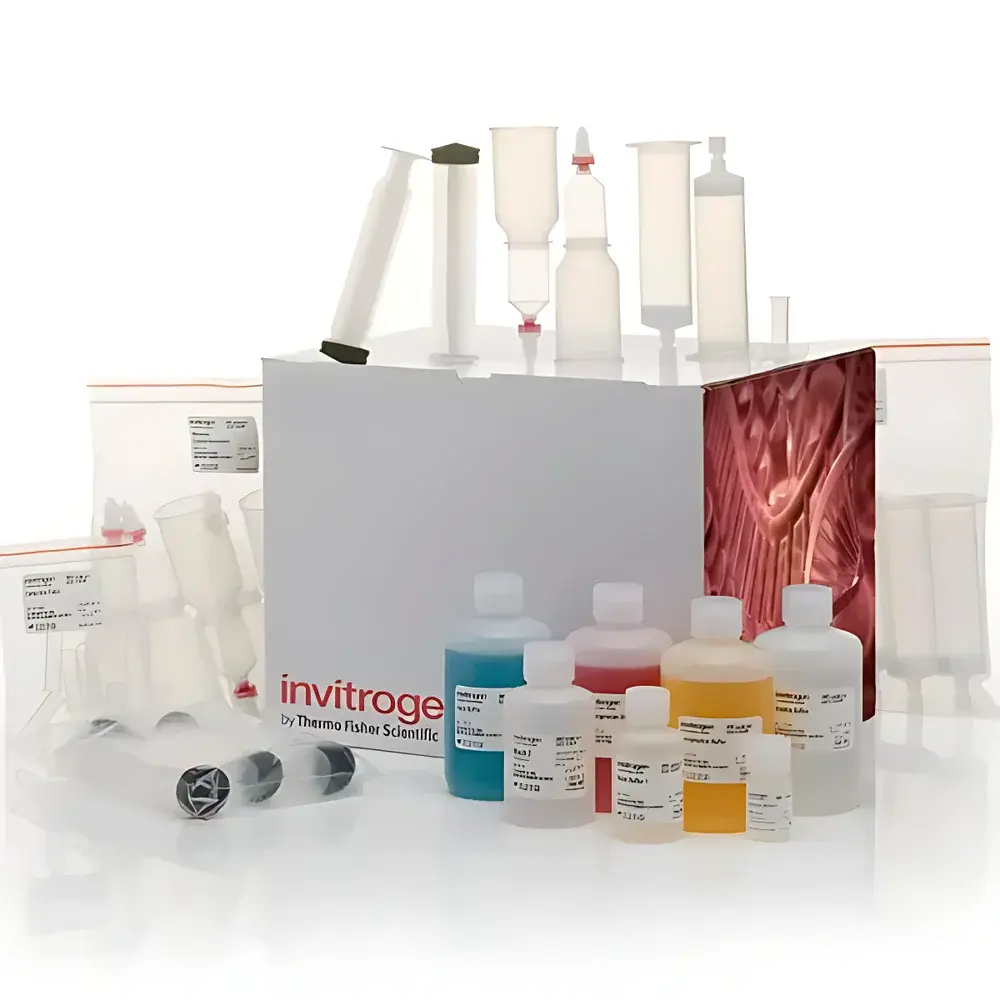
PureLink™ Fast Low-Endotoxin Maxi Plasmid Purification Kit
| Brand | Thermo Fisher Scientific |
|---|---|
| Model | A36228 |
| Format | Spin-column-based silica-membrane purification |
| Endotoxin Level | <1 EU/µg |
| Yield | Up to 1.5 mg high-purity plasmid DNA per prep |
| Processing Time | ~30 min |
| Required Equipment | Vacuum manifold (e.g., FastVac) or centrifuge (with optional adapter) |
| Buffer System | Colorimetric lysis and neutralization buffers |
| Intended Use | Transfection-grade plasmid isolation from E. coli cultures (up to 250 mL) |
Overview
The PureLink™ Fast Low-Endotoxin Maxi Plasmid Purification Kit is a rigorously engineered, silica-membrane-based system designed for the rapid isolation of transfection-ready plasmid DNA from bacterial cultures. Leveraging optimized alkaline lysis chemistry coupled with a proprietary high-capacity silica membrane, the kit achieves selective binding of supercoiled plasmid DNA under controlled chaotropic and pH conditions—while efficiently removing genomic DNA, RNA, proteins, and endotoxins. Its performance is validated for applications demanding stringent endotoxin control, including mammalian cell transfection, CRISPR vector delivery, and functional genomics studies where residual endotoxin can confound biological readouts. The entire workflow—from cell harvest to eluted DNA—is completed in approximately 30 minutes without precipitation steps, minimizing hands-on time and reducing risk of sample loss or degradation.
Key Features
- Rapid transfection-grade purification: Delivers plasmid DNA with endotoxin levels consistently below 1 EU/µg—validated per LAL assay protocols compliant with USP and ISO 11737-2—making it suitable for sensitive primary cell transfections and in vivo applications.
- High-yield capacity: Isolates up to 1.5 mg of high-molecular-weight, supercoiled plasmid DNA from up to 250 mL of overnight E. coli culture (OD600 ≈ 3–4), supporting downstream applications requiring large-scale material such as viral packaging, bioproduction seed stock preparation, and structural biology.
- Colorimetric process monitoring: Includes pH-indicating lysis and neutralization buffers that undergo distinct, irreversible color shifts (e.g., yellow → orange → pink) to provide real-time visual confirmation of complete cell lysis and proper neutralization—critical for reproducible plasmid recovery and avoidance of sheared DNA or precipitate formation.
- Robust membrane architecture: Utilizes a next-generation silica membrane with enhanced binding kinetics and reduced nonspecific adsorption, enabling consistent recovery across diverse plasmid sizes (3–20 kbp) and copy numbers (low-, medium-, and high-copy vectors).
- Flexible platform compatibility: Designed for vacuum manifold processing (recommended: Thermo Scientific FastVac Vacuum Manifold) but adaptable to centrifugation via optional spin adapters—ensuring integration into existing lab workflows without dedicated instrumentation investment.
Sample Compatibility & Compliance
The kit is validated for use with common laboratory E. coli strains including DH5α, TOP10, and Mach1. It accommodates both ampicillin- and kanamycin-resistant plasmids and demonstrates reliable performance with pUC-, pET-, and lentiviral backbone constructs. All reagents are manufactured under ISO 13485-certified processes; endotoxin testing follows FDA-recommended Limulus Amebocyte Lysate (LAL) methodology. Documentation supports GLP-compliant recordkeeping, and the kit’s lot-specific certificates of analysis include endotoxin quantitation, yield verification, and A260/A280 and A260/A230 ratios. No animal-derived components are present in the membrane or buffers, satisfying requirements for serum-free and xeno-free experimental systems.
Software & Data Management
While the PureLink™ Maxi Kit is a benchtop consumable system without embedded electronics or software, its protocol design integrates seamlessly with digital lab notebook platforms (e.g., LabArchives, Benchling) through standardized SOP templates provided in PDF and editable Word formats. Each kit includes a QR-coded lot label linking to online technical bulletins, safety data sheets (SDS), and regulatory documentation—including EU Declaration of Conformity and FDA Device Listing information. For labs operating under 21 CFR Part 11 requirements, Thermo Fisher provides audit-trail-ready electronic records packages upon request, including raw LAL assay reports and yield validation datasets traceable to NIST-traceable standards.
Applications
- Mammalian and stem cell transfection, including hard-to-transfect lines (e.g., HEK293T, iPSCs, primary neurons)
- Production of lentiviral, AAV, and adenoviral vectors for gene therapy research
- Large-scale plasmid preparation for CRISPR gRNA expression, base editing, and prime editing constructs
- Structural studies requiring high-concentration, low-endotoxin DNA (e.g., cryo-EM sample preparation, X-ray crystallography)
- Quality control in preclinical biomanufacturing, including plasmid DNA reference standard generation
- Next-generation sequencing library construction where contaminant-induced bias must be minimized
FAQ
What is the maximum recommended culture volume for optimal yield and purity?
For consistent endotoxin removal and maximal supercoiled recovery, we recommend processing 100–250 mL of mid-log to early-stationary phase E. coli culture (OD600 3–4). Volumes exceeding 250 mL may reduce binding efficiency and increase endotoxin carryover.
Can this kit be used with Gram-positive bacteria or yeast?
No—the lysis chemistry is specifically optimized for E. coli and closely related Gram-negative hosts. Alternative kits with enzymatic or mechanical lysis are required for Gram-positive or yeast systems.
Is the eluted DNA compatible with restriction digestion and in vitro transcription?
Yes—eluates contain no residual ethanol, guanidine, or EDTA at inhibitory concentrations. Typical A260/A280 ratios range from 1.80–1.90 and A260/A230 >2.0, confirming suitability for enzymatic downstream applications without additional cleanup.
Does Thermo Fisher offer automation-compatible versions of this kit?
Yes—robotic liquid handling protocols for QIAgility, Biomek i-Series, and Hamilton STAR systems are available upon request from Technical Support, including validated deck maps and script files.
How should I store the purified plasmid DNA for long-term stability?
Store eluted DNA at –20 °C in TE buffer (10 mM Tris-HCl, 1 mM EDTA, pH 8.0) or nuclease-free water. Avoid repeated freeze-thaw cycles; for archival storage (>1 year), consider lyophilization or –80 °C storage in 10 mM Tris-HCl (pH 8.5).




