
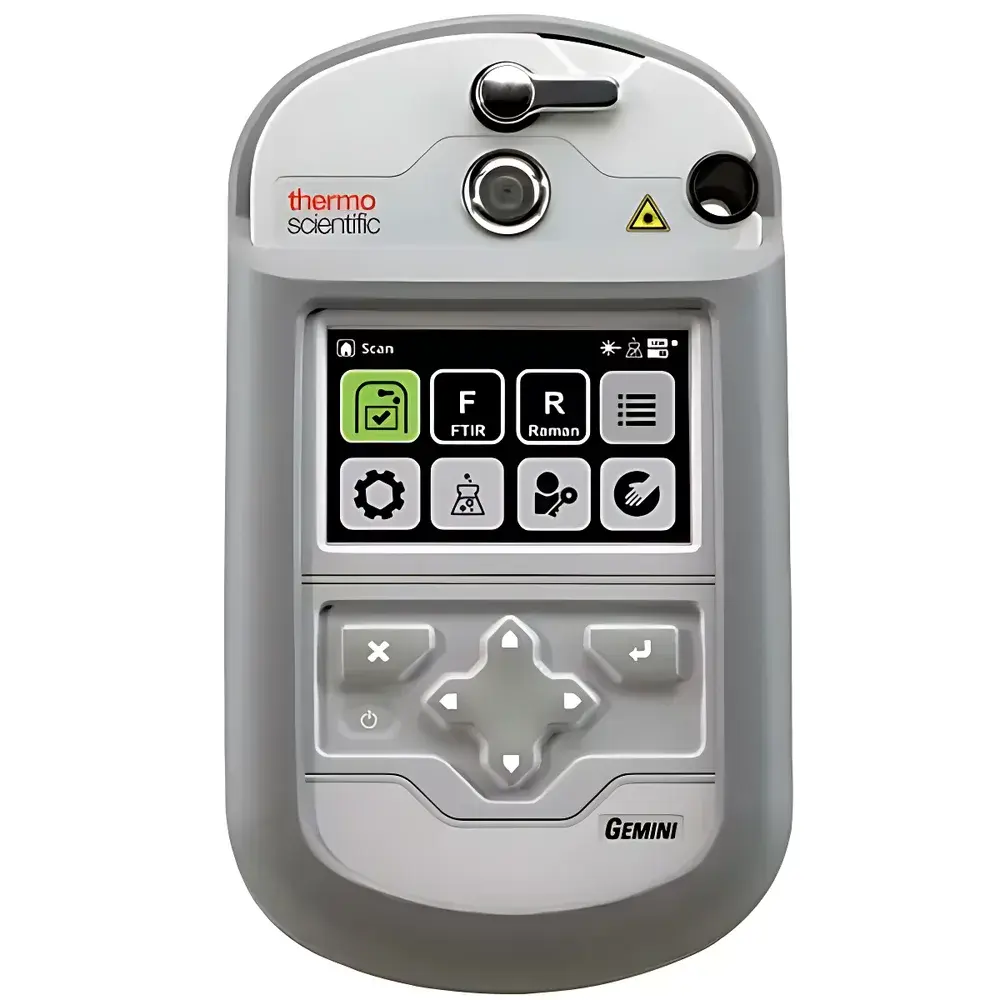
Thermo Scientific Gemini Handheld Raman-FTIR Dual-Mode Spectrometer
| Brand | Thermo Fisher |
|---|---|
| Origin | Shanghai, China |
| Manufacturer Type | Authorized Distributor |
| Origin Category | Domestic (China) |
| Model | Thermo Scientific Gemini Handheld Raman-FTIR Dual-Mode Spectrometer |
| Instrument Type | Portable/Handheld Raman-FTIR Spectrometer |
| Spectral Range | FTIR: 4,000–650 cm⁻¹ |
| Raman | 250–2,875 cm⁻¹ |
| Certifications | MIL-STD-810G, IP67 |
| Dimensions (L×W×H) | 25.6 × 14.6 × 6.1 cm |
| Weight | 1.9 kg |
| Operating Temperature | −20 °C to +50 °C |
| Power | Integrated 3.7 V Li-polymer battery (1 unit) + three CR123A batteries |
| Data Export Formats | SPC, TXT, JPEG |
| Optical Configurations | FTIR – Single-reflection diamond ATR crystal |
| Software Integration | Compatible with HazMasterG3™ decision support system |
| Support | 5-year comprehensive technical support, 24/7 spectral interpretation assistance by PhD-level spectroscopists |
Overview
The Thermo Scientific™ Gemini™ Handheld Raman-FTIR Dual-Mode Spectrometer represents a paradigm shift in field-deployable molecular identification. Engineered for tactical chemical analysis, it is the world’s first and only handheld instrument to integrate Fourier Transform Infrared (FTIR) spectroscopy and dispersive Raman spectroscopy within a single, ruggedized platform. Unlike conventional single-technique devices, Gemini leverages the complementary nature of these two vibrational spectroscopic methods: FTIR excels at detecting polar functional groups (e.g., O–H, N–H, C=O), while Raman provides high sensitivity to non-polar bonds (e.g., C–C, S–S, symmetric vibrations) and is inherently insensitive to water—enabling reliable analysis of aqueous or hydrated samples without signal suppression. This dual-mode architecture eliminates the need for sequential instrument swaps during hazardous material response, reducing analytical uncertainty and decision latency in time-critical scenarios such as explosive ordnance disposal (EOD), chemical threat assessment, and industrial incident response.
Key Features
- Dual-Modal Vibrational Spectroscopy: Simultaneous or sequential acquisition of FTIR (4,000–650 cm⁻¹) and Raman (250–2,875 cm⁻¹) spectra from a single measurement point—no sample repositioning required.
- Tactical Ergonomics & Environmental Resilience: Certified to MIL-STD-810G for shock, vibration, and thermal shock resistance; rated IP67 for dust-tightness and immersion up to 1 m for 30 minutes—validated for deployment in austere field conditions including desert, maritime, and urban rubble environments.
- Low-DoseID™ Acquisition Protocol: Patented scanning delay function enables operators to initiate FTIR or Raman acquisition remotely, then retreat to a safe standoff distance before spectral collection begins—critical for volatile, toxic, or energetic materials.
- Intelligent Sampling Interface: Motorized anvil with programmable pressure control ensures consistent contact force on solid samples during ATR-FTIR measurement, minimizing inter-operator variability and enhancing reproducibility across users and shifts.
- Scan Assist Workflow Guidance: On-device contextual prompts guide operators through technique selection (Raman vs. FTIR), sampling mode (solid/liquid/powder), and parameter optimization—reducing dependence on advanced spectroscopic training while maintaining analytical rigor.
- Modular Configuration Profiles: Predefined or user-customizable scan profiles store optimal laser power, integration time, co-adds, and ATR pressure settings per compound class (e.g., nitrate esters, organophosphates, pharmaceutical intermediates), enforcing method consistency and audit readiness.
Sample Compatibility & Compliance
Gemini accommodates a broad range of physical forms—including solids (crystalline, amorphous, tablets), liquids (neat, diluted, emulsified), gels, and powders—without requiring sample preparation or consumables. Its diamond ATR crystal (FTIR) and high-numerical-aperture Raman optics enable robust performance on dark, fluorescent, or highly scattering matrices where conventional handheld Raman systems fail. The instrument complies with U.S. Department of Defense and NATO STANAG 4569 Level 2 environmental requirements. All firmware and spectral libraries are maintained under documented change control procedures aligned with ISO/IEC 17025:2017 clause 7.7 (Method Validation) and support GLP/GMP-aligned workflows. Full traceability of spectral acquisitions—including operator ID, GPS metadata (when enabled), timestamp, ambient temperature/humidity, and instrument calibration status—is embedded in every exported SPC file.
Software & Data Management
Gemini operates natively with Thermo Scientific™ OMNIC™ Mobile software for real-time spectral visualization, library matching (with >25,000 reference spectra covering explosives, CWAs, TICs, pharmaceuticals, and precursors), and confidence scoring based on correlation coefficient and residual analysis. It integrates seamlessly with Alluviam LLC’s HazMasterG3™ decision support system for virtual mixture deconvolution, threat prioritization, and interactive hazard mitigation guidance. All spectral data are exportable in ASTM E131-compliant SPC format for third-party chemometric analysis (e.g., PCA, PLS-DA) or ingestion into laboratory information management systems (LIMS). Firmware updates, spectral library revisions, and regulatory compliance patches are delivered automatically via secure OTA channels—ensuring continuous alignment with evolving DHS, EPA, and NATO chemical threat lists. Audit trails—including all user actions, parameter modifications, and match results—are retained locally and exportable in CSV format for FDA 21 CFR Part 11-compliant review.
Applications
- Explosives identification and differentiation (e.g., distinguishing PETN from RDX or ammonium nitrate-based IED components)
- Chemical warfare agent (CWA) screening and confirmation (e.g., VX, sarin, mustard agents) in vapor, liquid, or surface-residue form
- Hazardous material (HAZMAT) triage during transportation incidents or industrial spills
- Pharmaceutical raw material verification and counterfeit detection at ports of entry
- Forensic trace evidence analysis (e.g., illicit drug profiling, polymer fragment identification)
- Environmental monitoring of persistent organic pollutants (POPs) and industrial contaminants in soil or water extracts
FAQ
Is Gemini compliant with international standards for field-deployable chemical analyzers?
Yes. Gemini meets MIL-STD-810G for environmental durability and IP67 for ingress protection. Its spectral data formats adhere to ASTM E131 and ASTM E1421 standards, and its software architecture supports 21 CFR Part 11 audit trail requirements when deployed in regulated environments.
Can Gemini analyze mixtures without prior separation?
While not a quantitative chromatographic system, Gemini—when used with HazMasterG3™—supports semi-quantitative virtual mixture analysis using spectral subtraction and library-driven component inference, particularly effective for binary or ternary blends common in illicit labs or improvised formulations.
What level of operator training is required?
Operators require ≤4 hours of certified field training to achieve proficiency. Scan Assist and context-aware configuration profiles eliminate subjective interpretation, enabling reliable results from personnel with minimal spectroscopy background.
How is spectral library maintenance handled?
Thermo Fisher provides automatic quarterly library updates via encrypted cloud sync, including newly added threat compounds identified by DHS, OPCW, and national laboratories—fully documented in release notes traceable to source validation reports.
Does Gemini support remote expert consultation?
Yes. The included 5-year support plan includes 24/7 access to Thermo’s global network of PhD-level application scientists for live spectral interpretation, method troubleshooting, and forensic report validation—all accessible directly from the instrument interface.





