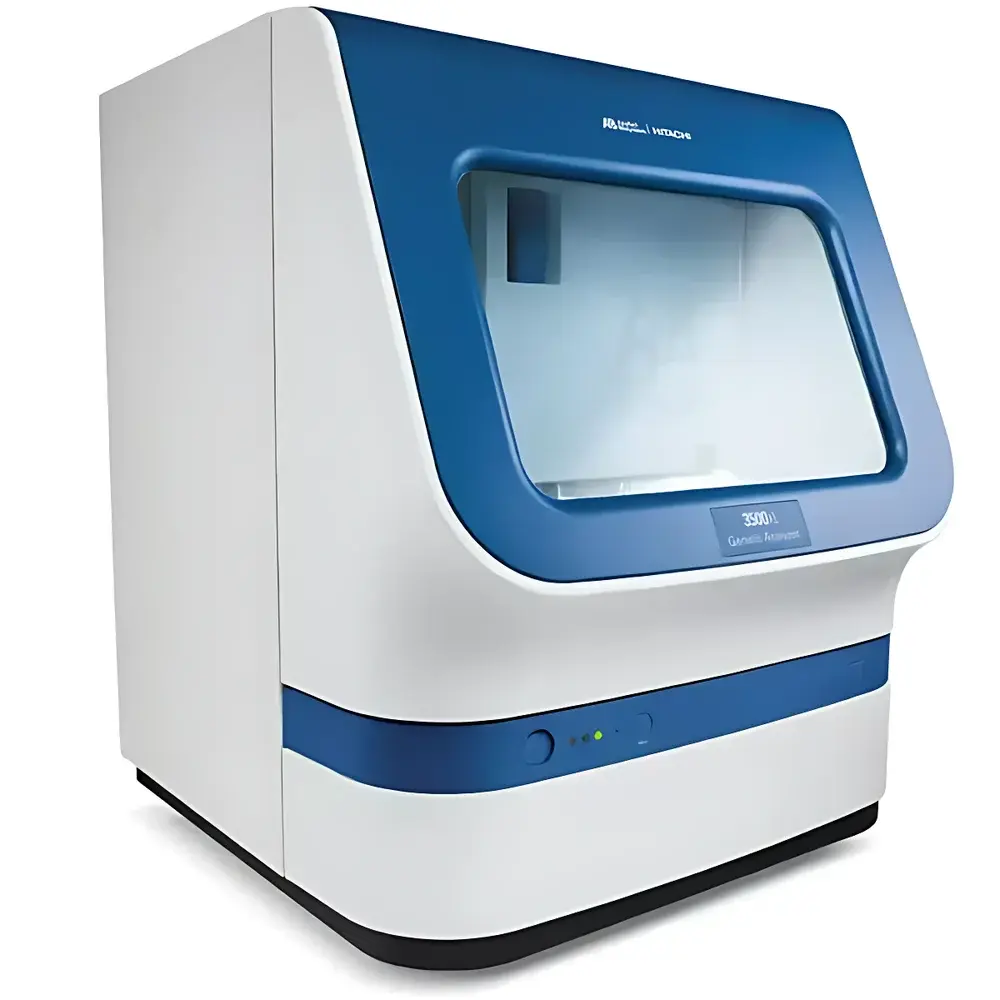
Thermo Fisher 3500xL Genetic Analyzer
| Brand | Thermo Fisher |
|---|---|
| Origin | Shanghai, China |
| Manufacturer Type | Authorized Distributor |
| Regional Classification | Domestic (China-manufactured) |
| Model | Thermo Fisher 3500xL Genetic Analyzer |
| Pricing | Available upon Request |
| Capillary Count | 24 |
| Laser Wavelength | 505 nm (solid-state, single-line) |
| Capillary Length | 36 cm / 50 cm |
| Electrical Requirement | 15 A, 220–240 V AC |
| Operating System | Windows 7 SP1 |
| Software | 3500 Series Data Collection Software |
| RFID-Enabled Consumables | Yes |
| Dye Capacity | Up to 6 fluorescent dyes |
| Polymer Compatibility | POP-4™, POP-6™, POP-7™ |
| Throughput | Up to 1,104 samples/day (ShortReadSeqPOP7 module) |
| Weight | 82 kg |
| Warranty | 1-year limited warranty covering parts, labor, installation, and application training |
Overview
The Thermo Fisher 3500xL Genetic Analyzer is a high-performance, 24-capillary capillary electrophoresis (CE) platform engineered for precision DNA fragment analysis and Sanger sequencing applications. It operates on the principle of size-based separation of fluorescently labeled DNA fragments under an electric field within polyacrylamide polymer-filled fused-silica capillaries, followed by real-time laser-induced fluorescence detection at 505 nm. This system delivers enhanced inter-instrument, inter-run, and intra-capillary signal uniformity—critical for reproducible genotyping, mutation detection, and allele sizing across diverse life science workflows. Designed for research use only (RUO), it complies with laboratory quality frameworks supporting GLP-aligned data integrity practices, including audit-trail–capable software logging and RFID-tracked consumable traceability.
Key Features
- 24-capillary array architecture enabling scalable throughput without compromising resolution or reproducibility
- Long-life, solid-state 505 nm laser—no external cooling required; powered via standard AC supply
- Integrated 3500 Series Data Collection Software with real-time QC metrics, automated base-calling, and on-instrument primary analysis
- RFID-enabled consumables management: automatic tracking of polymer lot numbers, buffer expiration dates, capillary array usage history, and instrument-specific calibration records
- Multi-dye compatibility (up to six spectrally distinct fluorophores) optimized for multiplexed fragment analysis and high-resolution SNP validation
- Thermal control system engineered for improved sizing accuracy in demanding fragment analysis applications, particularly for microsatellites, LOH, MLPA™, and MLST
- Pre-packaged, ready-to-install consumables—including POP-4™, POP-6™, and POP-7™ polymers—reducing setup time and operator variability
Sample Compatibility & Compliance
The 3500xL supports a broad range of nucleic acid sample types, including PCR-amplified fragments (10–1,200 bp), plasmid-derived sequencing templates, and restriction-digested genomic DNA. Its CE-based separation mechanism ensures compatibility with standard dye-terminator chemistries (e.g., BigDye™ v3.1) and fragment analysis reagents. While designated RUO per regulatory labeling, the platform’s hardware design, software audit trails, and consumable traceability align with foundational elements of ISO/IEC 17025 and FDA 21 CFR Part 11 readiness—particularly when deployed in controlled research environments requiring documentation of instrument performance, reagent lineage, and analyst intervention points. It is not validated for clinical diagnostic use or IVD compliance.
Software & Data Management
The 3500 Series Data Collection Software provides a unified interface for run setup, instrument control, real-time electropherogram visualization, and primary data evaluation. Its dashboard-driven UI includes graphical status indicators for capillary health, polymer integrity, and RFID-read success—enabling rapid troubleshooting prior to run initiation. Built-in QC tools assess peak height uniformity, migration time stability, and signal-to-noise ratios during acquisition. Raw data (.fsa files) are natively compatible with downstream analytical packages including GeneMapper™ ID-X, Variant Reporter™, and third-party open-source tools (e.g., FinchTV, BioEdit). All software operations generate timestamped, user-attributed logs compliant with basic GLP record-keeping requirements. The included Dell™ workstation features dual 500 GB SATA III drives (8 MB burst cache), 16 GB DDR3 non-ECC RAM, and a 4th-generation Intel Core i7 processor (3.1 GHz Turbo), ensuring deterministic processing of large-scale fragment datasets.
Applications
- De novo and resequencing: High-fidelity Sanger sequencing for validation of NGS findings, clone verification, and small-genome projects
- Mutation screening & variant confirmation: Detection of SNPs, indels, and splice-site variants in oncology, pharmacogenomics, and rare disease research
- Microsatellite instability (MSI) and loss of heterozygosity (LOH) analysis: Accurate sizing of repetitive loci using multi-dye panels
- MLPA™ and copy number variation (CNV) assessment: Quantitative fragment intensity profiling across multiple targets
- MLST and strain typing: Standardized allele calling across bacterial and fungal isolates
- Forensic STR profiling: Multiplexed amplification and sizing of core CODIS loci
FAQ
Is the 3500xL suitable for clinical diagnostics?
No. The system is designated for Research Use Only (RUO) and is not cleared or approved by regulatory bodies (e.g., FDA, CE-IVD) for diagnostic procedures.
What polymer formulations are supported?
The platform is validated for POP-4™, POP-6™, and POP-7™ polymers—each optimized for specific fragment size ranges and resolution requirements.
Does the system require external cooling or specialized power infrastructure?
No. The 505 nm solid-state laser operates without active thermal exhaust; standard 15 A, 220–240 V AC input suffices.
Can data be exported in standard formats for integration with LIMS?
Yes. Electropherogram files (.fsa) and run reports (.txt/.csv) are exportable; metadata fields support manual or scripted ingestion into laboratory information management systems.
What maintenance protocols are recommended?
Daily capillary flushes, weekly polymer replacement, and quarterly optical alignment verification are outlined in the service manual; RFID prompts notify users of consumable expiry or usage thresholds.