
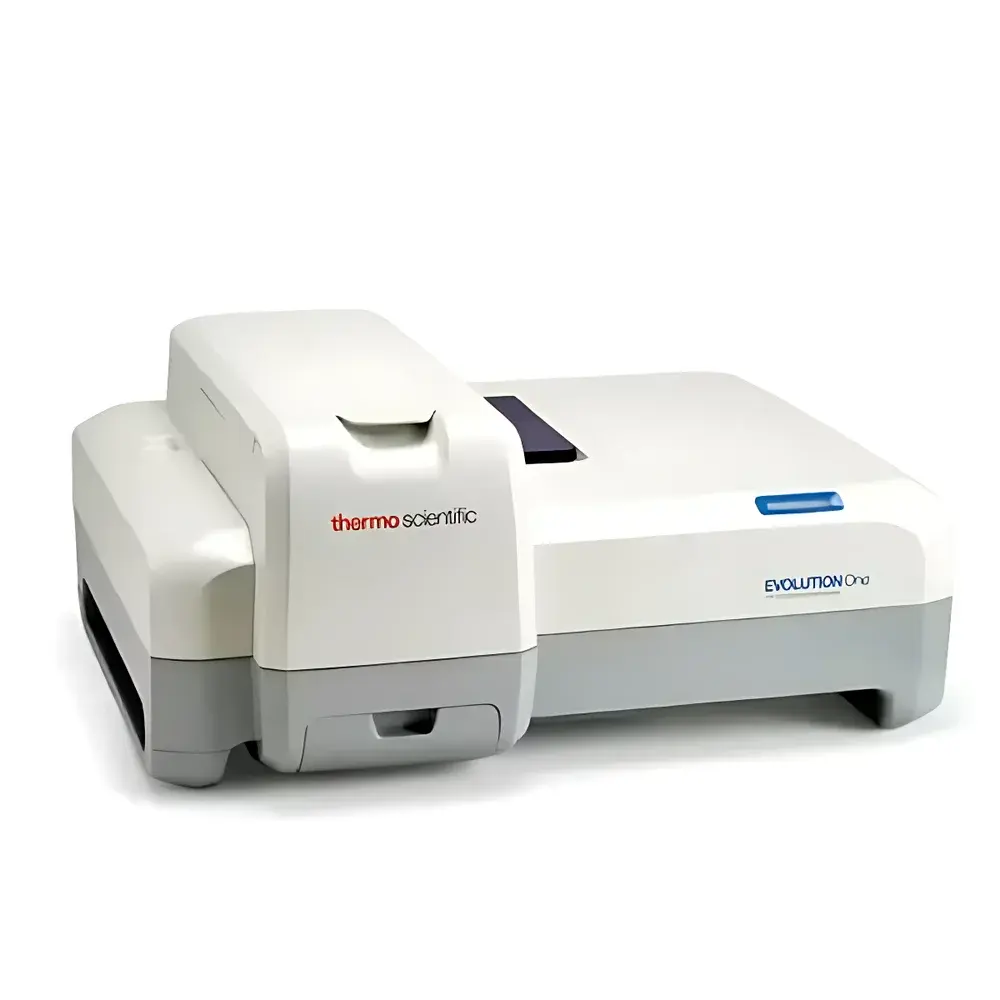
Thermo Fisher Scientific Evolution One UV-Vis Spectrophotometer
| Brand | Thermo Fisher Scientific |
|---|---|
| Origin | Shanghai, China |
| Instrument Type | Double-beam UV-Vis spectrophotometer |
| Detector | Photodiode array (PDA) |
| Wavelength Range | 190–1100 nm |
| Wavelength Repeatability | ≤0.05 nm (at 546.1 nm Hg line, SD of 10 measurements) |
| Spectral Bandwidth | Fixed 1.0 nm |
| Baseline Flatness | ±0.001 A (200–800 nm, 1.0 nm SBW, smoothed) |
| Photometric Accuracy | ±0.010 A (60 mg/L K₂Cr₂O₇) |
| Stray Light | ≤1% T @ 198 nm (KCl) |
| Wavelength Accuracy | ±0.5 nm (Hg lines at 541.9/546.1 nm), ±0.8 nm (full range) |
| Photometric Precision | ±0.004 A at 1 A, ±0.008 A at 2 A (NIST-traceable neutral density filters, 440 nm) |
| Noise Level | ≤0.00015 A (0 A), ≤0.00025 A (1 A), ≤0.00050 A (2 A, RMS, 260 nm, 1.0 nm SBW) |
| Drift | <0.0005 A/h (500 nm, 1.0 nm SBW, after 1 h warm-up) |
| Light Source | Xenon flash lamp |
| Dimensions (L×W×H) | 593 × 475 × 266 mm |
| Weight | 14.5 kg |
| Power Requirement | 100–240 V AC, auto-switching, 50/60 Hz, max. 150 W |
| Warranty | 2 years instrument, 3 years lamp |
Overview
The Thermo Fisher Scientific Evolution One UV-Vis Spectrophotometer is a double-beam, xenon flash lamp–based absorption spectrometer engineered for high reproducibility, regulatory readiness, and operational simplicity across routine QC, research, and compliance-driven laboratories. It employs a Czerny-Turner monochromator with advanced fixed 1.0 nm spectral bandwidth and optimized optical path geometry—termed Automatic Focusing Beam Geometry (AFBG)—to ensure consistent photometric performance across diverse sample formats, including microvolume cuvettes, solid samples, and fiber-optic probes. Unlike continuous-lamp instruments requiring thermal stabilization, the pulsed xenon source delivers instantaneous, stable illumination without warm-up delay, enabling rapid kinetic measurements and minimizing lamp-induced drift. The photodiode array (PDA) detector provides full-spectrum acquisition in a single flash, supporting high-speed scanning (up to 6000 nm/min) and robust signal averaging for low-noise quantitation down to 0.00015 A RMS baseline noise at zero absorbance.
Key Features
- Double-beam optical design with simultaneous sample and reference channel monitoring, ensuring real-time compensation for source fluctuation and environmental drift
- Xenon flash lamp with >5-year typical lifetime (under standard usage conditions), eliminating filament degradation and reducing recalibration frequency
- Fixed 1.0 nm spectral bandwidth optimized for resolution and throughput balance per ICH Q2(R2) and USP <857> guidance
- Automatic Focusing Beam Geometry (AFBG) enhances beam alignment stability across variable pathlengths and sample geometries—including 1 mm microcells and integrating spheres
- Baseline flatness of ±0.001 A (200–800 nm, smoothed) meets stringent requirements for multicomponent analysis and derivative spectroscopy
- Compliance-ready architecture: preconfigured for 21 CFR Part 11-compliant audit trails, electronic signatures, and role-based access control when paired with Insight Pro Security Software
Sample Compatibility & Compliance
The Evolution One supports a broad spectrum of sample types—from aqueous solutions and organic solvents to turbid suspensions, thin films, and powdered solids—via interchangeable accessories including Peltier-controlled single-cell holders (0–100 °C), Smart Peltier 8-position cell changers, fiber-optic probes, integrating spheres, and temperature-regulated solid-sample stages. All accessories are mechanically indexed and software-recognized to maintain traceability and prevent configuration errors. For regulated environments, optional qualification kits include USP/EP-certified reference standards (K₂Cr₂O₇, NaI, KI, KCl), NIST-traceable neutral density filters, and documented validation protocols aligned with ISO/IEC 17025, ASTM E275, and EU GMP Annex 11. Baseline stability, stray light performance (≤0.05% T at 220 nm), and photometric accuracy (±0.010 A per USP <857>) are verified during factory acceptance testing and supported by on-site IQ/OQ documentation packages.
Software & Data Management
Insight Pro software serves as the unified control and analysis platform, featuring a context-sensitive, workflow-driven interface designed to reduce operator training time and minimize procedural deviation. Its Custom User Environment (CUE) allows creation of locked, step-by-step methods—including automated background correction, multi-point calibration, and pass/fail criteria—for routine assays such as protein quantitation (A280/A260), DNA purity assessment, or dissolution testing. All data—including raw spectra, processed results, instrument parameters, and user actions—are stored in a secure, encrypted SQLite database with immutable audit trails compliant with FDA 21 CFR Part 11 and EU Annex 11. Software updates are delivered via validated patch mechanisms, preserving method integrity while incorporating new pharmacopeial templates (e.g., USP <1057>), enhanced reporting modules, and expanded export options (CSV, PDF/A-2, XML) for LIMS integration.
Applications
- Pharmaceutical QC: Assay validation, excipient compatibility screening, and stability-indicating methods per ICH Q5C and USP <1118>
- Biotechnology: Protein concentration, aggregation kinetics (via time-resolved UV scans), and nucleic acid purity (A260/A280, A260/A230)
- Materials science: Thin-film thickness calculation using interference fringes, bandgap estimation from Tauc plots, and dye loading quantification
- Environmental analysis: Nitrate/nitrite determination via colorimetric reaction, COD assessment, and heavy metal chelation studies
- Academic research: Ligand-binding stoichiometry (Job’s plot), enzyme kinetics (initial rate analysis), and pH-dependent spectral shifts
FAQ
Does the Evolution One support GLP/GMP-compliant data handling?
Yes—when configured with Insight Pro Security Software and Validator documentation, it supports full 21 CFR Part 11 compliance, including electronic signatures, audit trail review, and user access controls aligned with ALCOA+ principles.
Can the instrument perform kinetic measurements without lamp warm-up delays?
Yes—the xenon flash lamp enables sub-second acquisition initiation, supporting time-resolved studies with sampling intervals as short as 10 ms and no thermal stabilization requirement.
Is wavelength calibration traceable to national standards?
Yes—factory calibration uses mercury and deuterium emission lines; users may perform verification using supplied NIST-traceable holmium oxide and didymium filters per ASTM E275 and USP <857>.
What is the maximum scan speed and how does it affect data quality?
Scanning up to 6000 nm/min is achievable; however, optimal signal-to-noise ratio is maintained at ≤1200 nm/min for high-precision applications—software automatically recommends speed settings based on selected slit width and detector integration time.
Are solid-sample accessories compatible with quantitative reflectance analysis?
Yes—integrating sphere and specular reflectance accessories enable Kubelka-Munk transformation and absolute %R measurement, validated per ASTM E1331 and ISO 13468-2 for pigment and coating characterization.
Related Products




