
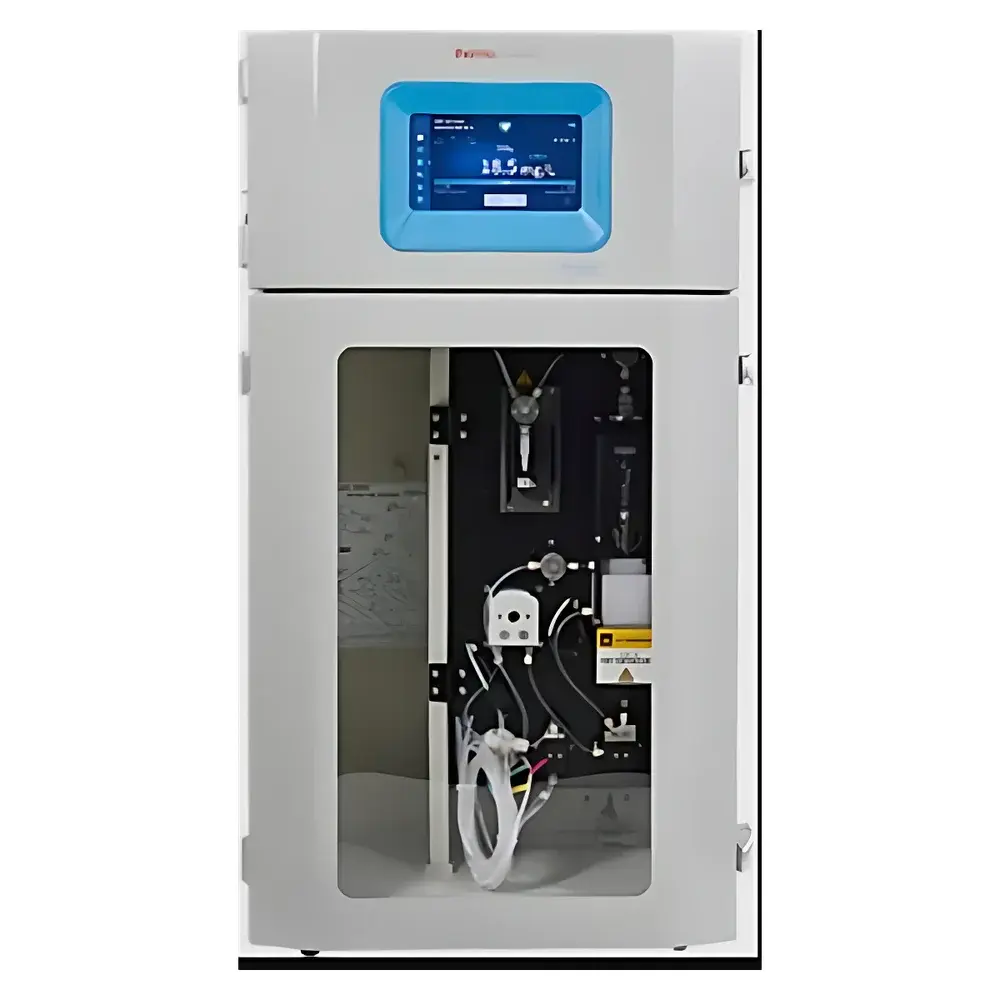
Thermo Fisher Scientific Orion 8006cX Online COD Analyzer
| Brand | Thermo Fisher Scientific |
|---|---|
| Origin | Shanghai, China |
| Manufacturer Type | Authorized Distributor |
| Product Category | Domestic (China-manufactured) |
| Model | Orion 8006cX Online COD Analyzer |
| Instrument Type | Online Analyzer |
| Measurement Range | 0–1000 mg/L and 1000–5000 mg/L |
| LOD | 10 mg/L |
| Chloride Interference Tolerance | up to 5000 mg/L |
| Compliance | HJ/T 399–2007, HJ 377–2019, HJ 35X–2019 |
| Certification | CCEP (China Environmental Protection Product Certification) |
Overview
The Thermo Fisher Scientific Orion 8006cX Online COD Analyzer is a fully automated, spectrophotometric system engineered for continuous, unattended measurement of Chemical Oxygen Demand (COD) in industrial effluents, municipal wastewater, and surface water. It operates on the dichromate digestion–colorimetric principle per Chinese environmental standards HJ/T 399–2007 and HJ 377–2019, where organic matter is oxidized under acidic, high-temperature conditions using potassium dichromate as the oxidant; the resulting Cr3+ concentration—proportional to consumed oxygen—is quantified via 600 nm absorbance detection. Designed for regulatory compliance and long-term field deployment, the analyzer integrates digestion, cooling, optical measurement, and waste handling into a single robust platform with dual-range capability (0–1000 mg/L and 1000–5000 mg/L), enabling accurate quantification across low-strength influents and high-load industrial discharges.
Key Features
- Automated multi-step operation: integrated sample aspiration, reagent dosing, high-temperature digestion (165 °C, 20 min), air-cooling, colorimetric measurement, and waste discharge—all without manual intervention.
- Dynamic range switching: automatic scale selection based on real-time signal intensity ensures optimal photometric linearity and minimizes dilution errors.
- Chloride compensation architecture: validated tolerance to Cl− up to 5000 mg/L, mitigating interference through optimized digestion chemistry and matrix-matched calibration protocols.
- IP65-rated enclosure with physical separation between electrical and wet modules—ensuring operational safety and electromagnetic immunity in harsh plant environments.
- Proven mechanical durability: critical fluidic components (peristaltic pump tubing, solenoid valves, digestion coil) validated for ≥1.2 million actuation cycles under abrasive, particulate-laden sample conditions—equivalent to >5 years of continuous operation at 4-hour measurement intervals.
- 7-inch capacitive touchscreen HMI with hierarchical navigation menus, multilingual support (English/Chinese), real-time trend graphs, and context-sensitive help overlays.
Sample Compatibility & Compliance
The Orion 8006cX accepts raw, unfiltered wastewater samples with suspended solids ≤100 mg/L and particle size <1 mm. It complies with China’s mandatory online monitoring requirements outlined in HJ 35X–2019 series (HJ 353–2019, HJ 354–2019, HJ 355–2019, HJ 356–2019), including data validity criteria, zero/span verification frequency, and audit trail retention. The unit holds CCEP certification (Certificate No. CCEP-XXXXX), confirming conformity to GB/T 37977–2019 (Environmental Monitoring Instruments – General Technical Requirements). All reagent formulations are publicly disclosed per national transparency guidelines and formulated to minimize mercury-free dichromate consumption while maintaining stoichiometric completeness and Cr3+ molar absorptivity stability.
Software & Data Management
Embedded firmware supports local data storage (≥30 days of 15-minute interval records), RS-485/Modbus RTU, Ethernet TCP/IP, and optional 4–20 mA analog output. Remote access enables secure configuration, diagnostic logging, and firmware updates via HTTPS. Audit trails capture all user actions (e.g., calibration initiation, range change, maintenance log entries), aligned with GLP-aligned record-keeping expectations. Data export formats include CSV and XML, compatible with SCADA systems and China’s National Monitoring Platform (NMP) data ingestion protocols. Alarm events—including no-sample, no-reagent, leakage, temperature deviation, and optical path fouling—are timestamped, prioritized, and logged with auto-reset thresholds.
Applications
- Real-time effluent compliance monitoring at municipal wastewater treatment plants (WWTPs) subject to discharge permits under the Water Pollution Prevention and Control Law.
- Process control in chemical, pharmaceutical, food & beverage, and textile manufacturing facilities where COD load variability demands adaptive feedback loops.
- Early-warning detection of shock loads or upstream process upsets in combined sewer systems.
- Long-term trend analysis for environmental impact assessments and basin-wide water quality modeling.
- Validation of biological treatment efficiency via correlation with BOD5, TOC, and NH3-N time-series data.
FAQ
What digestion method does the Orion 8006cX employ?
It uses closed-system, high-temperature (165 °C) acid dichromate digestion per HJ/T 399–2007, with automated cooling prior to photometric detection.
Is remote calibration supported?
Yes—zero and span calibrations can be initiated locally or remotely; all calibration parameters, timestamps, and results are retained in the immutable audit log.
How often must reagents be replenished?
At standard 4-hour measurement intervals, the onboard reagent reservoir supports ≥7 days of continuous operation; low-reagent alerts trigger configurable notifications.
Does the analyzer meet international standards such as ISO 6060 or ASTM D1252?
While optimized for Chinese regulatory frameworks, its fundamental dichromate oxidation methodology is technically equivalent to ISO 6060:1989 and ASTM D1252–12 Method B; however, formal certification to those standards requires site-specific validation per local accreditation bodies.
Can it interface with third-party LIMS or cloud-based platforms?
Yes—via Modbus TCP or RESTful API (optional license), enabling bidirectional data exchange with laboratory information management systems and Industry 4.0 infrastructure.
Related Products







