
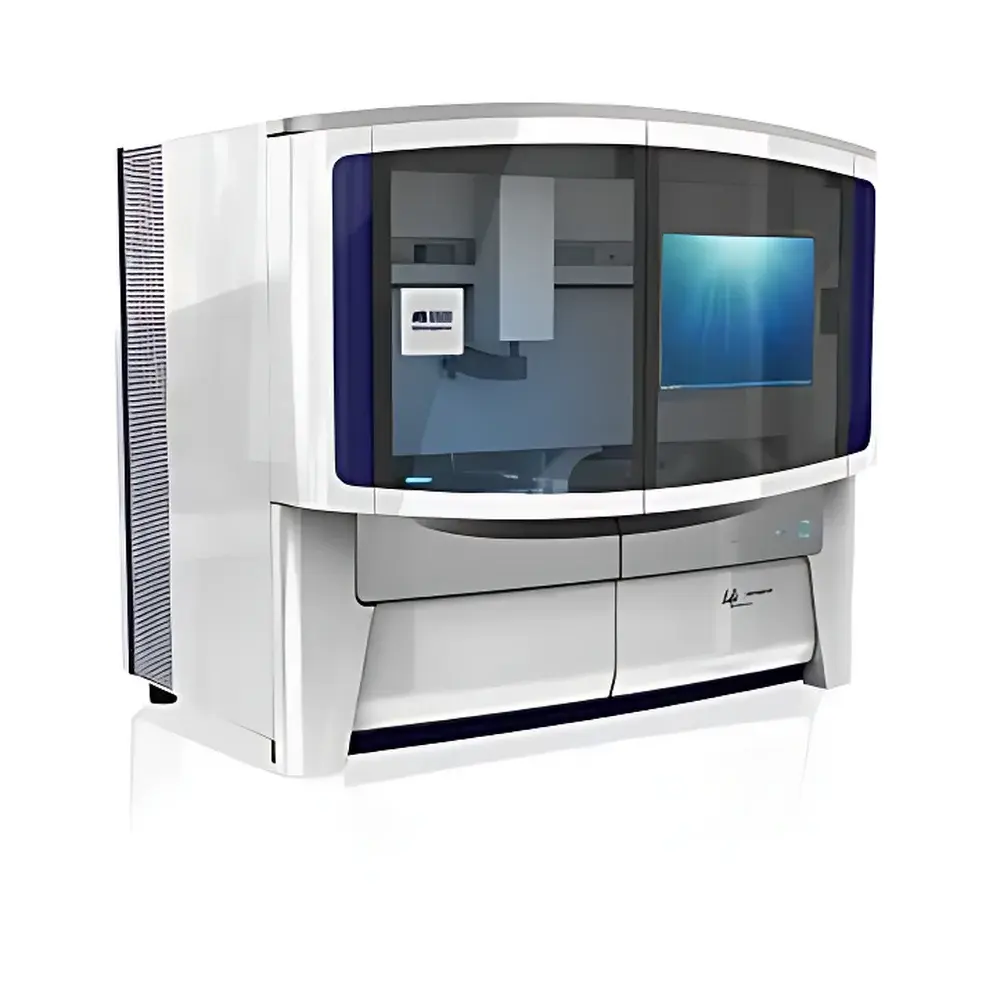
Life Technologies SOLiD™ 5500 Next-Generation Sequencing System
| Brand | Life Technologies |
|---|---|
| Origin | USA |
| Model | SOLiD™ 5500 |
| Configuration | FlowChip-based, addressable channel architecture |
| Sequencing Chemistry | Ligation-based sequencing |
| Accuracy | Up to 99.99% per base (with ECC error correction) |
| Multiplexing Capacity | Up to 96 barcodes per run |
| Software Platform | SOLiD™ System Software Suite v4.x |
| Compliance | Designed for GLP/GMP-aligned workflows, compatible with FDA 21 CFR Part 11 audit trail requirements (when deployed with validated IT infrastructure) |
Overview
The Life Technologies SOLiD™ 5500 Next-Generation Sequencing System is a ligation-based, high-accuracy DNA sequencing platform engineered for reproducible, scalable, and cost-controlled genomic analysis. Unlike synthesis-by-extension chemistries, the SOLiD™ system employs sequential oligonucleotide ligation and detection—leveraging fluorescently labeled di-base probes and iterative ligation cycles to determine nucleotide identity with dual-base encoding logic. This fundamental design delivers intrinsic error correction capability through its two-base encoding scheme and Enhanced Color Calling (ECC) algorithm, enabling robust discrimination of low-frequency variants (<0.1% allele frequency) in heterogeneous samples. The system utilizes reusable FlowChips with physically addressable, independently configurable sequencing channels—allowing users to allocate sequencing capacity per experiment rather than committing full-chip runs. This architecture supports flexible experimental scaling from targeted resequencing to whole-exome capture and RNA-Seq applications, all within a single instrument footprint and standardized workflow.
Key Features
- Channel-level sequencing allocation: Run one or two FlowChips simultaneously, with each chip containing multiple independent, addressable channels—eliminating unused channel waste and reducing per-run reagent consumption.
- Enhanced Color Calling (ECC) module: Integrated real-time base-calling correction that improves raw read accuracy to ≥99.99% by resolving color-space ambiguities and mitigating phasing/pre-phasing artifacts.
- Ligation chemistry specificity: Reduced incorporation bias compared to polymerase-based methods—particularly advantageous for GC-rich or repetitive genomic regions and formalin-fixed paraffin-embedded (FFPE) derived libraries.
- Automated library preparation compatibility: Fully interoperable with AB Library Builder™ systems for consistent shearing, end-repair, A-tailing, adapter ligation, and size selection—minimizing manual intervention and inter-operator variability.
- Modular bead templating: SOLiD™ EZ Bead™ System enables automated emulsion PCR and bead enrichment, delivering uniform template density across FlowChip channels and supporting high cluster uniformity.
- High-multiplex sample processing: Supports up to 96 unique molecular barcodes per run using rigorously validated Ambion®-optimized indexing adapters, ensuring cross-sample carryover <0.001% under standard QC conditions.
Sample Compatibility & Compliance
The SOLiD™ 5500 system accepts input nucleic acid libraries prepared from diverse sources—including genomic DNA, FFPE tissue extracts, plasma cfDNA, and enriched RNA (via ribosomal RNA depletion or poly-A selection). Library inputs must meet defined size distribution (150–300 bp post-adapter) and molarity specifications to ensure optimal clonal amplification on beads. All reagents—including ligase enzymes, di-base probes, and buffer formulations—are manufactured under ISO 13485-certified processes. The system’s software architecture supports electronic signatures, user access controls, and audit-trail logging—enabling alignment with GLP, GCP, and GMP documentation requirements when deployed in regulated environments. While not pre-certified as a medical device, the platform has been used in CLIA-laboratory validation studies for somatic variant detection in oncology panels.
Software & Data Management
SOLiD™ System Software Suite v4.x provides integrated control of instrument operation, real-time quality monitoring, and primary data processing—including color-space to base-space conversion, alignment (using BioScope™ aligner), and variant calling (via Corona Lite and DiBayes algorithms). Raw data files (csfasta and qual) are stored in vendor-neutral formats compliant with GA4GH standards. The software supports batch processing, metadata tagging per channel/run, and export to common downstream analysis environments (e.g., IGV, Galaxy, custom R/Bioconductor pipelines). Audit logs record all user actions, parameter changes, and system events—retained for ≥180 days by default and exportable in CSV/SQL format for regulatory review.
Applications
- Whole-exome sequencing (WES) with uniform coverage depth (>100× mean) and high on-target rates (>95%) using Agilent SureSelect or NimbleGen SeqCap capture kits.
- Targeted resequencing of disease-associated gene panels (e.g., BRCA1/2, EGFR, KRAS) with validated limit-of-detection at 2% VAF in matched tumor-normal pairs.
- RNA-Seq for differential expression, splice isoform quantification, and fusion transcript detection—leveraging strand-specific library prep and digital counting precision.
- ChIP-Seq and ATAC-Seq for epigenomic profiling, benefiting from low background noise and high signal-to-noise ratio in low-input chromatin immunoprecipitation libraries.
- Microbial metagenomics where species-level resolution is required, particularly in complex polymicrobial communities with closely related strains.
FAQ
What sequencing chemistry does the SOLiD™ 5500 use?
It uses a ligation-based method with di-base encoded probes and iterative ligation cycles—not polymerase extension. This enables dual-base encoding and inherent error correction via color-space decoding.
Is the SOLiD™ 5500 still supported with current reagents and software updates?
Official technical support and reagent supply were discontinued by Thermo Fisher Scientific (following acquisition of Life Technologies) in 2016. However, validated legacy protocols, archived software versions, and third-party service providers continue to support operational deployment in academic and core facility settings.
Can SOLiD™ data be integrated into modern NGS analysis pipelines?
Yes—csfasta/qual files can be converted to FASTQ using open-source tools (e.g., csfasta2fastq), and aligned using BWA or Bowtie2 after base-space conversion. Many published cancer genomics datasets generated on SOLiD™ remain publicly available in dbGaP and EGA repositories.
What is the typical turnaround time from library loading to final BAM file?
A standard 75-bp paired-end run on two FlowChips requires ~7 days total: 2 days for emulsion PCR/bead deposition, 5 days for sequencing and primary analysis—including base calling, alignment, and QC metric generation.
Does the system require dedicated bioinformatics infrastructure?
Yes—optimal performance requires a Linux-based server with ≥64 GB RAM, ≥10 TB storage, and multi-core CPU support for parallel alignment and variant calling. Reference genomes (hg19/GRCh37 recommended) must be pre-indexed for BioScope™ compatibility.





