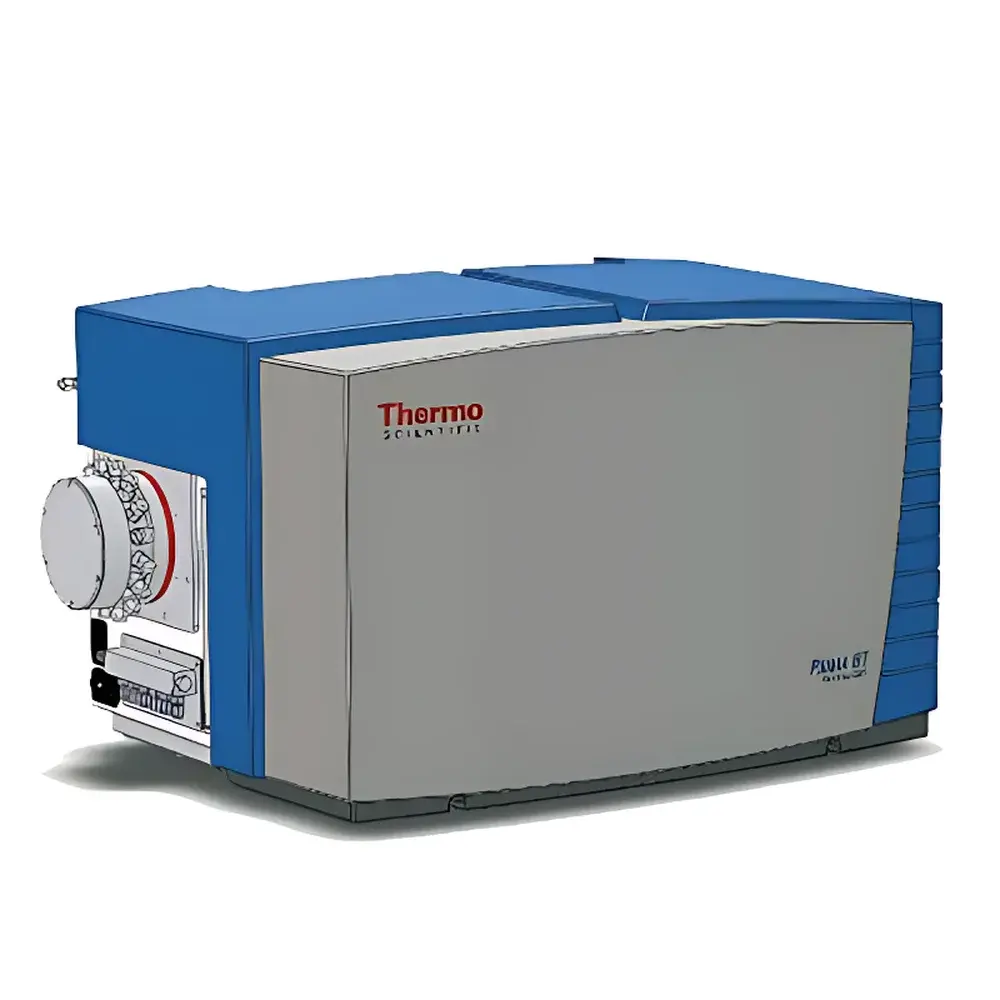
Thermo Scientific Prima BT Process Development Mass Spectrometer
| Brand | Thermo Fisher |
|---|---|
| Origin | USA |
| Manufacturer Type | Authorized Distributor |
| Product Category | Imported Instrument |
| Model | Thermo Scientific Prima BT |
| Pricing | Available Upon Request |
Overview
The Thermo Scientific Prima BT is a high-performance, benchtop process development mass spectrometer engineered for real-time, quantitative gas-phase analysis in laboratory-scale bioprocess environments—including fermentation, cell culture, and upstream/downstream development workflows. It employs sector-field magnetic sector mass spectrometry (MS) based on the fundamental principle of Lorentz force separation: ionized gaseous analytes are accelerated through a fixed electric field and subsequently deflected by a precisely controlled magnetic field; mass-to-charge (m/z) resolution is achieved via angular dispersion of ions with differing m/z ratios along a 80° arc path within a 6 cm radius magnetic sector. This architecture delivers exceptional mass stability (<0.013 amu at m/z 28 over 24 h), flat-top peak profiles (peak-top/peak-base width ratio = 0.5 at resolution 60), and robust reproducibility under variable sample matrix conditions—critical for longitudinal monitoring of metabolic gases (e.g., O₂, CO₂, N₂, NH₃, CH₄, ethanol, methanol) during fed-batch or perfusion bioreactor runs.
Key Features
- Magnetic sector mass analyzer with user-selectable resolution modes (standard 60/20 slits; optional 140/81, 100/45, or 140/45 slit combinations) enabling optimized trade-offs between sensitivity and resolution across the 1–200 amu range.
- Electron impact (EI) ion source with dual filaments, temperature-controlled (120–200 °C ±0.1 °C), and sealed design—minimizing contamination and extending operational lifetime in humid or condensable vapor environments.
- Integrated Rapid Multi-stream Sampler (RMS) supporting up to 15 independent sample streams; stepper-motor-driven, non-rotary, continuous-flow selector with <6 million switching cycles/year reliability and optional 80 °C heated manifold for polar compound transmission (e.g., NH₃, C₂H₅OH).
- Dual detection capability: standard Faraday cup detector for high-precision %-level quantification; optional microchannel plate (MCP) detector for sub-ppm trace gas detection (down to 10 ppb theoretical dynamic range).
- Modular, hot-swappable electronics architecture compliant with RS-485 industrial communication standards; VGiNet internal protocol enables distributed control, secure firmware updates, and synchronized diagnostics without system power-down.
- Freescale-based real-time operating system (RTOS) controller with dedicated motherboard—designed for uninterrupted operation independent of external PC failure; supports concurrent Modbus RTU, OPC DA, and custom serial protocols for DCS/SCADA/LIMS integration.
Sample Compatibility & Compliance
The Prima BT accommodates a broad spectrum of process gases—from inert carrier matrices (N₂, Ar) to reactive, condensable, or corrosive species (NH₃, H₂S, Cl₂, alcohols). Sample introduction operates at ambient pressure (0.1–1.0 L/min, nominal 0.2 L/min), with inlet pressure differential maintained below 100 mbar (1.5 psi) to ensure RMS integrity and flow stability. Its vacuum system combines a turbomolecular pump and external diaphragm or rotary vane backing pump—optimized for long-term stability in non-classified lab spaces with controlled ambient temperature (15–30 °C). The instrument meets applicable electromagnetic compatibility (EMC) requirements per IEC 61326-1 and carries CE marking. While not certified for hazardous area installation (e.g., ATEX/IECEx), its design supports GLP-compliant operation when deployed with audit-trail-enabled GasWorks software and configured for 21 CFR Part 11–compliant data handling.
Software & Data Management
GasWorks™ software serves as the primary configuration, calibration, and visualization interface—deployed remotely via RS-232 or Ethernet. It provides full access to mass calibration, peak integration, background subtraction, and multi-point quantification using internal or external standards. All analytical parameters—including dwell time, scan sequence, ion source temperature, and detector gain—are stored with timestamped metadata. Raw spectral data and processed results are exportable in CSV, XML, or ASTM E1394-compliant formats. Local onboard memory retains full diagnostic logs (vacuum status, filament emission, detector voltage drift, RMS valve actuation history) for root-cause analysis during preventive maintenance. Optional historical data logging enables direct storage of concentration time-series for up to 12 months—accessible via FTP or USB transfer without interrupting acquisition.
Applications
The Prima BT is purpose-built for bioprocess R&D laboratories requiring precise, multiplexed gas analysis where scalability, regulatory readiness, and method transferability are essential. Key use cases include: real-time off-gas profiling in single-use and stainless-steel fermenters; dissolved oxygen and CO₂ kinetics modeling in mammalian cell culture; metabolic flux analysis via isotopic tracer studies (¹³C, ¹⁵N); headspace monitoring of lyophilization cycles; validation of gas blending systems in bioreactor control strategies; and QC release testing of sterile gas manifolds. Its ability to resolve isobaric interferences (e.g., N₂⁺ vs. CO⁺ at m/z 28) and quantify low-abundance metabolites (e.g., acetate, butyrate fragments) makes it particularly valuable in synthetic biology and continuous manufacturing process characterization.
FAQ
What is the maximum number of sample streams the Prima BT can monitor simultaneously?
Up to 15 independent sample points via the integrated Rapid Multi-stream Sampler (RMS), with fully programmable dwell time per stream.
Does the Prima BT require carrier gas or calibration gas cylinders for routine operation?
No carrier gas is needed—the instrument analyzes samples directly from process lines. Calibration gases are required only during initial setup or periodic verification; automated calibration routines support multi-point bracketing with internal reference masses.
Can the Prima BT be integrated into a DeltaV or Emerson DCS environment?
Yes—via native Modbus RTU/ASCII or OPC DA drivers; all analog and digital I/O signals (including alarm outputs and stream selection status) are configurable through the onboard 15-pin D-sub interface.
What maintenance intervals are recommended for the ion source and vacuum system?
Ion source replacement is recommended every 3 years using the optional Service Kit (“Toolbox”); secondary vacuum pump maintenance frequency depends on duty cycle and gas composition—typically every 6–12 months with <5 minutes per intervention.
Is remote diagnostics and firmware update supported?
Yes—through VGiNet’s embedded network layer and GasWorks’ secure remote session capability; firmware updates preserve all user-defined methods and calibration tables.
Related Products