
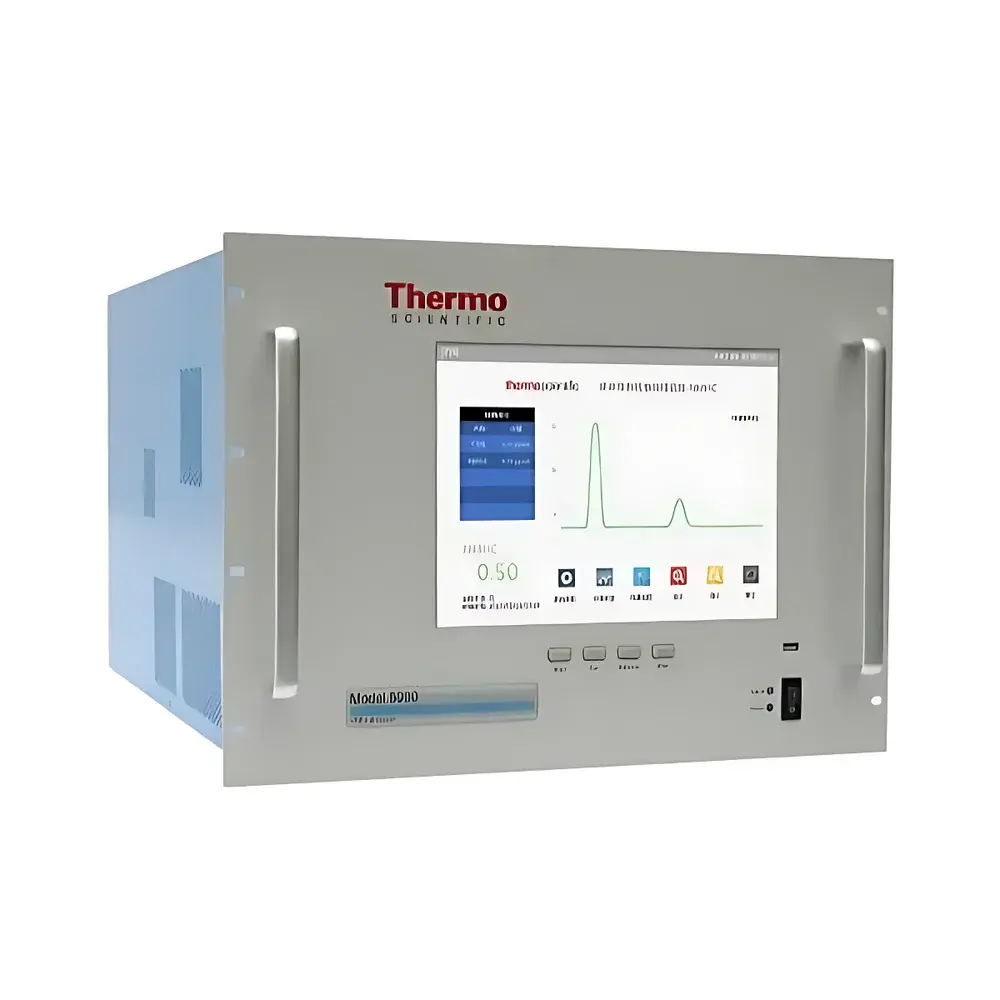
Thermo Scientific 5900-A Total Hydrocarbons, Methane & Non-Methane Hydrocarbons Online Analyzer
| Brand | Thermo Fisher |
|---|---|
| Origin | USA |
| Model | 5900-A |
| Detection Principle | Gas Chromatography with Flame Ionization Detection (GC-FID) |
| Detection Limit | ≤30 ppb (as methane) |
| Compliance | ASTM D6348, EPA Method 25A, HJ 1012-2018, HJ 38-2017 |
| Installation Form | 19-inch rack-mountable chassis |
| Control System | Integrated EPC (Electronic Pressure Control) for carrier gas and sample flow |
| Data Output | Modbus TCP, RS-232/485, Analog 4–20 mA |
| Software | Thermo Scientific Chromeleon™ CDS (with 21 CFR Part 11 compliance option) |
| Operating Environment | 5–40 °C, <90% RH non-condensing |
| Power Supply | 100–240 VAC, 50/60 Hz |
Overview
The Thermo Scientific™ 5900-A Total Hydrocarbons, Methane & Non-Methane Hydrocarbons Online Analyzer is a fully automated, laboratory-grade gas chromatographic system engineered for unattended, continuous monitoring of ambient air and industrial stack emissions. It employs dual-column GC-FID architecture—separating methane on a dedicated PLOT Al₂O₃/KCl column while directing total hydrocarbons (THC) to a high-temperature capillary column—to enable simultaneous, orthogonal quantification of methane (CH₄), total hydrocarbons (THC), and non-methane hydrocarbons (NMHC = THC − CH₄). The instrument operates on the principle of flame ionization detection, where organic compounds eluting from the columns are pyrolyzed in a hydrogen–air flame, generating ions proportional to carbon mass. This provides inherent linearity across six orders of magnitude and robust response to volatile and semi-volatile hydrocarbons (C₁–C₁₂). Designed for regulatory-grade environmental compliance, the 5900-A meets performance criteria defined in U.S. EPA Method 25A, ASTM D6348, and Chinese standard HJ 38-2017 for fixed-source and ambient air NMHC monitoring.
Key Features
- Dual-channel GC-FID configuration with independent temperature-controlled ovens for methane and THC columns, ensuring retention time stability and chromatographic resolution under variable ambient conditions.
- Integrated high-efficiency particulate filter and moisture trap upstream of the sampling loop, minimizing maintenance intervals and protecting column integrity in high-dust or humid environments.
- Automated back-flush functionality eliminates high-boiling interferences (e.g., C₈+ aromatics, terpenes) after each analysis cycle, reducing cycle time to ≤3.5 minutes and preventing column contamination.
- Full-stream electronic pressure control (EPC) with real-time feedback loops for carrier gas (N₂ or He), detector gases (H₂, air), and sample flow—achieving ±0.01 psi pressure stability and enabling method reproducibility across installations.
- Self-diagnostic firmware with remote access capability via Ethernet; supports predictive maintenance alerts based on valve actuation count, FID baseline drift, and column head pressure trends.
- Rack-mountable 19-inch chassis (4U height) with front-accessible consumables (FID jet, ignition electrode, filters) and rear-panel I/O for seamless integration into existing CEMS or SCADA architectures.
Sample Compatibility & Compliance
The 5900-A accepts gaseous samples ranging from ambient air (0–100% relative humidity, particulate load <1 mg/m³) to diluted stack effluents (dilution ratio up to 1:100). It is validated for use with certified reference gas mixtures traceable to NIST SRMs. Regulatory compliance includes full alignment with U.S. EPA Performance Specification 8 (PS-8) for NMHC analyzers, EU EN 15267-3 for automated measuring systems, and China’s HJ 1012-2018 technical specification for online NMHC monitoring equipment. When configured with optional audit trail logging and user role management, the system satisfies data integrity requirements under FDA 21 CFR Part 11 and GLP/GMP environments.
Software & Data Management
Chromeleon™ Chromatography Data System (CDS) v7.3 or later serves as the embedded and remote software platform. It delivers real-time chromatogram visualization, automatic peak integration using ASTM-compliant algorithms, and NMHC calculation per ISO 8573-5:2010 methodology. All raw data—including detector voltage traces, valve timing logs, pressure sensor readings, and calibration history—are stored in ACID-compliant SQLite databases with configurable retention policies. Audit trails record every user action (method edit, calibration run, report export) with timestamp, operator ID, and IP address. Data export formats include CSV, PDF analytical reports, and XML compliant with China’s EPMS (Environmental Protection Monitoring System) data interface standards.
Applications
- Continuous emission monitoring (CEM) at petrochemical refineries, chemical manufacturing plants, and landfill gas collection facilities.
- Ambient air quality networks requiring NMHC speciation for ozone precursor assessment per EPA’s Photochemical Assessment Monitoring Stations (PAMS) protocol.
- Indoor air quality surveillance in semiconductor cleanrooms and pharmaceutical production suites where hydrocarbon contamination must be tracked below 50 ppb.
- Research applications involving VOC reactivity studies, atmospheric chemistry modeling, and catalyst efficiency evaluation in oxidation reactors.
- Regulatory compliance reporting for local environmental agencies under Tier II reporting, Title V permits, or China’s “Blue Sky Defense Campaign” enforcement mandates.
FAQ
What is the minimum detectable concentration for methane using the 5900-A?
The instrument achieves a method detection limit (MDL) of ≤30 ppb (as methane) under standard operating conditions (100 mL sample loop, 30-minute averaging), verified per EPA 40 CFR Part 136 guidelines.
Can the 5900-A operate without external calibration gas sources?
No. Continuous operation requires periodic calibration with certified methane-in-air and propane-in-air standards. Optional integrated dynamic dilution calibrators (e.g., Thermo Scientific 1110 Series) support automated multi-point calibration without manual cylinder changes.
Is the system compatible with third-party data acquisition platforms?
Yes. Native Modbus TCP and ASCII-based RS-232/485 protocols enable direct integration with Siemens Desigo, Honeywell Experion, or Schneider EcoStruxure systems without middleware.
How often does the FID require maintenance?
Under typical ambient air monitoring conditions, FID cleaning and electrode replacement are recommended every 6 months; extended intervals (up to 12 months) are achievable with low-humidity, low-particulate sampling environments.
Does the 5900-A support remote firmware updates?
Yes. Secure HTTPS-based firmware updates can be deployed over the instrument’s Ethernet interface, with version rollback capability and SHA-256 signature verification to ensure integrity.
Related Products







