
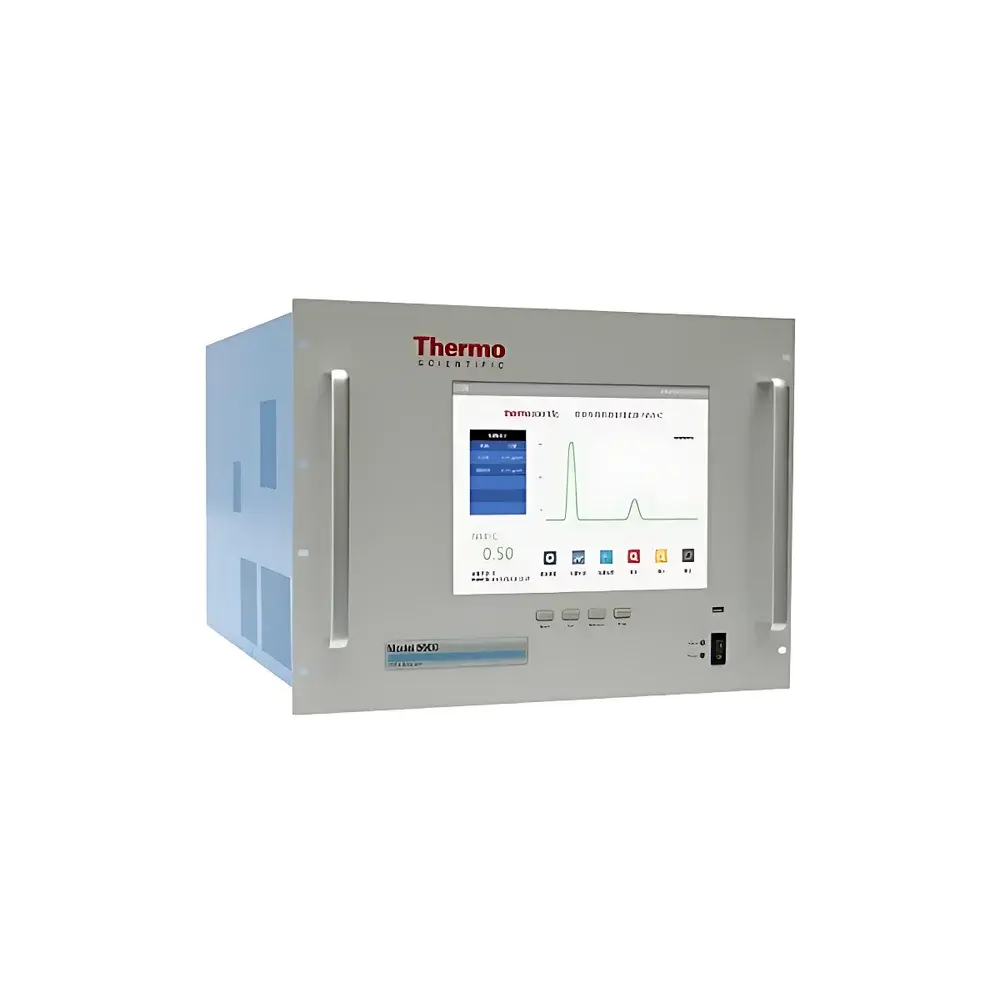
Thermo Scientific 5900-A Total Hydrocarbons, Methane and Non-Methane Hydrocarbons Online Analyzer
| Brand | Thermo Fisher |
|---|---|
| Origin | USA |
| Manufacturer | Thermo Fisher Scientific |
| Product Type | Imported |
| Model | 5900-A |
| Pricing | Available Upon Request |
Overview
The Thermo Scientific™ 5900-A Total Hydrocarbons, Methane and Non-Methane Hydrocarbons Online Analyzer is a laboratory-grade, continuous-emission monitoring system engineered for unattended, real-time quantification of hydrocarbon species in ambient air and stack gas applications. Built upon proven gas chromatography with flame ionization detection (GC-FID) architecture, the instrument delivers regulatory-grade measurement performance for total hydrocarbons (THC), methane (CH₄), and non-methane hydrocarbons (NMHC) — calculated as the arithmetic difference between THC and CH₄ concentrations. The system operates on a dual-column GC configuration: one dedicated to methane separation using a methanizer-optimized packed or capillary column, and another for total hydrocarbon elution. Both effluents are directed to high-stability, low-noise FID detectors calibrated traceably to NIST-certified standards. With a detection limit of ≤30 ppb (as methane carbon equivalent), the 5900-A meets the sensitivity requirements of U.S. EPA Method 25A, EN 12619, and ISO 8573-5 for continuous hydrocarbon monitoring in environmental and industrial compliance settings.
Key Features
- Dual-channel GC-FID architecture with independent temperature-controlled ovens for methane and total hydrocarbon columns, enabling simultaneous yet selective detection
- Integrated sample introduction system featuring a corrosion-resistant diaphragm sampling pump, particulate filter, moisture trap, and programmable 1-mL quantitative loop
- High-precision electronic pressure control (EPC) across the entire gas path — including carrier, make-up, and hydrogen/air flows — ensuring long-term retention time stability (<0.02 min RSD) and peak area reproducibility (<1.5% RSD)
- Automated backflush function to eliminate high-boiling interferences (e.g., C₈+ aliphatics, aromatics) and reduce cycle time to ≤3.5 minutes per analysis
- Thermostatically controlled multi-port switching valves with heated zones (up to 180 °C) to prevent condensation and carryover of semi-volatile compounds
- Self-diagnostic firmware with remote access capability via Ethernet; supports Modbus TCP and OPC UA protocols for integration into SCADA and EMS platforms
Sample Compatibility & Compliance
The 5900-A accepts gaseous samples within a pressure range of −5 to +5 kPa(g) and a temperature range of 0–45 °C. It is compatible with ambient air, ducted flue gas (diluted or undiluted), and process vent streams containing up to 5% CO₂ and <10 ppm H₂S. All wetted materials comply with ASTM B117 salt-spray resistance specifications, and the analyzer enclosure meets IP54 ingress protection rating. Regulatory alignment includes full conformance with U.S. EPA Performance Specification 8 (PS-8) for THC/NMHC analyzers, EU Directive 2010/75/EU (IED), and China’s HJ 1012-2018 standard for online NMHC monitoring. Data integrity safeguards satisfy FDA 21 CFR Part 11 requirements through audit-trail-enabled software with role-based user authentication and electronic signature support.
Software & Data Management
The instrument runs Thermo Scientific™ ChromaTOF™-EM software — a validated, Windows-based platform designed for environmental monitoring compliance. It provides real-time chromatogram visualization, automated peak integration using retention time locking (RTL), and configurable reporting templates aligned with local regulatory formats (e.g., EPA Form R, UK EA XML, CNEMC CSV). Raw data files are stored in vendor-neutral .CDF format compliant with ASTM E1947 and ISO/IEC 17025 archival requirements. Scheduled calibration checks (single-point and multi-point), drift verification, and zero/span validation logs are automatically timestamped and exportable. Remote firmware updates and diagnostic logs can be scheduled during off-peak hours without interrupting data acquisition.
Applications
- Continuous emissions monitoring (CEMS) at municipal wastewater treatment plants, landfills, and biogas upgrading facilities
- Ambient air quality networks measuring NMHC as ozone precursors under national air toxics programs
- Industrial fenceline monitoring per U.S. EPA OTM-33A and EU BREF guidelines for petrochemical, refining, and coating operations
- Research-grade hydrocarbon speciation studies requiring sub-ppb repeatability over extended deployment periods (>6 months)
- Validation of catalytic oxidizer efficiency and fugitive emission quantification in LDAR programs
FAQ
What regulatory methods does the 5900-A support?
The analyzer is configured to meet U.S. EPA Method 25A, PS-8, EN 12619, ISO 8573-5, and HJ 1012-2018, with optional configuration for ASTM D6420.
Can the 5900-A operate without external calibration gas sources?
No — it requires certified methane-in-air and propane-in-air standards for daily zero/span verification and multi-point calibration; dynamic dilution systems (e.g., Thermo Scientific 1110 Dynamic Calibrator) are recommended for automated calibration routines.
Is the system suitable for high-humidity or corrosive sample matrices?
Yes — when paired with Thermo Scientific’s optional Nafion™ dryer and stainless-steel particulate filtration module, the 5900-A maintains accuracy in relative humidity up to 95% RH and H₂S concentrations below 10 ppm.
How is data security and audit readiness ensured?
ChromaTOF-EM enforces ALCOA+ principles: attributable, legible, contemporaneous, original, accurate, complete, consistent, enduring, and available — with full electronic audit trail, locked historical records, and 21 CFR Part 11-compliant e-signature workflows.
What maintenance intervals are recommended for routine operation?
FID jet cleaning every 90 days, detector ceramic insulator inspection every 180 days, and EPC sensor recalibration annually — all tracked via built-in maintenance scheduler with email alerts.
Related Products







