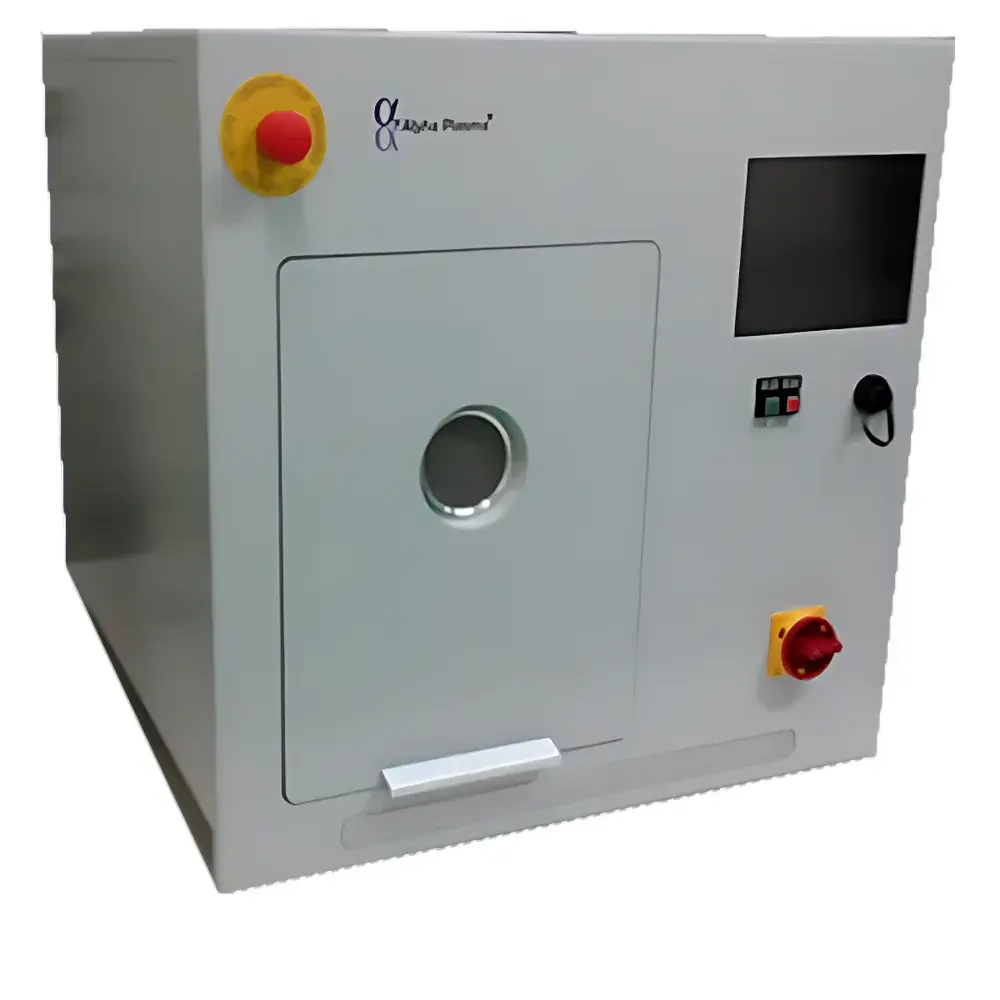
Alpha Plasma Q240 Microwave Plasma Resist Stripper
| Brand | Alpha Plasma |
|---|---|
| Origin | Germany |
| Model | Q240 |
| Plasma Source | 2.45 GHz, 1200 W |
| Chamber | Quartz, Ø240 mm × 460 mm (21 L), accommodates up to 200 mm wafers |
| Dimensions (L×W×H) | 760 × 775 × 775 mm |
| Gas Lines | 3 standard + optional 4th line |
| Mass Flow Controllers | Digital MKS |
| Vacuum Door | Drawer-type with UV/microwave-shielded viewport |
| Wafer Chuck | Temperature-controlled |
| HMI | 10.4" touchscreen, Windows CE OS |
Overview
The Alpha Plasma Q240 is a high-reliability, 2.45 GHz microwave-driven plasma resist stripper engineered for precision photoresist removal in semiconductor fabrication, MEMS development, and advanced microfabrication laboratories. Unlike capacitive RF plasma systems, the Q240 employs a waveguide-coupled microwave source operating at the industrial ISM frequency band, generating high-density, low-damage plasma with minimal ion energy spread—critical for preserving underlying device layers during post-lithography or pre-etch cleaning. Its quartz chamber (Ø240 mm × 460 mm, 21 L volume) supports batch processing of up to 25 × 200 mm (8-inch) wafers or equivalent substrate carriers, making it equally suitable for high-throughput production environments and flexible R&D workflows requiring process repeatability across multiple chemistries. The system operates under controlled vacuum conditions (base pressure <5 × 10⁻³ mbar), with real-time pressure regulation integrated into the gas delivery architecture.
Key Features
- Microwave plasma generation at 2.45 GHz with 1200 W nominal power output, enabling stable, uniform plasma ignition and sustained operation without electrode erosion or contamination.
- Quartz process chamber with optimized geometry for homogeneous plasma distribution and minimal standing-wave interference—validated via Langmuir probe mapping across wafer plane.
- Temperature-regulated electrostatic chuck (ESC) with ±1 °C thermal stability, supporting process-sensitive substrates including low-k dielectrics and polymer-based MEMS structures.
- Three independent digital MKS mass flow controllers (MFCs) with NIST-traceable calibration; optional fourth gas line available for complex chemistries (e.g., O₂/CF₄/N₂ blends).
- Drawer-style vacuum door with dual-layer fused silica viewport featuring integrated UV-blocking coating and Faraday cage shielding—compliant with IEC 61000-4-3 for electromagnetic compatibility.
- 10.4-inch industrial-grade touchscreen HMI running Windows CE 6.0 with deterministic real-time response, supporting recipe-based operation, parameter logging, and user-level access control.
Sample Compatibility & Compliance
The Q240 is validated for removal of conventional positive/negative photoresists (e.g., AZ series, Shipley S18xx), thick-film SU-8 epoxy resins, and sacrificial polymers used in surface-micromachining processes. It accommodates silicon, SiC, GaN, glass, quartz, and metal-coated wafers up to 200 mm diameter, as well as ceramic and polymer substrates in carrier trays. System design conforms to SEMI S2-0215 (safety) and SEMI E10-0715 (equipment reliability); vacuum components meet ISO 2859-1 sampling standards. Optional dry pump package includes oil-free scroll technology compliant with ISO 8573-1 Class 0 air purity requirements. All electrical interfaces comply with UL 61010-1 and CE Machinery Directive 2006/42/EC.
Software & Data Management
The embedded control software provides full audit trail functionality—including operator ID, timestamped parameter changes, gas flow setpoints, power ramp profiles, and chamber pressure logs—structured to support GLP/GMP documentation requirements. Data export is supported via USB 2.0 and Ethernet (TCP/IP), with CSV-compatible output for integration into MES platforms such as Camstar or FactoryTalk. Optional OPC UA server module enables secure, standardized communication with SCADA and factory automation systems. Firmware updates are performed offline via signed packages to ensure integrity and traceability per FDA 21 CFR Part 11 Annex 11 guidelines.
Applications
- Post-lithography photoresist stripping prior to etch or deposition steps in CMOS, MEMS, and compound semiconductor processes.
- Clean removal of SU-8 and other epoxy-based resists after UV lithography—minimizing carbon residue and sidewall scorching.
- Sacrificial layer release in surface-micromachined devices (e.g., accelerometers, RF switches), where selective etch rates and low substrate heating are essential.
- Surface activation and descum prior to thin-film deposition (ALD, PVD, CVD) to improve adhesion and nucleation uniformity.
- Residue-free cleaning of stencil masks, reticles, and metrology reference samples without mechanical abrasion or solvent exposure.
FAQ
What wafer sizes does the Q240 support?
The system is configured for 200 mm (8-inch) wafers as standard; custom chucks and carrier fixtures are available for 100 mm, 150 mm, and non-circular substrates.
Is the Q240 compatible with oxygen-free chemistries such as CF₄ or SF₆?
Yes—its gas delivery architecture supports corrosive and inert gases; optional stainless-steel wetted parts and fluoropolymer seals are available for extended service life with halogenated chemistries.
Can process recipes be exported and shared between multiple Q240 units?
All recipes are stored in encrypted XML format and can be transferred via USB drive; version-controlled recipe libraries are supported through optional centralized management software.
Does the system include validation documentation for GMP environments?
Factory-installed IQ/OQ protocols are provided; PQ support documentation and URS templates are available upon request for regulated pharmaceutical or medical device manufacturing applications.
What maintenance intervals are recommended for the microwave generator and vacuum system?
Microwave waveguide and magnetron require inspection every 2,000 operational hours; dry pump maintenance is scheduled every 500 hours or per manufacturer’s lubrication log—both tracked automatically in the system event log.