
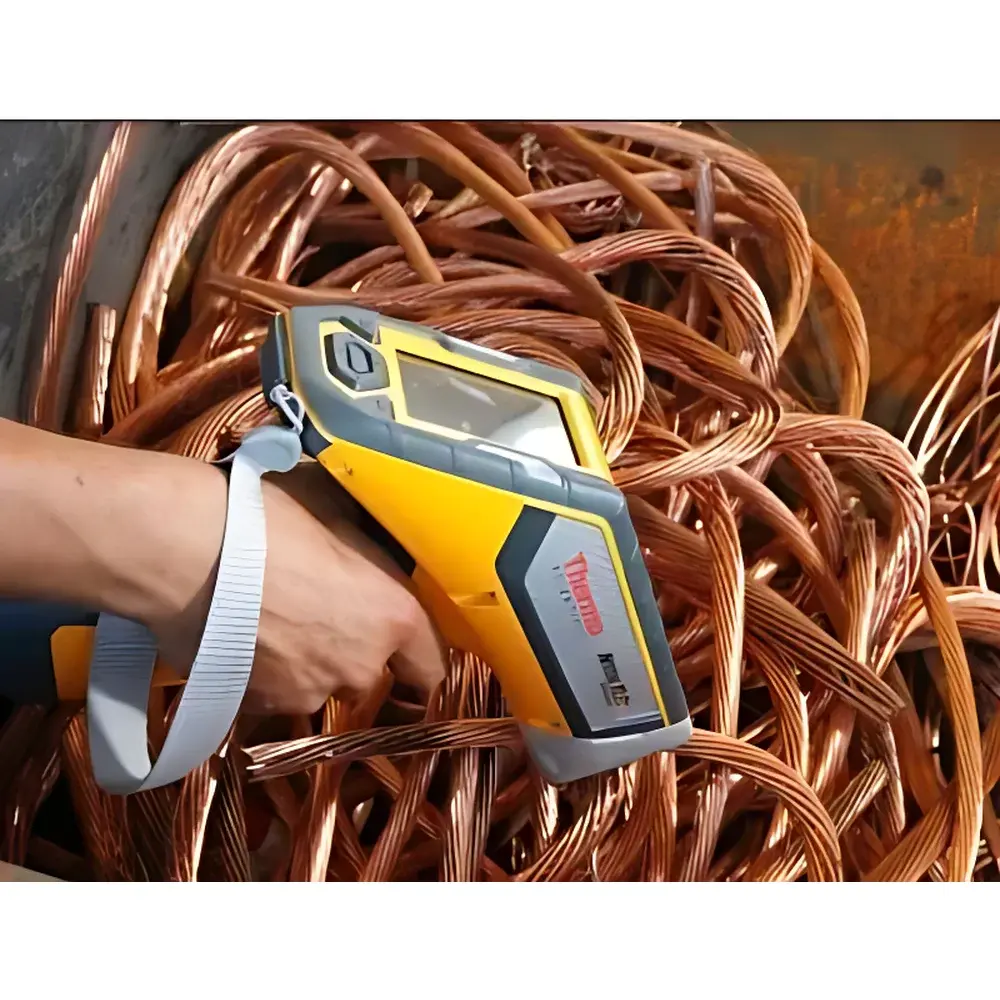
Thermo Scientific Niton XL5 Plus Portable Energy Dispersive X-Ray Fluorescence (ED-XRF) Spectrometer
| Origin | USA |
|---|---|
| Manufacturer Type | Authorized Distributor |
| Origin Category | Imported |
| Model | Niton XL5 Plus |
| Price Range | USD 42,000 – 70,000 |
| Form Factor | Handheld / Portable |
| Regulatory Compliance | ASTM E1621, ISO 13322-2, IEC 62596, RoHS/WEEE Directive Annex II, CPSIA Section 101, EN 71-3, EU REACH SVHC Screening |
Overview
The Thermo Scientific Niton XL5 Plus is a field-deployable, battery-powered Energy Dispersive X-Ray Fluorescence (ED-XRF) spectrometer engineered for rapid, non-destructive elemental analysis of solid, powdered, and coated samples in situ. Operating on the fundamental principle of X-ray fluorescence—where primary X-rays excite inner-shell electrons in sample atoms, inducing characteristic secondary (fluorescent) X-ray emission—the instrument quantifies elemental composition by measuring energy spectra of emitted photons using a high-performance silicon drift detector (SDD). Its optimized X-ray tube (Ag anode, 50 kV max), real-time spectrum processing engine, and integrated GPS/geotagging module enable trace-level detection (ppm to % w/w) across the Mg–U range under ambient conditions without vacuum or helium purge. Designed for regulatory enforcement, industrial QA/QC, and exploratory field science, the XL5 Plus meets the operational rigor required by customs laboratories, environmental agencies, and OEM supply chain auditors conducting on-site compliance screening per CPSIA, RoHS, WEEE, EN 71-3, and EU REACH mandates.
Key Features
- Ruggedized IP54-rated magnesium alloy housing with shock-absorbing polymer overmold, certified to MIL-STD-810G for drop resistance (1.5 m onto concrete)
- Integrated 5-megapixel autofocus camera with LED ring illumination for precise sample positioning and automated image-based report annotation
- Real-time spectral deconvolution using proprietary FP+ (Fundamental Parameters Plus) algorithm with matrix correction for heterogeneous or irregular surfaces
- Battery life of ≥12 hours (dual hot-swappable Li-ion packs), supporting continuous operation during multi-site inspections or extended survey campaigns
- Onboard data encryption (AES-256), user role-based access control (up to 10 permission tiers), and audit-trail logging compliant with FDA 21 CFR Part 11 requirements
- Pre-loaded method libraries for >30 industry-specific applications—including alloy grade identification (ASTM E529), soil heavy metal screening (EPA Method 6200), consumer product lead/cadmium verification (CPSC-CH-E1001), and solder alloy halogen screening (IEC 61249-2-21)
Sample Compatibility & Compliance
The XL5 Plus accommodates flat, curved, rough, or painted surfaces up to 20 mm in thickness without sample preparation. It supports direct analysis of metals, polymers, ceramics, soils, ores, electronic components, and coated substrates—including galvanized steel, anodized aluminum, and multi-layer PCBs. All factory calibration standards are traceable to NIST SRMs (e.g., NIST 2782, 2783, 2784) and verified annually per ISO/IEC 17025-accredited procedures. The instrument’s measurement uncertainty profile adheres to ASTM E1621 (Standard Test Method for Determining Elements in Waste Streams by Wavelength Dispersive XRF) and ISO 13322-2 (Particle Size Analysis — Image Analysis Methods — Part 2: Dynamic Image Analysis), with documented repeatability (RSD ≤ 2.5% for Fe in stainless steel at 10 s count time) and long-term stability (<0.5% drift over 8-hour shift).
Software & Data Management
Niton Connect Cloud software provides secure, browser-based instrument fleet management, remote firmware updates, and centralized report generation with customizable templates (PDF, CSV, XML). Raw spectral data, acquisition metadata (GPS coordinates, operator ID, timestamp, environmental sensor readings), and QA/QC logs are stored in encrypted SQLite databases with automatic backup to on-premise or AWS S3 endpoints. Audit trails record all parameter modifications, calibration events, and user logins—fully exportable for GLP/GMP internal audits or regulatory submissions. Optional integration with LIMS platforms (e.g., LabWare, STARLIMS) via HL7 or RESTful API ensures seamless workflow alignment with enterprise laboratory informatics infrastructure.
Applications
- Regulatory enforcement: Screening for restricted substances (Pb, Cd, Hg, Cr⁶⁺, Br, Cl) in children’s products, electronics, packaging, and toys per CPSIA, RoHS, and EN 71-3
- Scrap metal sorting: Real-time identification of stainless steel grades (304 vs. 316), titanium alloys (Ti-6Al-4V), and superalloys (Inconel 718) in recycling facilities
- Environmental site assessment: In-field mapping of As, Pb, and Cd contamination in soils and sediments prior to remediation planning
- Manufacturing QA: Verification of plating thickness and composition (e.g., Ni/Cu/Zn coatings on automotive fasteners) and raw material lot acceptance testing
- Geological prospecting: Semi-quantitative assay of base metals (Cu, Zn, Pb), precious metals (Au, Ag), and pathfinder elements (As, Sb, Bi) in drill core and outcrop samples
FAQ
Is the Niton XL5 Plus certified for use in regulated environments such as CPSC or EU customs labs?
Yes—it is listed on the U.S. CPSC’s Approved Equipment List and has been formally validated by EU PROSAFE for border control screening under Decision 2009/715/EC.
Does the instrument require annual recalibration to maintain compliance?
While factory calibration remains stable for 12 months under normal use, ISO/IEC 17025-accredited laboratories must perform quarterly performance verification using check standards traceable to NIST SRMs.
Can the XL5 Plus quantify light elements such as magnesium or aluminum in air?
It detects Mg (Z=12) and Al (Z=13) reliably in vacuum or helium-purged mode; in air, detection limits rise to ~1,000 ppm for Mg and ~500 ppm for Al due to atmospheric absorption.
How does the device ensure data integrity during offline field operations?
All measurements are timestamped, geotagged, and cryptographically signed locally; data syncs automatically upon Wi-Fi or cellular reconnection, with version-controlled conflict resolution.
Is training and method development support included with purchase?
Thermo Fisher provides onsite application specialist training (2-day standard), custom method development services, and access to the global Niton User Community portal with validated SOPs and troubleshooting guides.




