
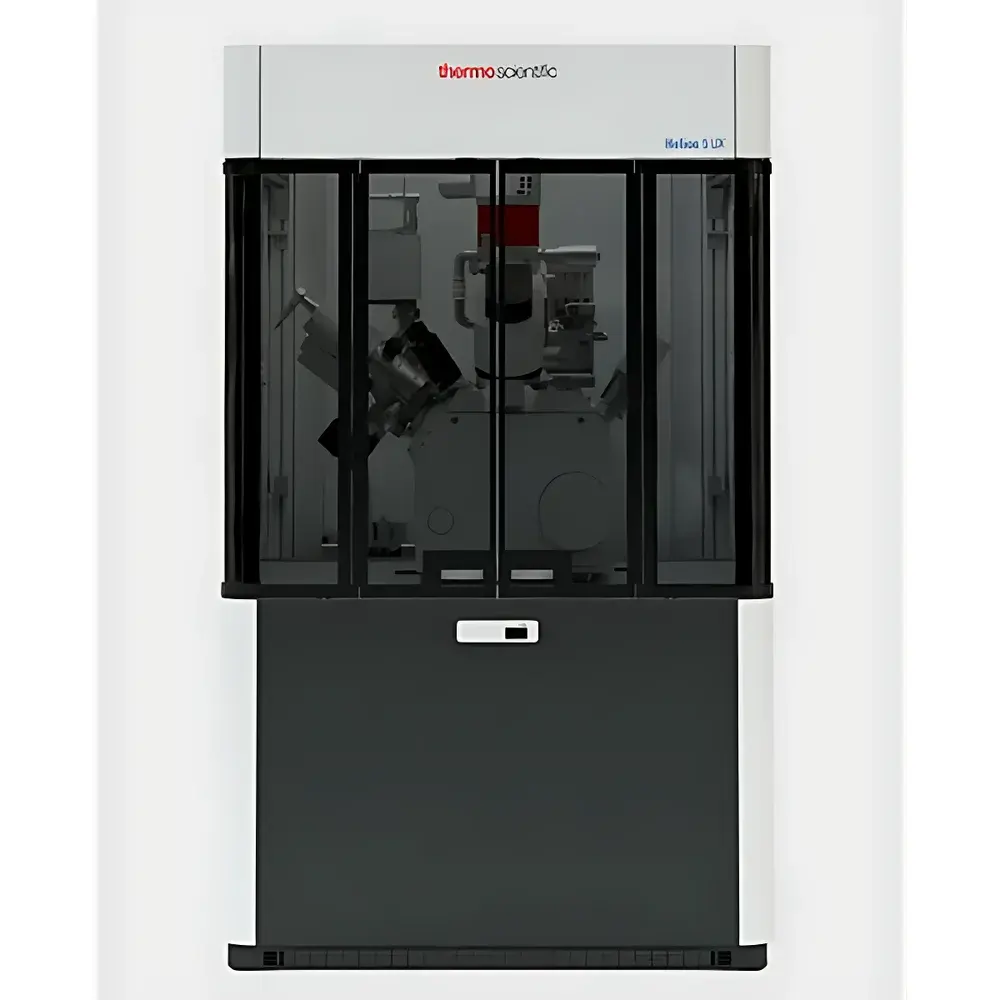
Thermo Fisher Scientific Helios 5 DualBeam Focused Ion Beam–Scanning Electron Microscope (FIB-SEM)
| Brand | Thermo Fisher Scientific |
|---|---|
| Origin | Shanghai, China |
| Manufacturer Type | Authorized Distributor |
| Product Category | Domestic (China-manufactured) |
| Model | Helios 5 DualBeam FIB-SEM |
| Pricing | Upon Request |
Overview
The Thermo Fisher Scientific Helios 5 DualBeam FIB-SEM is a high-performance, integrated dual-beam platform engineered for nanoscale imaging, precise site-specific milling, and advanced 3D structural characterization. Combining a field-emission scanning electron microscope (FE-SEM) with a gallium liquid-metal ion source (LMIS) focused ion beam (FIB), the system operates on the principle of simultaneous or sequential electron imaging and ion-induced sputtering—enabling real-time observation of ion-milling progress, cross-sectioning, TEM lamella preparation, and atom probe tomography (APT) specimen fabrication. Its Elstar electron column delivers sub-nanometer resolution at low kV (<1 keV) with high material contrast, while the Tomahawk or Phoenix ion columns provide high-current, low-voltage FIB capabilities essential for damage-minimized sample preparation. Designed for materials science, semiconductor metrology, geoscience, and life science applications, the Helios 5 DualBeam supports rigorous scientific workflows requiring traceable, reproducible, and GLP-compliant data acquisition.
Key Features
- Elstar electron optical column with UC+ monochromator: Enables sub-0.7 nm resolution at 1 kV and enhanced signal-to-noise ratio for low-voltage, charge-free imaging of insulating or beam-sensitive materials.
- Tomahawk or Phoenix FIB columns: Deliver high-current (up to 65 nA) Ga⁺ beam with variable landing energy (0.5–30 keV), optimized for rapid milling, high-fidelity TEM lamella thinning, and APT tip sharpening.
- FLASH (Fast Low-dose Acquisition and Smart Handling) technology: Automates beam alignment, stigmation, and focus via intuitive on-screen gestures—reducing setup time from minutes to seconds without user intervention.
- SmartAlign automation suite: Integrates real-time feedback from multiple detectors to dynamically optimize electron and ion beam parameters during acquisition or milling—ensuring consistent image quality across operator skill levels.
- Piezo-driven 150-mm stage with <10 nm positional repeatability: Supports high-precision navigation, multi-site serial sectioning, and correlation between SEM/FIB/EDS/EBSD modalities.
- Nav-Cam in-chamber optical camera: Provides macro-scale sample context and enables fast coarse-to-fine navigation—critical for targeting regions of interest (ROIs) in heterogeneous or large-area specimens.
- Integrated detector architecture: Includes in-lens SE, BSE, STEM, and Everhart-Thornley detectors—plus optional backscattered electron (BSE) segmentation and time-of-flight secondary ion mass spectrometry (ToF-SIMS) interfaces.
Sample Compatibility & Compliance
The Helios 5 DualBeam accommodates a broad range of conductive, semi-conductive, and non-conductive samples—including bulk metals, ceramics, polymers, geological thin sections, biological tissues (cryo- or resin-embedded), and semiconductor wafers up to 200 mm diameter. Conductive coating (e.g., carbon or platinum sputtering) is optional for insulators. The system complies with IEC 61000-6-3 (EMC emissions), ISO 14644-1 Class 5 cleanroom requirements for chamber integrity, and supports audit-ready operation under GLP and GMP frameworks. Optional 21 CFR Part 11-compliant software modules (via AutoTEM 5 and AS&V4) provide electronic signatures, audit trails, and secure user access controls—meeting regulatory expectations for pharmaceutical and medical device development labs.
Software & Data Management
Control and analysis are unified through Thermo Scientific Connect Software—a modular, Windows-based platform supporting instrument control, automated scripting (Python API), and metadata-rich data export (TIFF, HDF5, EMDB-compatible formats). AutoTEM 5 enables fully automated, multi-location TEM lamella preparation with endpoint detection via real-time BSE monitoring and thickness mapping. Auto Slice & View 4 (AS&V4) provides robust 3D reconstruction workflows—including fiducial-free registration, drift-corrected tilt-series acquisition, and voxel-based segmentation for quantitative porosity, grain boundary, or phase distribution analysis. All software modules support DICOM export for correlative light-electron microscopy (CLEM) integration and are validated per ISO/IEC 17025 calibration traceability requirements.
Applications
- High-throughput TEM specimen preparation for battery cathode particles, catalyst nanoparticles, and metallurgical interphases.
- 3D microstructure reconstruction of additively manufactured alloys, porous fuel cell membranes, and geological pore networks.
- Nanoscale failure analysis in advanced logic and memory devices—including gate oxide defects, Cu interconnect voids, and BEOL trench inspection.
- In situ nanomechanical testing via integrated nanoindenter or heating/stage modules coupled with real-time SEM-FIB imaging.
- APT specimen fabrication with <5 nm tip radius and <1° apex angle tolerance—validated against ISO/IEC 17025 reference standards.
- Correlative multimodal analysis combining EDS elemental mapping, EBSD crystallographic indexing, and cathodoluminescence spectroscopy.
FAQ
What vacuum level does the Helios 5 DualBeam maintain during operation?
The system operates at ultra-high vacuum (UHV) conditions: ≤1×10⁻⁸ mbar in the electron column and ≤5×10⁻⁶ mbar in the main chamber—ensuring optimal beam coherence and minimizing hydrocarbon contamination.
Is cryogenic capability available for beam-sensitive biological samples?
Yes—optional cryo-transfer stages and in-chamber cryo-shielding enable low-temperature (<−140°C) FIB milling and SEM imaging of vitrified biological specimens.
Can the Helios 5 DualBeam be integrated into a centralized lab data management system?
It supports DICOM, LIMS, and OPC UA protocols; raw data and metadata are exportable in standardized formats compatible with Thermo Fisher’s Cloud Connect infrastructure and third-party ELN platforms.
What maintenance intervals are recommended for the Ga⁺ ion source?
The LMIS source is rated for ≥1,500 hours of operation; routine cleaning and alignment are scheduled every 6 months per ISO 13847 preventive maintenance guidelines.
Does the system meet ASTM E1558 and ISO 16700 standards for FIB-SEM dimensional metrology?
Yes—calibration certificates traceable to NIST SRM 2053 are provided; measurement uncertainty budgets comply with both standards for critical dimension (CD) and depth profiling accuracy.




