
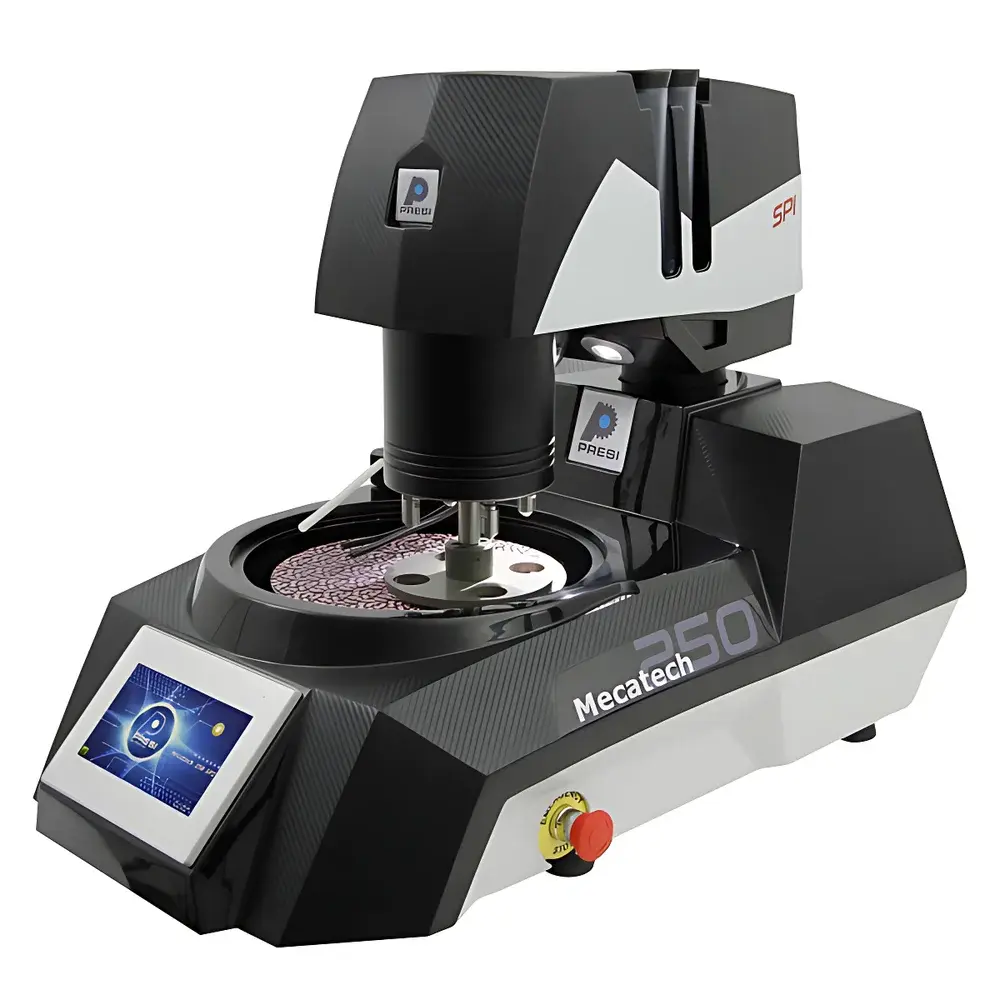
PRESI MECATECH 250 SPI Automated Grinding and Polishing System
| Brand | PRESI |
|---|---|
| Origin | France |
| Model | MECATECH 250 SPI |
| Dimensions (L×W×D) | 665 × 510 × 810 mm |
| Number of Platen Stations | 1 |
| Platen Diameter | 250 mm |
| Rotational Speed Range | 20–700 rpm |
| Motor Power | 750 W |
| Control Interface | 7-inch LCD touchscreen |
| Fluid Delivery | Integrated peristaltic pump with 200 mL dispenser |
| Connectivity | USB + optional Ethernet module |
| Safety Compliance | CE, EN 61000-6-2/6-4, EN ISO 12100 |
Overview
The PRESI MECATECH 250 SPI is a fully automated grinding and polishing system engineered for precision metallographic sample preparation in industrial quality control, R&D laboratories, and accredited testing facilities. It operates on a single-platen, dual-mode architecture—combining controlled rotational motion (20–700 rpm) with programmable directional rotation (clockwise or counterclockwise)—to deliver reproducible surface conditioning across heterogeneous material classes, including hardened steels, tungsten carbides, ceramics, and composite alloys. Its core design adheres to the principles of standardized mechanical material removal: consistent pressure distribution, regulated coolant/lubricant delivery, and kinematically stable sample–platen interaction. The system is not intended for abrasive cutting or sectioning; rather, it serves as the final stage in a multi-step preparation workflow—replacing manual or semi-automated units where inter-operator variability compromises microstructural analysis validity.
Key Features
- Variable-speed AC motor with integrated frequency inverter ensures torque stability across the full speed range (20–700 rpm), critical for maintaining uniform material removal rates on high-hardness specimens (e.g., HRC > 60).
- 7-inch capacitive touchscreen interface enables intuitive configuration of rotational parameters, fluid dispensing schedules, dwell times, and directional logic—all accessible without external software.
- Dual operational modes: “R&D Mode” permits granular adjustment of all process variables (speed, direction, time, fluid volume per cycle); “Program Mode” executes pre-validated methods from an internal database supporting up to 100 material-specific protocols.
- Integrated peristaltic pump drives a 200 mL reagent dispenser with programmable pulse frequency and volume per activation—compatible with aqueous slurries, oil-based lubricants, and colloidal silica suspensions.
- Modular DISTRITECH 5.1 interface support enables traceable, audit-ready liquid handling via external multi-channel dispensers—fully compliant with GLP/GMP documentation requirements.
- Tilted platen base (3° inclination) and elevated main shaft bearing housing prevent fluid ingress into mechanical assemblies; stainless-steel splash ring minimizes cross-contamination between cycles.
- Removable polymer-coated bowl assembly resists chemical corrosion and abrasion—designed for rapid decontamination and long-term dimensional stability under repeated thermal cycling.
- Automatic platen drying function engages post-cycle to centrifugally remove residual fluids from abrasive papers, polishing cloths, and diamond-impregnated discs—extending consumable service life.
- 180° rotating workhead facilitates ergonomic loading of irregular or oversized samples (up to Ø150 mm × 50 mm height) while maintaining concentric alignment relative to the platen centerline.
- Dual-layer safety architecture includes a front-panel emergency stop button, automatic workhead position lock during active operation, and real-time motor current monitoring to detect jamming or overload conditions.
Sample Compatibility & Compliance
The MECATECH 250 SPI accommodates flat, cylindrical, and irregularly shaped metallic and ceramic specimens requiring planarization prior to optical microscopy, SEM imaging, or hardness testing. It supports standard consumables—including silicon carbide papers (P80–P2500), diamond suspension pads (1–6 µm), and woven/non-woven polishing cloths—with no proprietary consumable lock-in. All electrical and mechanical subsystems conform to CE marking directives (2014/30/EU EMC, 2014/35/EU LVD), EN ISO 12100:2018 (risk assessment), and EN 61000-6-2 (immunity) / EN 61000-6-4 (emission). The embedded firmware supports audit trail generation per FDA 21 CFR Part 11 when paired with validated networked data management systems.
Software & Data Management
Method files are stored internally in non-volatile memory and may be imported/exported via USB 2.0 or Ethernet (optional). Each protocol includes metadata fields for operator ID, date/time stamp, revision number, and calibration status. Password-protected hierarchical access (administrator/user/operator tiers) enforces procedural integrity—ensuring only authorized personnel modify master methods. All parameter changes are logged with timestamps and user credentials. Firmware updates are delivered via signed binary packages to prevent unauthorized modification.
Applications
- Quality assurance of heat-treated components in aerospace and automotive supply chains (ASTM E3–22, ISO 13009).
- Failure analysis labs performing root-cause investigation of fatigue cracks, intergranular corrosion, or coating delamination.
- Academic metallurgy departments standardizing specimen preparation across multi-user teaching labs.
- Third-party certification bodies conducting ISO/IEC 17025-accredited hardness or grain size measurements (ASTM E112, ISO 643).
- Foundry process development requiring statistically robust surface finish repeatability across cast iron, aluminum, and nickel-based superalloys.
FAQ
Does the MECATECH 250 SPI support multi-step sequential protocols within a single run?
Yes—up to five discrete steps (e.g., coarse grind → fine grind → rough polish → final polish → dry) can be sequenced with independent speed, time, fluid volume, and directional settings.
Is remote monitoring or integration with LIMS possible?
Via optional Ethernet module and RESTful API (documentation provided under NDA), enabling status polling, method push, and event logging into enterprise laboratory informatics platforms.
What maintenance intervals are recommended for the peristaltic pump tubing?
Tubing replacement is advised every 6 months under continuous use or after 500 operating hours—whichever occurs first—to maintain volumetric accuracy within ±3% tolerance.
Can the system be validated for GxP environments?
Yes—IQ/OQ documentation templates, calibration certificates for rotational speed and timer accuracy, and traceable test reports are supplied with each unit.
Is the touchscreen interface compatible with gloved operation in cleanroom settings?
The capacitive display supports operation with standard nitrile or latex gloves; resistive overlay kits are available for enhanced tactile feedback in ISO Class 5–7 environments.



