
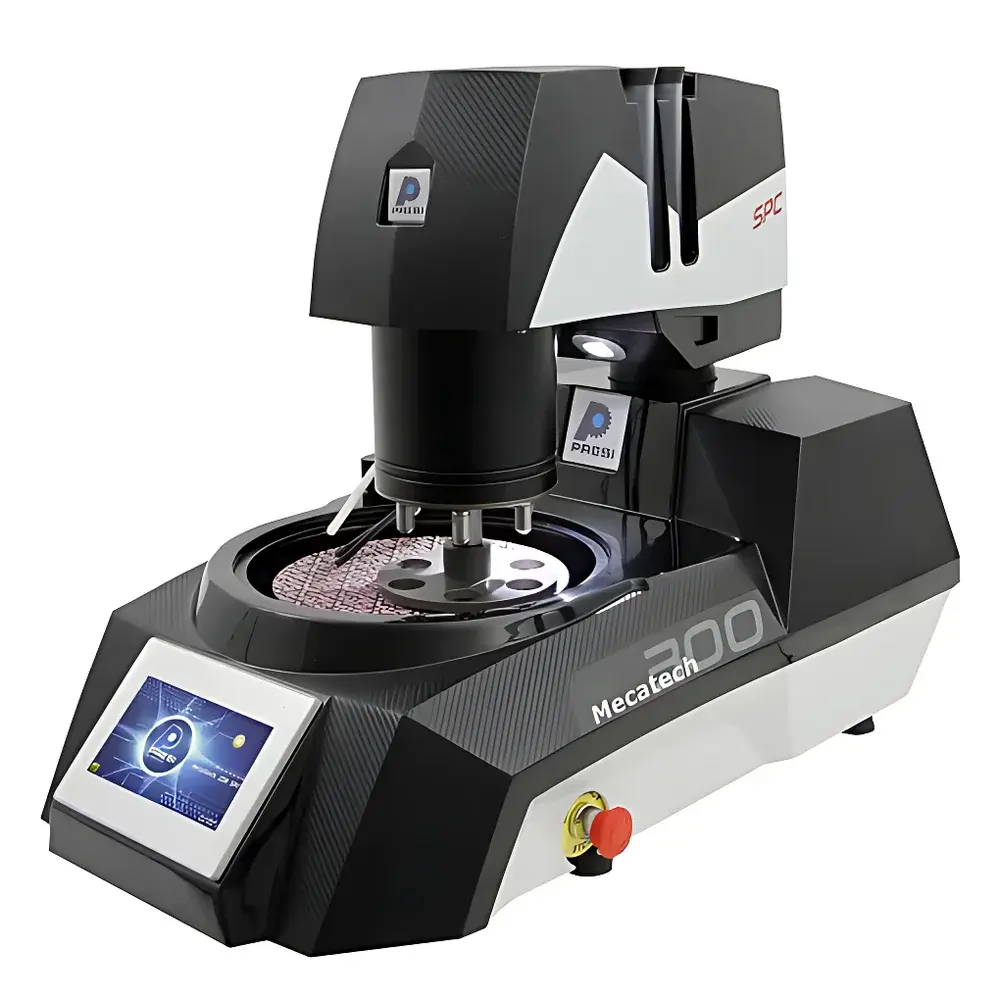
PRESI MECATECH 300 SPC Automated Grinding and Polishing System
| Brand | PRESI |
|---|---|
| Origin | France |
| Model | MECATECH 300 SPC |
| Dimensions (L×W×D) | 665 × 510 × 810 mm |
| Platen Count | 1 |
| Platen Diameter | 250–300 mm |
| Rotational Speed Range | 20–700 rpm |
| Motor Power | 1500 W |
| Control Interface | 7-inch LCD touchscreen |
| Sample Capacity | 6–8 specimens per cycle |
| Fluid Delivery | Integrated peristaltic pump (200 mL dispenser) with programmable dosing |
| Connectivity | USB + optional Ethernet module |
| Safety Compliance | CE, EN 61000-6-2/6-4, EN ISO 12100 |
Overview
The PRESI MECATECH 300 SPC is a fully automated grinding and polishing system engineered for precision metallurgical and materials science sample preparation. Designed according to the principles of controlled mechanical abrasion and surface planarization, it employs a single rotating platen architecture coupled with a motorized, vertically adjustable workhead capable of simultaneous multi-specimen processing. Its core function is to deliver repeatable, artifact-free cross-sectional surfaces—critical for optical microscopy (OM), scanning electron microscopy (SEM), energy-dispersive X-ray spectroscopy (EDS), and hardness testing. The system integrates closed-loop speed regulation via frequency-controlled AC drive, ensuring constant torque delivery across the full 20–700 rpm range—essential for maintaining consistent material removal rates on heterogeneous or high-hardness substrates (e.g., tungsten carbide, ceramic composites, additively manufactured alloys). Unlike manual or semi-automated units, the MECATECH 300 SPC eliminates operator-dependent variability through programmable force application, timed fluid dispensing, and synchronized head rotation—enabling compliance with standardized preparation protocols such as ASTM E3, ISO 14577, and EN 10365.
Key Features
- Single-platen design with 250–300 mm diameter compatibility, supporting standard consumables (SiC papers, diamond suspensions, cloth-backed polishing cloths)
- Programmable bidirectional platen rotation (clockwise/counterclockwise) to minimize edge rounding and improve flatness uniformity
- Motor-driven workhead with 180° rotational capability for ergonomic specimen loading and unloading
- Integrated peristaltic pump delivering precise, time-scheduled lubricant or suspension dosing (0.1–5 mL/s, adjustable in 0.1 mL increments)
- Optional DISTRITECH 5.1 modular dispensing interface for multi-reagent, multi-step protocols without manual intervention
- Tilted platen base with integrated drainage channel and elevated spindle bearing housing to prevent fluid ingress and corrosion
- Removable polymer-coated bowl assembly resistant to chemical degradation and mechanical wear, facilitating rapid cleaning and maintenance
- Platen spin-dry function activated post-cycle to remove residual fluids from abrasive media prior to storage
- Dual operational modes: R&D Mode (full parameter override) and Program Mode (execution of stored methods from internal database)
- Multi-level access control via password-protected software interface—enabling lab managers to lock critical parameters while granting technicians limited runtime permissions
Sample Compatibility & Compliance
The MECATECH 300 SPC accommodates specimens up to 40 mm in height and 32 mm in diameter per station, with support for both mounted (epoxy/resin) and unmounted samples. It is routinely deployed for preparation of ferrous and non-ferrous metals, sintered ceramics, geological thin sections, electronic packaging substrates, and composite laminates. All mechanical and electrical subsystems conform to EU Machinery Directive 2006/42/EC and Electromagnetic Compatibility Directive 2014/30/EU. The embedded control firmware supports audit-trail generation (user ID, timestamp, method name, parameter set) in alignment with GLP and GMP documentation requirements. Optional validation packages include IQ/OQ documentation templates compliant with ISO/IEC 17025 and ASTM E2917-22.
Software & Data Management
The system runs on proprietary PREMIUM software v4.2, accessible via the front-mounted 7-inch capacitive touchscreen or remote desktop connection. Up to 100 preparation methods—including stage-specific speed, time, pressure, fluid volume, and rotation direction—can be saved, categorized, and version-controlled. Methods may be imported/exported via USB mass storage or network transfer using CSV or XML schema. The software logs all operational events in a tamper-resistant binary log file, with optional export to CSV for LIMS integration. Firmware updates are delivered via secure HTTPS download with SHA-256 signature verification. No cloud dependency: all data remains on-device unless explicitly exported.
Applications
- Quality assurance laboratories performing routine metallographic evaluation per ASTM E3 and ISO 643
- R&D facilities developing new alloy systems requiring reproducible microstructural analysis
- Failure analysis labs preparing fracture surfaces for SEM/EBSD characterization
- Academic teaching labs where method transparency and student-accessible parameter tuning are required
- Automotive and aerospace component suppliers validating heat treatment consistency via grain size and phase distribution metrics
- Electronics manufacturers preparing solder joint cross-sections for IPC-A-610 conformance assessment
FAQ
Does the MECATECH 300 SPC support multi-step sequential protocols (e.g., coarse grind → fine polish → final etch)?
Yes—each method can define up to six independent stages, with individual control over speed, time, fluid type/volume, and platen direction per stage.
Can third-party consumables be used without voiding warranty?
Yes—the system accepts industry-standard 250 mm and 300 mm diameter papers, cloths, and diamond suspensions; no proprietary consumables are required.
Is remote monitoring or troubleshooting possible?
Yes—via optional Ethernet module enabling VNC-based screen sharing and diagnostic log retrieval under authenticated SSH session.
What maintenance intervals are recommended for the peristaltic pump tubing?
Tubing replacement is advised every 6 months under continuous operation or after 500 cycles, whichever occurs first.
How is calibration traceability established?
Speed accuracy is factory-verified against NIST-traceable tachometer standards; annual recalibration service is available through authorized PRESI service centers in Europe and North America.
Related Products



