
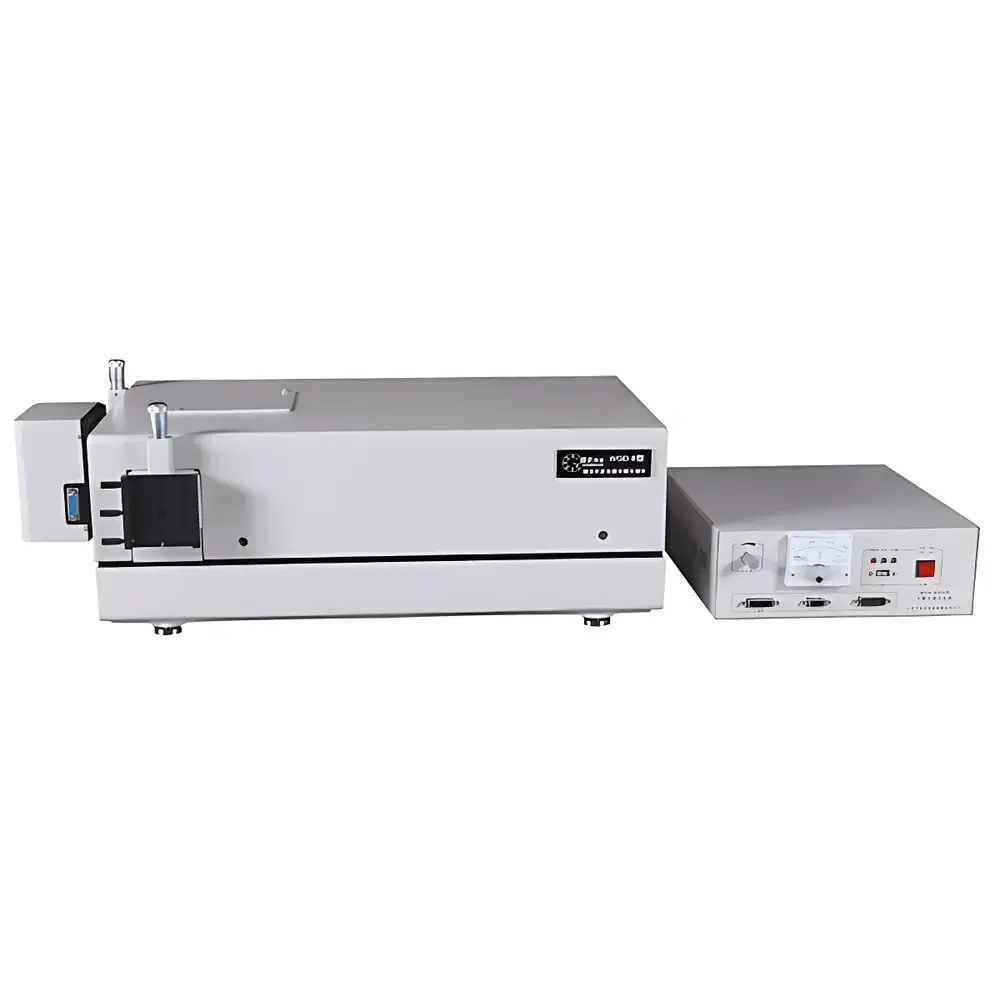
Gangdong WGD-8 / WGD-8A Combined Multi-Functional Grating Spectrometer
| Brand | Gangdong |
|---|---|
| Origin | Tianjin, China |
| Manufacturer | Yes |
| Type | Domestic |
| Model | WGD-8 / WGD-8A |
| Application System | Emission Spectroscopy |
| Grating Configuration | Dual-grating turret |
| Spectral Resolution | ≤0.1 nm (WGD-8), ≤0.06 nm (WGD-8A) |
| Wavelength Range | 200–800 nm (PMT) |
| F-number | F/4 |
| Wavelength Accuracy | ±0.4 nm (WGD-8), ±0.2 nm (WGD-8A) |
| Wavelength Repeatability | 0.2 nm (WGD-8), 0.1 nm (WGD-8A) |
| Stray Light | ≤10⁻³ |
| Slit Width Adjustment | 0–2 mm, 0.01 mm resolution |
| Focal Length | 500 mm |
| Relative Aperture | D/F = 1/7 |
| Dimensions | 560 × 380 × 230 mm |
| Weight | 30 kg |
Overview
The Gangdong WGD-8 and WGD-8A are Czerny–Turner configuration grating spectrometers engineered for high-fidelity spectral acquisition in both educational and research environments. These instruments operate on the principle of angular dispersion via ruled diffraction gratings, enabling precise wavelength separation across the ultraviolet–visible (UV–Vis) spectrum. Designed with a 500 mm focal length and F/4 optical architecture, the system balances throughput and resolution—critical for low-light emission spectroscopy applications such as atomic line analysis, plasma diagnostics, and laser-induced fluorescence. The dual-grating turret allows rapid interchange between 1200 l/mm (WGD-8) and 2400 l/mm (WGD-8A) blazed gratings (λB = 250 nm), optimizing either broad spectral coverage or enhanced resolving power. Unlike scanning monochromators with single-output ports, the WGD-8/8A features two independent exit slits—each optimized for distinct detector technologies—enabling simultaneous or sequential measurement modes without realignment.
Key Features
- Dual-detector optical path: Separate PMT and CCD exit slits support concurrent signal acquisition with complementary dynamic range and sensitivity profiles
- High-resolution grating options: 2400 l/mm grating (WGD-8A) delivers ≤0.06 nm resolution at 250 nm—suitable for hydrogen–deuterium isotope splitting and fine-structure sodium D-line analysis
- Precision mechanical slit drive: 0–2 mm continuously adjustable entrance/exit slits with 0.01 mm vernier scale calibration, ensuring reproducible bandwidth control
- Low-stray-light optical design: Optimized baffling and coated optics limit stray radiation to ≤10⁻³—essential for accurate background subtraction in weak-emission measurements
- Modular excitation compatibility: Supports standardized lamp sources (e.g., Hg, D₂, W–halogen) via dedicated mounting interfaces for absorption, fluorescence, and calibration workflows
- Rugged benchtop construction: Aluminum alloy optical baseplate with thermal-stable kinematic mounts minimizes drift during extended acquisition sessions
Sample Compatibility & Compliance
The WGD-8/8A accommodates standard 10 mm-path quartz cuvettes (via optional DF-1/DF-2 cells) and free-space beam coupling for gas-phase or plasma emission studies. Its 200–800 nm operational range covers key atomic transitions (e.g., Hα at 656.3 nm, Na D at 589.0–589.6 nm, Hg lines at 253.7 nm and 404.7 nm) and molecular band systems. While not certified to ISO/IEC 17025 or ASTM E275 for accredited testing, the instrument’s wavelength accuracy (±0.2 nm for WGD-8A) and repeatability (0.1 nm) align with pedagogical validation requirements per AAPT laboratory standards. All firmware and software adhere to basic data integrity principles—including timestamped raw spectra storage and non-destructive parameter logging—to support GLP-aligned teaching labs and preliminary research documentation.
Software & Data Management
Gangdong’s proprietary spectral acquisition software provides cross-platform (Windows) control of grating selection, slit width, detector gain, and scan parameters. The interface supports real-time spectral preview, peak identification with centroid fitting, and export of ASCII-compatible .txt or .csv files for third-party analysis (e.g., OriginLab, MATLAB, Python SciPy). Raw data includes full metadata: grating ID, slit setting, integration time, detector type, and wavelength calibration coefficients. Audit trails are maintained through session logs; however, the software does not implement FDA 21 CFR Part 11-compliant electronic signatures or role-based access control. For institutional deployment, batch processing scripts and API hooks (DLL-based) are available under OEM licensing agreements.
Applications
- Undergraduate physics laboratories: Hydrogen–deuterium isotope shift measurement, Rydberg constant determination, and Zeeman effect observation
- Chemistry education: Atomic emission analysis of alkali metals (Na, K, Li), transition metal ions (Cu²⁺, Mn²⁺), and rare-earth dopants
- Materials characterization: Photoluminescence quantum yield screening of quantum dots and perovskite thin films
- Environmental monitoring: Qualitative identification of trace metal contaminants in flame or arc emission sources
- Laser spectroscopy: Linewidth verification of diode lasers and frequency-doubled solid-state sources
- Calibration services: Wavelength reference using Hg, D₂, and low-pressure Na lamps traceable to NIST SRM standards
FAQ
What detector types are supported, and how do they differ in performance?
The WGD-8/8A integrates a side-on photocathode PMT (200–800 nm) for high-gain, low-noise detection of weak emission lines, and a back-illuminated CCD array (300–900 nm) for multi-channel spectral capture with ~0.1 nm pixel resolution. PMT mode enables photon-counting operation; CCD mode supports rapid full-spectrum acquisition at 1–10 Hz frame rates.
Can the instrument perform absorbance or fluorescence measurements?
Yes—when configured with optional excitation sources (GY-1 tungsten-halogen lamp, GY-4C Hg lamp, or GY-13 D₂ lamp) and sample holders (DF-1 absorption cell, DF-2 fluorescence cuvette), the system functions as a scanning spectrophotometer or fluorimeter. Excitation/emission monochromator sequencing requires manual grating and slit reconfiguration.
Is wavelength calibration traceable to international standards?
Calibration is performed using primary emission lines from NIST-traceable low-pressure lamps (Hg: 253.65 nm, 404.66 nm, 435.83 nm; D₂: 486.01 nm, 656.10 nm). Users may generate custom calibration polynomials using ≥5 reference lines; residual errors remain within specified accuracy limits.
What maintenance is required for long-term optical stability?
No routine optical alignment is needed due to kinematic grating mounts. Recommended practices include periodic cleaning of entrance slit blades with spectroscopic-grade solvent, desiccant replacement in the housing (if equipped), and annual verification of wavelength accuracy using reference lamps.





