
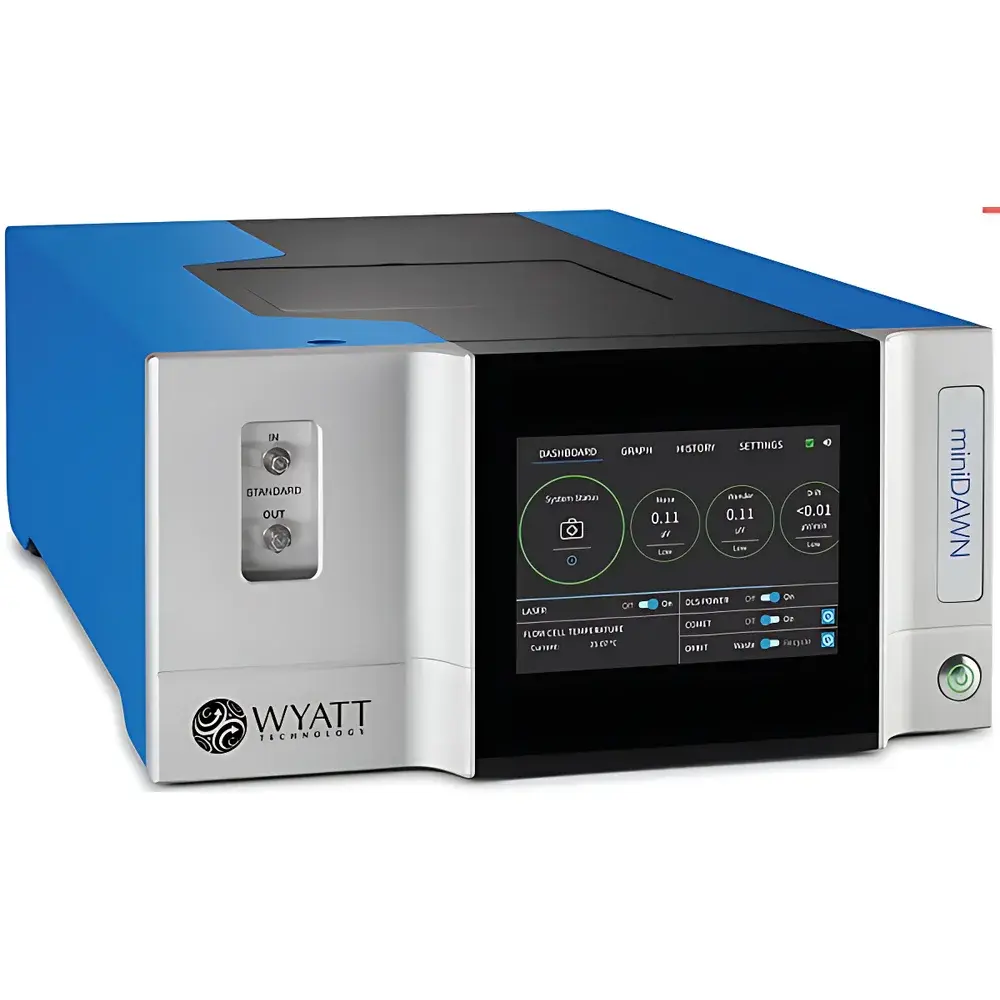
Wyatt miniDAWN Multi-Angle Light Scattering Detector
| Brand | Wyatt |
|---|---|
| Origin | USA |
| Manufacturer | Wyatt Technology Corporation |
| Type | GPC/SEC-Compatible MALS Detector |
| Wavelength | 658 nm |
| Detection Method | Single-Beam |
| Light Source | 60 mW GaAs Linearly Polarized Laser |
| Angles | 3 (Low, 90°, High) + 2 Reference Angles |
| Molecular Weight Range | 10³ – 10⁷ Da |
| Size Range (Rg) | 10 – 50 nm |
| Data Interface | Ethernet |
| Display | Full-Color LCD |
Overview
The Wyatt miniDAWN is a compact, high-performance multi-angle light scattering (MALS) detector engineered for integration with gel permeation chromatography (GPC) and size-exclusion chromatography (SEC) systems. It operates on the fundamental principle of static light scattering (SLS), measuring the angular dependence of scattered laser intensity to determine absolute molar mass (Mw), root-mean-square radius (Rg), and the second virial coefficient (A2)—all without reliance on column calibration standards. Its fixed 3-angle configuration—comprising low-angle (e.g., 7°), 90°, and high-angle (e.g., 150°) detection—enables robust characterization of macromolecules across an exceptionally broad molar mass range (10³–10⁷ Da) and hydrodynamic sizes (Rg = 10–50 nm). Two additional reference photodiodes continuously monitor laser stability and optical alignment, ensuring measurement integrity over extended runs. Designed for seamless coupling with industry-standard HPLC platforms—including Waters 150C, PL220C, and Alliance 2000—the miniDAWN delivers real-time, label-free, and calibration-independent structural insights critical for biopharmaceutical development, polymer science, and nanomaterial characterization.
Key Features
- Three precisely aligned scattering angles (low, 90°, high) plus two integrated reference diodes for continuous optical performance validation
- 60 mW linearly polarized GaAs laser at 658 nm—optimized for low fluorescence interference and high signal-to-noise ratio in aqueous and organic SEC mobile phases
- Photodiode-based detection architecture delivering high linearity, low dark current, and excellent long-term stability
- Ethernet-enabled digital data acquisition with sub-second time resolution, synchronized with concentration detectors (UV, RI, or viscometer)
- Onboard full-color LCD display for immediate visualization of raw scattering intensities, angle-normalized signals, and real-time Rg/Mw trends
- Compact footprint (24 × 18 × 12 cm) and low power consumption suitable for benchtop deployment in QC labs and regulated environments
Sample Compatibility & Compliance
The miniDAWN supports a wide range of sample types—including proteins, monoclonal antibodies, viral vectors, synthetic polymers, polysaccharides, and colloidal nanoparticles—in common SEC solvents (e.g., PBS, 0.1 M NaNO3, THF, DMF). When paired with a concentration-sensitive detector (e.g., UV-Vis or differential refractometer), it enables absolute molar mass determination per ASTM D7243 and ISO 16014-4. For biologics analysis, its output meets ICH Q5E comparability requirements and supports GLP/GMP workflows when used with compliant software (e.g., ASTRA 8 with 21 CFR Part 11 audit trail and electronic signature modules). The instrument’s mechanical and optical design conforms to IEC 61010-1 safety standards for laboratory electrical equipment.
Software & Data Management
Data acquisition and analysis are performed using Wyatt’s ASTRA software—a validated platform supporting batch processing, method templates, and automated peak deconvolution. ASTRA calculates Mw, Mn, dispersity (Đ), Rg, A2, and conformation plots (e.g., log Rg vs. log Mw) directly from raw MALS and concentration signals. Integration with third-party chromatography data systems (CDS) is achieved via standard ASCII export or direct API linkage. All raw detector data—including time-stamped angle-resolved intensities—are stored in vendor-neutral HDF5 format, enabling traceability, reprocessing, and long-term archival in accordance with ALCOA+ principles.
Applications
- Determination of absolute molecular weight and polydispersity of therapeutic proteins and ADCs without calibration standards
- Quantification of aggregation state (monomer/dimer/oligomer) and fragment analysis in stressed stability studies
- Characterization of branching architecture in polyolefins and dendrimers using combined MALS–viscometer–RI analysis (Mark–Houwink parameter derivation)
- Assessment of protein–ligand binding stoichiometry and affinity via composition-gradient MALS (CG-MALS) in solution
- Size and conformation analysis of lipid nanoparticles (LNPs), exosomes, and polymeric micelles in formulation development
- Batch release testing of heparin and other glycosaminoglycans under USP and pharmacopeial guidelines
FAQ
Can the miniDAWN be used offline for batch measurements?
Yes—it supports stop-flow and cuvette-based static light scattering mode for direct solution-phase analysis of molar mass, Rg, and A2 without chromatography.
Is it compatible with UHPLC systems operating at >100 bar?
The miniDAWN flow cell is rated to 15 MPa (150 bar); optional high-pressure fittings enable integration with modern UHPLC-SEC platforms.
Does it require routine recalibration?
No—its photodiode response is inherently stable; verification is performed using NIST-traceable polystyrene standards or sucrose solutions per ASTM D7243 Annex A2.
How is data security handled in regulated environments?
ASTRA 8 supports role-based access control, electronic signatures, and immutable audit trails compliant with FDA 21 CFR Part 11 and EU Annex 11 requirements.
What maintenance is required?
Annual optical alignment verification and quarterly flow cell cleaning with appropriate solvents (e.g., isopropanol for aqueous systems, THF for organics) are recommended per the manufacturer’s service schedule.






