
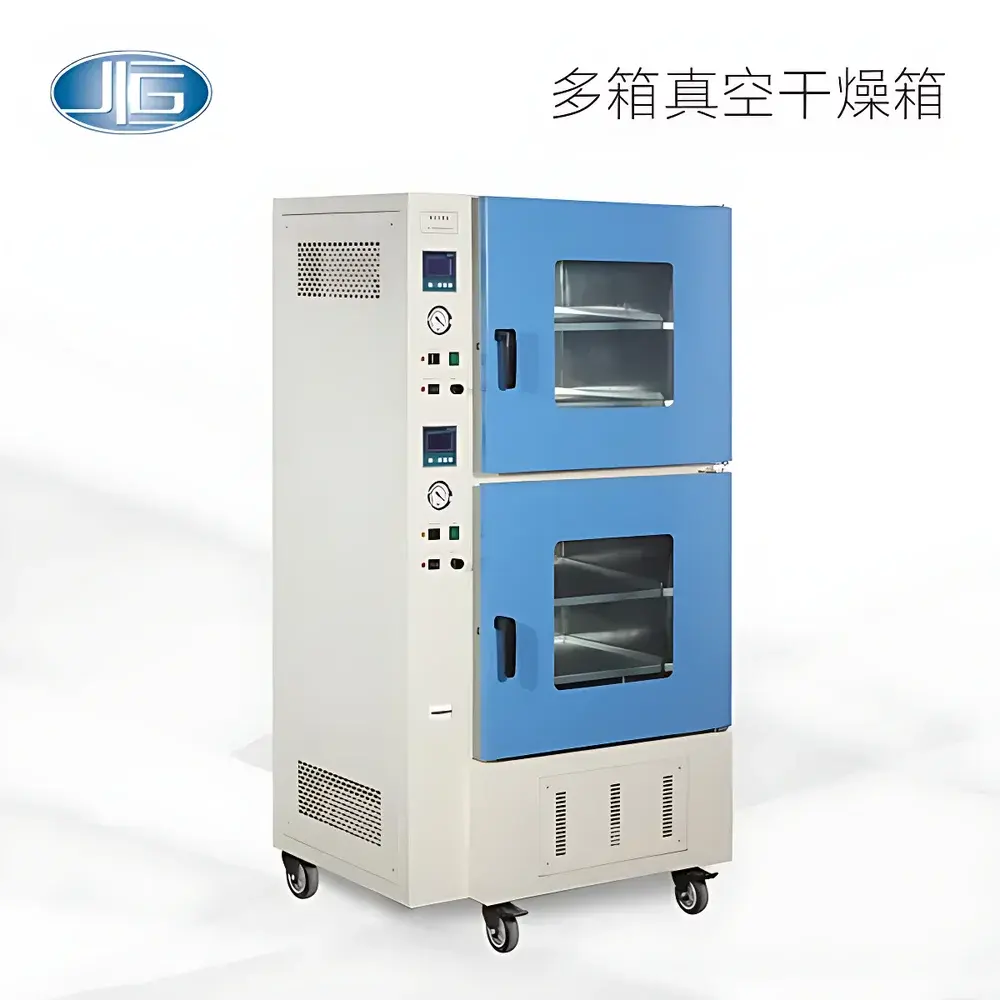
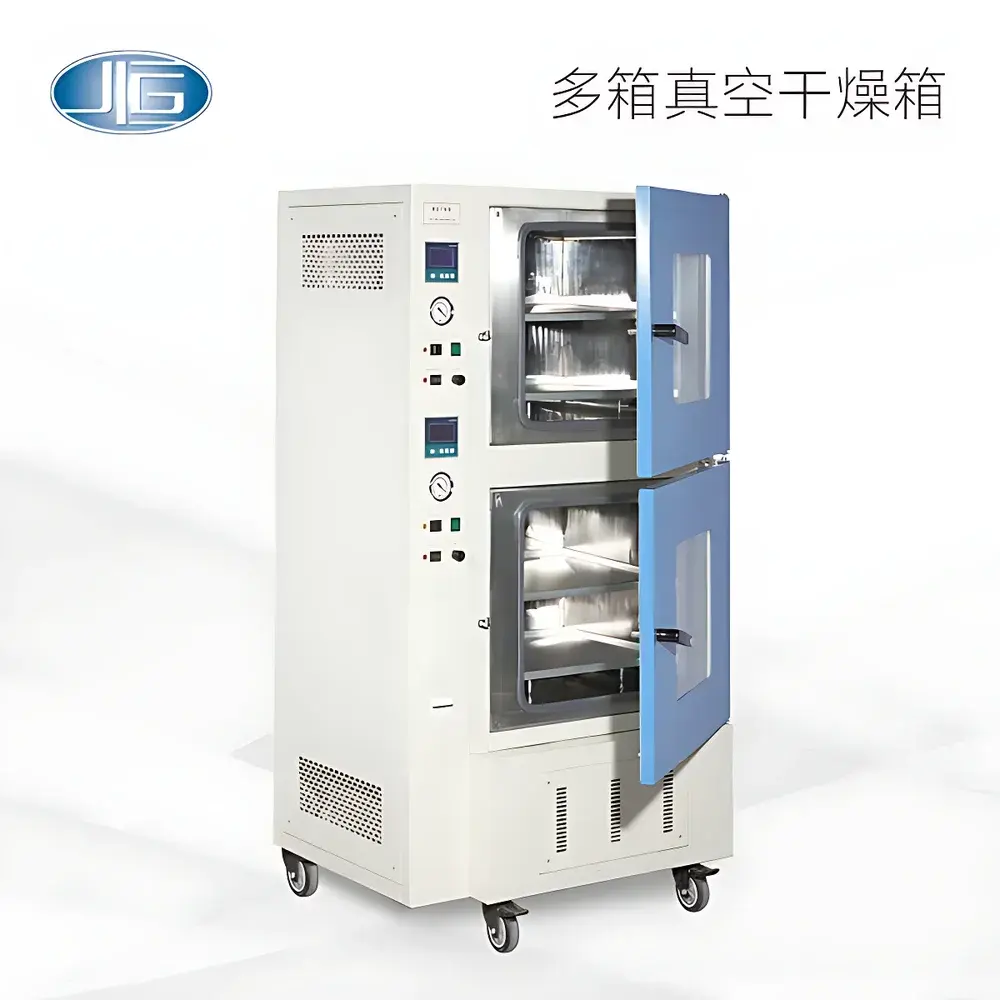
YIHENG BPZ Series Multi-Chamber Vacuum Drying Oven
| Brand | YIHENG |
|---|---|
| Origin | Shanghai, China |
| Manufacturer Type | Direct Manufacturer |
| Product Category | Domestic |
| Model | BPZ Series |
| Instrument Type | Vacuum Oven |
| Temperature Range | RT+10°C to 200°C (customizable up to 250°C) |
| Temperature Uniformity | ±1°C |
| Temperature Resolution | 0.1°C |
| Operating Ambient Temperature | +5°C to +40°C |
| Chamber Material | Stainless Steel (AISI 304) |
| Heating Method | Forced-Convection Hot Air Circulation |
| Vacuum Level | ≤133 Pa |
| Chamber Configuration | Independently Controlled Multi-Layer Chambers |
| Optional Features | Programmable Cycle Control, Nitrogen Purge Capability, LED Interior Lighting, Removable Heated Shelving with Individual PID Control |
Overview
The YIHENG BPZ Series Multi-Chamber Vacuum Drying Oven is an engineered solution for precision-controlled thermal processing under reduced-pressure environments. Designed around the fundamental principles of vacuum-assisted moisture removal and uniform convective heat transfer, this system enables reproducible drying, curing, degassing, and solvent recovery across diverse sample types—including heat-sensitive pharmaceuticals, hygroscopic polymers, ceramic precursors, and analytical standards. Unlike single-chamber vacuum ovens, the BPZ architecture integrates multiple thermally and vacuum-isolated chambers within a unified chassis, allowing concurrent yet independent operation—each chamber featuring dedicated heating elements, vacuum regulation, and nitrogen inerting capability. This modular approach supports parallel batch processing while maintaining strict process traceability per chamber, aligning with GLP-compliant laboratory workflows.
Key Features
- Multi-chamber design with fully independent temperature control, vacuum regulation, and optional nitrogen purging per chamber—eliminating cross-contamination and enabling heterogeneous process conditions in a single footprint.
- Forced-convection hot air circulation system with stainless-steel (AISI 304) internal chamber walls and seamless welded construction ensures corrosion resistance, cleanability, and long-term dimensional stability under thermal cycling.
- Individually heated and PID-controlled shelving units: each shelf incorporates an embedded Pt100 sensor and discrete heating element mounted directly beneath the surface—reducing thermal lag, improving spatial uniformity (50% compared to perimeter-heated cavity designs.
- Double-glazed, tempered observation window with adjustable door tension and integrally molded silicone gasket maintains vacuum integrity down to ≤133 Pa; door seal compression force is factory-calibrated for repeatable sealing performance over 10,000+ cycles.
- Independent over-temperature protection circuit—hardwired and electrically isolated from the main controller—triggers immediate power cutoff if setpoint deviation exceeds user-defined thresholds, satisfying IEC 61010-1 safety requirements.
- Optional programmable controller supports multi-step sequences including ramp-soak-vacuum-hold-nitrogen purge phases, with time-stamped event logging compliant with FDA 21 CFR Part 11 audit trail requirements when paired with validated software.
Sample Compatibility & Compliance
The BPZ Series accommodates samples ranging from small-volume vials and crucibles to large-format trays (up to 400 mm × 400 mm per shelf), with load capacity scalable via configurable shelving (standard: 3–5 shelves/chamber). Its stainless-steel interior meets ISO 14644-1 Class 7 cleanroom compatibility when operated under nitrogen purge, making it suitable for moisture-critical applications in battery electrode drying, catalyst activation, and API stabilization. The system conforms to GB/T 5170.11–2017 (Chinese national standard for environmental testing equipment), and its electrical safety architecture complies with IEC 61010-1:2010. Vacuum performance validation is supported through optional calibrated Pirani gauge integration (traceable to NIM standards).
Software & Data Management
When equipped with the optional programmable controller, the BPZ Series records real-time temperature, vacuum pressure, and elapsed time for each chamber at user-selectable intervals (1–60 s). All data are stored internally on non-volatile memory with timestamped metadata and exportable via USB to CSV or PDF formats. Audit trails include operator ID, parameter changes, alarm events, and manual interventions—structured to support 21 CFR Part 11 electronic record retention when deployed with validated access controls and digital signature modules. Raw sensor outputs (Pt100 resistance, vacuum transducer mV signal) remain accessible for third-party SCADA integration via RS485 Modbus RTU protocol.
Applications
- Pharmaceutical: Residual solvent removal from lyophilized intermediates and granules under inert atmosphere to prevent oxidation.
- Materials Science: Thermal aging studies of polymer composites and controlled dehydration of MOFs without structural collapse.
- Electronics: Degassing of encapsulants and conformal coatings prior to curing to eliminate microvoids affecting dielectric strength.
- Academic Research: Comparative kinetic modeling of moisture diffusion in porous media using synchronized multi-chamber trials at varying T/vacuum setpoints.
- Quality Control Labs: Standardized drying protocols for loss-on-drying (LOD) analysis per USP and ASTM E1218–22.
FAQ
Can the BPZ Series be validated for GMP manufacturing environments?
Yes—when configured with IQ/OQ documentation packages, calibrated sensors (NIST-traceable certificates available), and 21 CFR Part 11-compliant software, the system supports full qualification under Annex 15 and EU GMP guidelines.
What is the maximum allowable load per shelf without compromising temperature uniformity?
Uniformity remains within ±1°C across the entire shelf surface when loaded with ≤15 kg of evenly distributed mass; heavier or asymmetric loads require empirical mapping per application.
Is nitrogen purge compatible with all vacuum levels specified?
Nitrogen introduction is optimized for pressures between 133 Pa and 10 kPa; below 100 Pa, purge gas flow must be dynamically modulated to maintain target vacuum setpoint without destabilizing the chamber.
How frequently does the vacuum pump require maintenance?
The integrated oil-free diaphragm pump requires filter replacement every 1,500 operating hours and full service (valve inspection, membrane replacement) every 6,000 hours—service intervals documented in the OEM maintenance logbook.
Are calibration certificates included with shipment?
Factory calibration reports (temperature uniformity, vacuum accuracy) are provided with each unit; NIST-traceable certificates for individual sensors are available as a chargeable option.



