
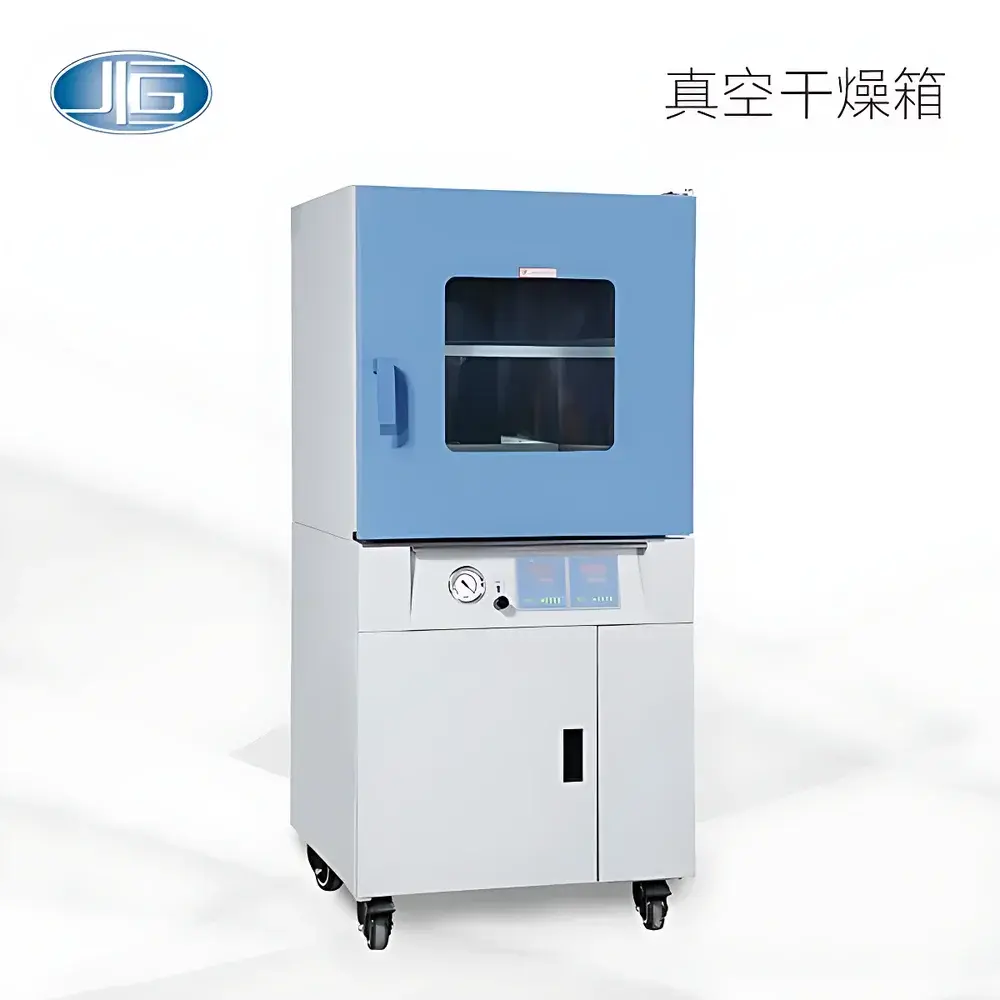
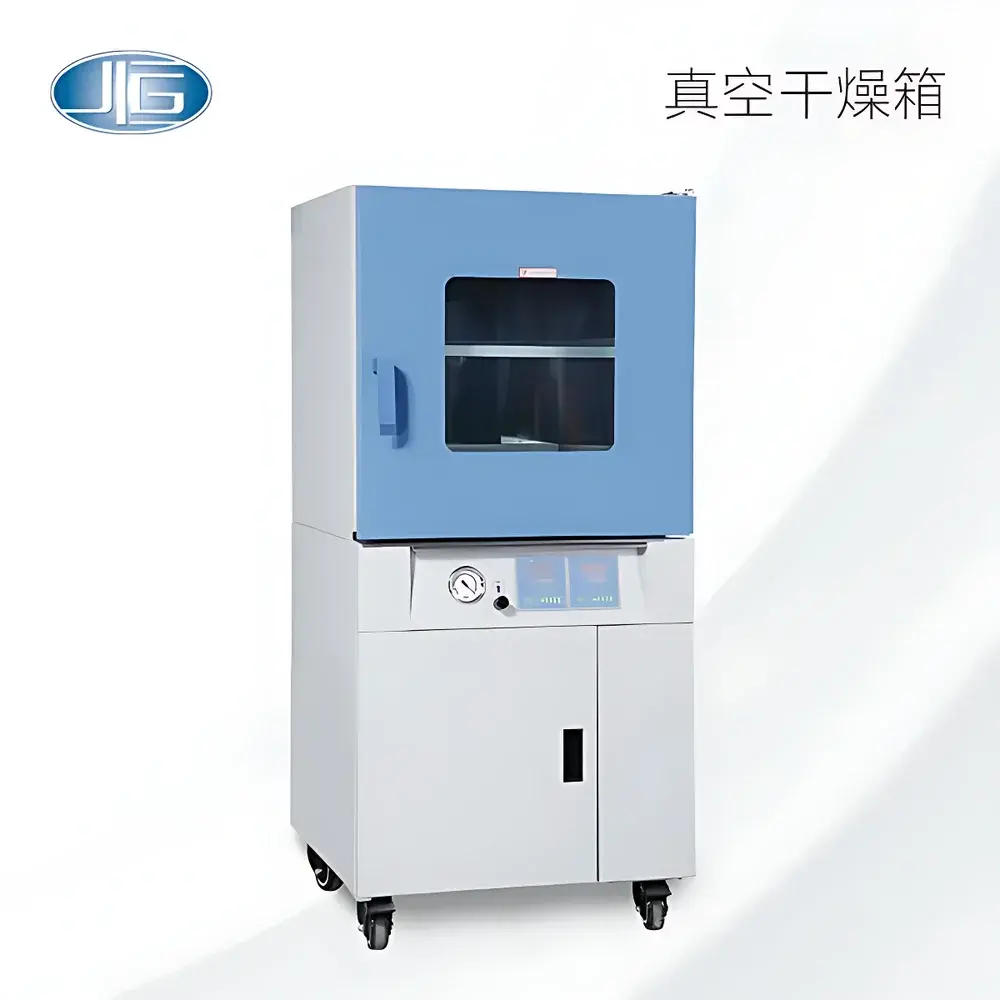
YIHENG BPZ-6033 Programmable Vertical Vacuum Drying Oven
| Brand | YIHENG |
|---|---|
| Origin | Shanghai, China |
| Manufacturer Type | Direct Manufacturer |
| Product Category | Domestic |
| Model | BPZ-6033 |
| Instrument Type | Vacuum Oven |
| Temperature Range | RT+10 °C to 200 °C |
| Temperature Uniformity | ±1 °C |
| External Dimensions | 550 × 490 × 1240 mm |
| Chamber Dimensions | 320 × 320 × 320 mm |
| Temperature Resolution | 0.1 °C |
| Chamber Material | Stainless Steel (SUS304) |
| Heating Method | Forced Air Circulation |
| Ultimate Vacuum | 133 Pa |
| Control Mode | Programmable Multi-Step Sequence (Heating / Vacuum Hold / N₂ Purge Hold) |
Overview
The YIHENG BPZ-6033 is a vertically oriented, programmable vacuum drying oven engineered for precision thermal processing under controlled low-pressure environments. It operates on the fundamental principle of reducing ambient pressure to lower the boiling point of solvents and moisture—enabling gentle, uniform drying of thermally sensitive or oxidation-prone materials without thermal degradation. Unlike conventional convection ovens, this system integrates active vacuum regulation with stepwise temperature ramping and optional inert gas (N₂) purging, making it suitable for applications where residual moisture, outgassing, or atmospheric contamination must be rigorously minimized. Designed specifically for high-reliability manufacturing processes in electronics and advanced materials, the BPZ-6033 supports repeatable, auditable thermal cycles essential for process validation and quality assurance frameworks.
Key Features
- Vertically configured stainless steel chamber (SUS304) with reinforced structural integrity and corrosion resistance—optimized for long-term exposure to vacuum and elevated temperatures up to 200 °C.
- Programmable multi-segment controller enabling precise definition of heating rate, dwell time at target temperature, vacuum hold duration, and optional nitrogen backfill sequences—ensuring batch-to-batch consistency in production environments.
- Ergonomic double-layer tempered glass observation door with adjustable silicone rubber gasket seal, maintaining stable vacuum integrity (<133 Pa) while permitting real-time visual monitoring without process interruption.
- Forced air circulation heating system with rear-mounted fan and symmetrically distributed heating elements—delivering uniform temperature distribution across the full 32 L working volume (320 × 320 × 320 mm).
- Dual safety architecture: independent overtemperature cut-off sensor plus configurable alarm thresholds; all critical parameters—including actual vacuum level, setpoint deviation, and heater status—are continuously logged and accessible via front-panel interface.
- Modular vacuum integration: compatible with standard two-stage rotary vane pumps (optional high-stability “B-series” pump available); vacuum line includes integrated pressure transducer and manual vent valve with fine-tuning capability.
Sample Compatibility & Compliance
The BPZ-6033 accommodates a broad range of sample forms—including wafers, PCB assemblies, battery electrode sheets, optical components, ceramic substrates, and polymer-coated devices—without requiring custom fixtures. Its chamber geometry supports both horizontal tray loading and vertical stacking configurations. The system complies with general-purpose laboratory equipment standards including IEC 61010-1 (safety requirements for electrical equipment) and GB/T 28850–2012 (Chinese national standard for vacuum ovens). While not certified for Class A cleanroom use, its sealed construction and stainless interior meet baseline requirements for ISO 14644-1 Class 8 environments when operated within controlled facilities. For regulated industries (e.g., medical device component manufacturing), the programmable logic supports audit-ready cycle documentation when paired with external data logging systems compliant with FDA 21 CFR Part 11.
Software & Data Management
The embedded microprocessor-based controller provides local operation via intuitive membrane keypad and LCD display. All program steps—including temperature setpoints, ramp rates, vacuum stabilization windows, and purge timing—are stored in non-volatile memory with password-protected access levels (operator vs. engineer). Real-time parameter trends (chamber temperature, vacuum pressure) are displayed graphically during operation. Although the unit does not include native Ethernet or USB export, analog output signals (0–5 V or 4–20 mA) are available for integration into SCADA or MES platforms. Optional RS485 Modbus RTU communication enables remote supervision and historical data retrieval through third-party industrial software, supporting traceability requirements under GLP and GMP-aligned workflows.
Applications
- Lithium-ion battery manufacturing: solvent removal from cathode/anode slurries, electrolyte impregnation drying, and post-lamination moisture control prior to cell sealing.
- LED and optoelectronic packaging: degassing of encapsulants and adhesives to eliminate microvoids; post-cure drying of phosphor coatings under inert atmosphere.
- Quartz crystal and SAW device fabrication: removal of cleaning solvents and hydration layers from resonator blanks without inducing stress-induced frequency drift.
- High-purity ceramic and thin-film processing: binder burnout in green-state components and pre-sintering moisture evacuation under controlled thermal gradients.
- Research laboratories conducting accelerated aging studies, moisture sorption/desorption kinetics, and vacuum-assisted solvent exchange protocols.
FAQ
What is the maximum operating temperature and vacuum level supported by the BPZ-6033?
The chamber is rated for continuous operation up to 200 °C with an ultimate vacuum of ≤133 Pa (1 Torr) using a standard two-stage rotary vane pump.
Can the BPZ-6033 perform nitrogen-purged drying cycles?
Yes—when equipped with the optional N₂ inlet port and solenoid valve, the controller supports timed nitrogen backfill sequences following vacuum hold phases, enabling oxygen-sensitive processing.
Is calibration documentation provided with the unit?
Factory calibration certificates for temperature and vacuum sensors are available upon request; users are advised to implement periodic verification per internal SOPs or ISO/IEC 17025 guidelines.
How is temperature uniformity verified across the chamber volume?
Uniformity is validated per GB/T 28850–2012 using nine-point mapping with calibrated PT100 probes at defined load conditions (empty chamber, 30% volume loaded with inert mass).
Does the system support automated data export for quality records?
While onboard storage retains last-run parameters and alarms, full-cycle data export requires connection to an external Modbus-compatible data acquisition system or analog signal recorder.



