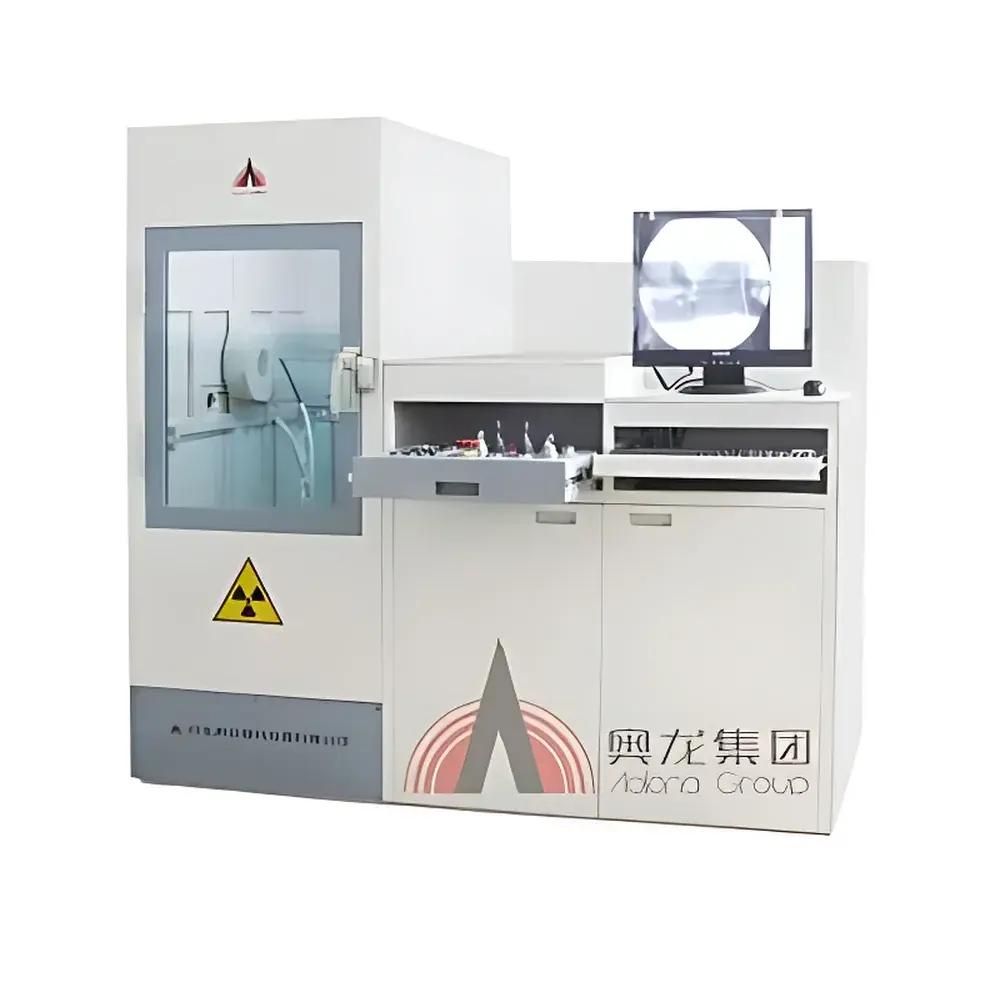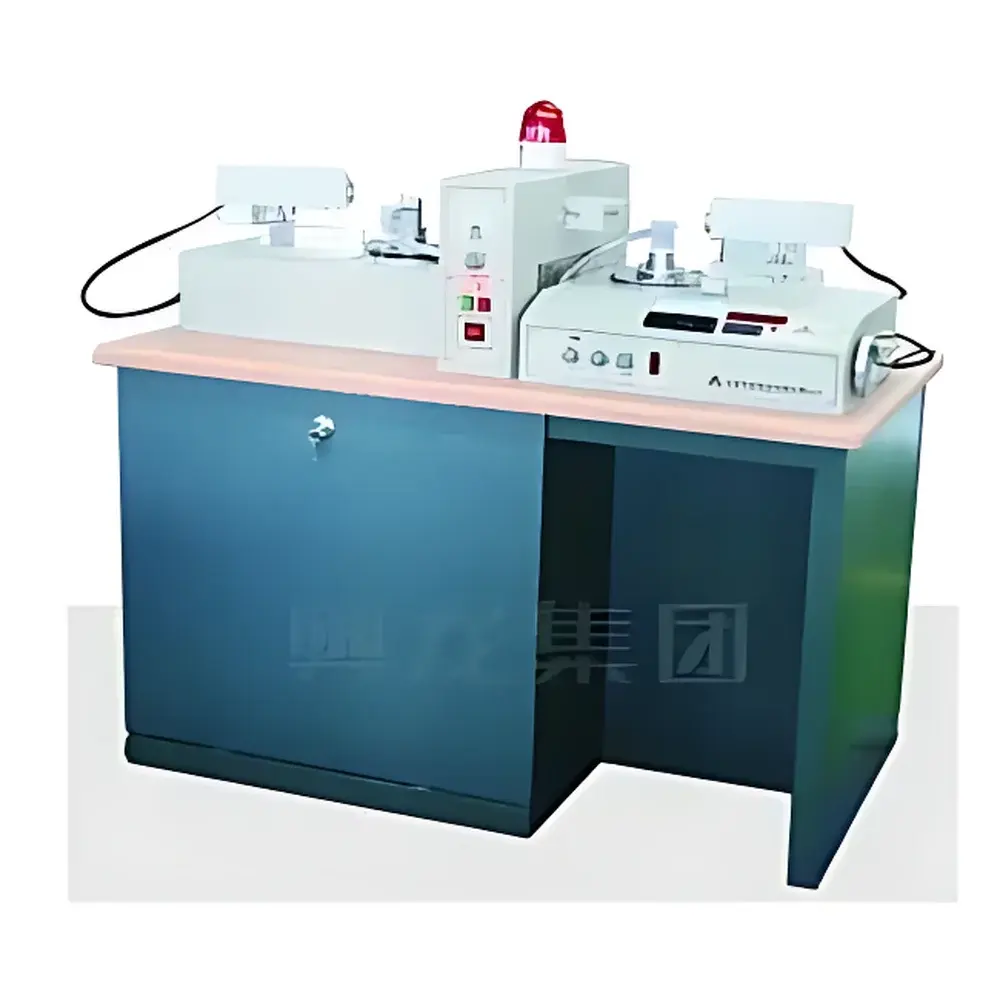
Aolong YX-300 Dual-Crystal High-Precision X-Ray Orientation Instrument

| Brand | Aolong |
|---|---|
| Origin | Liaoning, China |
| Manufacturer Type | Manufacturer |
| Origin Category | Domestic |
| Model | YX-300 |
| Price | Upon Request |
| Input Power | 220 V AC, 50 Hz, 0.3 kW |
| X-ray Tube | Cu anode, air-cooled, 30 kV, 0–5 mA |
| Detector | Geiger–Müller counter |
| Time Constants | 0.1 s, 0.4 s, 3 s |
| Angular Range | θ = −10° to +50°, 2θ = −10° to +100° |
| Angular Resolution | 1″ (digital display), minimum readable increment 1″ |
| Accuracy | ±10″ |
| Optical Shutter | Manual |
| Display | Digital angle readout |
| Dimensions | 1150 mm × 665 mm × 1040 mm (L×W×H) |
| Weight | 150 kg |
Ask about pricing, availability and specifications.
Overview
The Aolong YX-300 Dual-Crystal High-Precision X-Ray Orientation Instrument is a benchtop Bragg-angle diffractometer engineered for crystallographic orientation determination of single-crystal materials. It operates on the principle of double-crystal X-ray diffraction—where a highly collimated Cu-Kα beam (λ = 1.5418 Å) is first monochromatized by a reference silicon or quartz crystal, then incident upon the sample under precise angular control. The diffracted intensity is measured via a Geiger–Müller counter as a function of θ and 2θ angles, enabling high-fidelity identification of crystallographic planes relative to the physical surface normal. Designed for metrology-grade alignment in piezoelectric, optical, and acousto-optic crystal manufacturing, the YX-300 delivers traceable angular accuracy of ±10 arcseconds with digital interpolation down to 1 arcsecond resolution—meeting routine requirements for quartz wafer lapping, LiNbO₃ substrate slicing, and sapphire boule orientation verification.
Key Features
- Dual-crystal Bragg geometry ensuring high spectral purity and angular reproducibility without reliance on mechanical slits or secondary optics
- Motorized goniometer with digital encoder feedback and real-time angular readout (θ and 2θ axes independently adjustable)
- Three selectable time constants (0.1 s, 0.4 s, 3 s) for optimized signal-to-noise ratio across varying crystal reflectivity and mosaicity
- Manual optical shutter with interlocked safety circuitry compliant with IEC 61010-1 for Class I X-ray equipment
- Stable air-cooled Cu-anode X-ray tube (30 kV / 0–5 mA), eliminating need for water cooling infrastructure
- Rigid cast-iron base and vibration-damped optical bench minimizing thermal drift and mechanical hysteresis during long-duration scans
- Compact footprint (1150 × 665 × 1040 mm) suitable for cleanroom-integrated QC labs and crystal growth facilities
Sample Compatibility & Compliance
The YX-300 supports planar samples up to Ø100 mm and thickness ≤25 mm—including quartz (AT-, BT-, SC-cut), lithium tantalate (LiTaO₃), lithium niobate (LiNbO₃), sapphire (Al₂O₃), silicon carbide (SiC), and gallium arsenide (GaAs). Sample mounting uses vacuum chucks or kinematic three-point fixtures to minimize tilt error. All operational parameters conform to GB/T 15066–2008 (Chinese national standard for X-ray orientation instruments) and align with foundational principles of ISO 17025:2017 for testing laboratory competence. While not certified to FDA 21 CFR Part 11, the instrument’s manual operation mode and deterministic analog signal path support GLP-compliant recordkeeping when integrated with external audit-trail-capable lab notebooks or LIMS.
Software & Data Management
The YX-300 operates in standalone mode with front-panel digital interface; no proprietary software is required for basic orientation measurement. Angle settings, exposure timing, and peak detection thresholds are configured directly via membrane keypad. Raw count data can be exported via RS-232 serial port (optional USB-to-serial adapter) for post-processing in MATLAB, Python (using NumPy/SciPy), or commercial crystallography tools such as GSAS-II or FullProf. Peak search algorithms implement centroid-based angular fitting with Gaussian deconvolution to resolve overlapping reflections—critical for low-symmetry crystals. Calibration routines include reference crystal alignment using NIST-traceable Si(111) or quartz(0006) standards.
Applications
- Verification of cut-angle deviation in quartz resonator blanks prior to electrode deposition
- Orientation mapping of Czochralski-grown sapphire wafers for LED epitaxy substrate qualification
- Post-polish angular validation of LiNbO₃ modulators to ensure electro-optic coefficient alignment
- Quality control of synthetic gemstone crystals (e.g., YAG, GGG) for laser host material certification
- Teaching laboratories for undergraduate solid-state physics courses covering Bragg’s law, reciprocal lattice construction, and Laue symmetry analysis
- Failure analysis of misoriented crystal substrates in semiconductor packaging where thermal expansion mismatch induces wafer warpage
FAQ
What crystallographic standards does the YX-300 support for calibration?
The instrument is compatible with NIST SRM 640d (Si powder) and IUCr-certified quartz (0006) reference crystals for absolute angular calibration.
Is radiation shielding included in the standard configuration?
Yes—the lead-lined steel housing provides ≥2.5 mm Pb equivalent attenuation at 30 kV; full compliance documentation per GBZ 138–2002 is supplied with each unit.
Can the YX-300 measure off-axis orientations beyond the primary (hkl) plane?
It supports χ-tilt measurements up to ±15° via optional manual goniometer add-on, enabling pseudo-psi scans for low-symmetry crystal systems.
What maintenance intervals are recommended for the X-ray tube?
Under typical usage (≤4 hrs/day), the Cu anode tube requires annual filament emission testing and vacuum integrity verification; no scheduled replacement is specified before 5,000 operating hours.
Does the system support automated batch measurement for production line integration?
Not natively—but the RS-232 interface enables PLC-level triggering and position synchronization via TTL signals when paired with third-party automation controllers.