
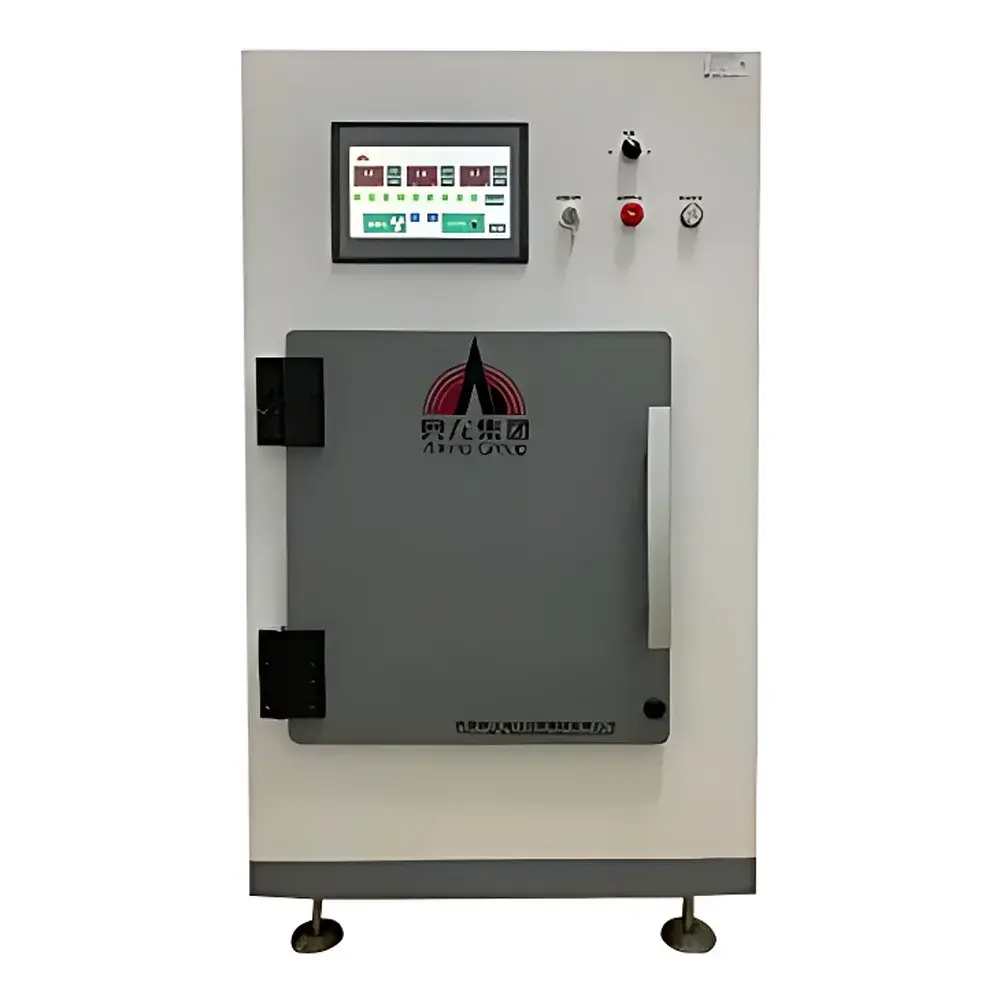
Aolong FXRAD 800 Biological X-ray Irradiator for Thermoluminescence (TL) Detection of Irradiated Foods
| Brand | Aolong |
|---|---|
| Model | FXRAD 800 |
| Radiation Source | High-voltage X-ray tube (≤160 kV) |
| Maximum Dose Rate | ≥1000 Gy per irradiation cycle |
| Sample Chamber | Drawer-type, shielded stainless-steel cavity |
| Shielding Performance | ≤0.5 µSv/h at 5 cm from surface |
| Safety Interlocks | Dual redundant door/X-ray enable interlock + emergency stop |
| Cooling System | Closed-loop liquid cooling |
| Compliance | GB 23748–2016, GB 31643–2016, CODEX STAN 106–1983 |
| Operating System | Windows-based HMI with touchscreen interface |
| Data Logging | Audit-trail enabled parameter recording (time, voltage, current, dose, duration) |
Overview
The Aolong FXRAD 800 is a laboratory-grade biological X-ray irradiator engineered specifically for controlled, reproducible irradiation of food samples in support of thermoluminescence (TL)-based detection protocols. Unlike radioactive isotope sources (e.g., 60Co), the FXRAD 800 employs a high-stability, high-voltage X-ray tube (up to 160 kV) to generate bremsstrahlung radiation, enabling precise, on-demand delivery of ionizing radiation without regulatory burdens associated with radioactive material licensing, transport, or disposal. Its primary application lies in generating reference irradiated samples—particularly those containing silicate minerals (e.g., in spices, shellfish, herbs, and dried fruits)—for subsequent TL analysis. This supports compliance verification against international standards including CODEX STAN 106–1983 and national regulations such as GB 23748–2016 (screening method) and GB 31643–2016 (TL-specific identification of irradiated silicate-containing foods). The system operates within a fully shielded, interlocked stainless-steel chamber and is designed for routine use in QC laboratories, regulatory testing facilities, and research institutions conducting food authenticity and irradiation certification studies.
Key Features
- Engineered radiation safety: Lead-equivalent shielding ensures surface dose rate ≤0.5 µSv/h at 5 cm—well below China’s national limit (2.5 µSv/h) and aligned with IEC 61000-4-3 immunity requirements for adjacent instrumentation.
- Dual-redundant safety architecture: Mechanical door interlock and electronic X-ray enable circuit operate independently; interruption of either immediately terminates beam emission. Integrated emergency stop button meets ISO 13850 Category 3 performance level.
- Dose stability & repeatability: Closed-loop liquid cooling maintains X-ray tube thermal equilibrium across extended operation, eliminating drift due to anode heating—critical for multi-cycle dosimetry consistency.
- Precision irradiation control: Adjustable kV (80–160 kV) and mA (0.1–5 mA) parameters, coupled with aluminum/copper filtration options, allow optimization of beam quality (HVL) for specific sample matrices and TL sensitivity profiles.
- Windows-based HMI with full audit trail: Touchscreen interface supports user-defined irradiation protocols (dose, time, voltage), real-time status feedback, error logging, and exportable CSV reports compliant with GLP documentation requirements.
Sample Compatibility & Compliance
The FXRAD 800 accommodates heterogeneous food matrices—including ground spices, freeze-dried vegetables, frozen seafood, and raw meat cuts—via its drawer-style sample stage (internal dimensions: 200 × 200 × 150 mm). Sample positioning is optimized for uniform dose distribution (±5% variation over 90% of chamber volume, verified per ISO/IEC 17025 calibration procedures). All irradiation protocols are traceable to NIM (National Institute of Metrology, China)–certified dosimetry standards. The system satisfies technical prerequisites for TL method validation under GB 31643–2016, which mandates controlled, calibrated irradiation sources for generating positive controls. It further supports readiness for FDA Food Safety Modernization Act (FSMA) third-party certification audits and EU Regulation (EC) No 1925/2006 Annex II compliance verification workflows.
Software & Data Management
The embedded Windows 10 IoT Enterprise OS hosts a dedicated irradiation control application with role-based access (Operator, Supervisor, Administrator). Each irradiation event logs timestamp, operator ID, setpoint parameters (kV, mA, exposure time), measured tube current/voltage, calculated dose (Gy), and system fault codes. All records are digitally signed and stored locally with optional network backup. Audit trails comply with 21 CFR Part 11 requirements for electronic records and signatures when configured with time-synchronized NTP servers and password-protected user accounts. Export functions support direct integration into LIMS platforms via ODBC or RESTful API endpoints (available as optional module).
Applications
- Preparation of TL-positive reference materials for method validation and laboratory proficiency testing.
- Routine generation of irradiated calibration samples for quantitative TL intensity calibration curves.
- Supporting export-oriented food manufacturers requiring documented irradiation history per EU Directive 1999/2/EC and US FDA 21 CFR §179.26.
- Research into dose-response relationships between X-ray energy spectra and TL signal yield in quartz/feldspar fractions extracted from foodborne silicates.
- Training and inter-laboratory comparison programs organized by national food safety authorities and AOAC International working groups.
FAQ
Does the FXRAD 800 require radioactive source licensing?
No. As a machine-generated X-ray device operating below 160 kV, it falls under Class II radiation equipment per China’s Regulations on the Safety and Protection of Radioactive Isotopes and Radiation Devices—exempt from radioactive material licensing but subject to registration with provincial ecological environment departments.
Can the system be integrated into an existing LIMS?
Yes. With optional API module enabled, the FXRAD 800 supports bidirectional data exchange using HTTPS/JSON protocol for irradiation log ingestion and remote job initiation.
What is the typical lifetime of the X-ray tube?
Rated for ≥5,000 hours of cumulative operation under recommended cooling and duty cycle (≤30% duty factor for >500 Gy cycles); replacement tubes are factory-calibrated and include updated firmware.
Is third-party dosimetry validation supported?
Yes. The chamber geometry and beam profile are compatible with standard alanine pellets, TLD-100 chips, and radiochromic film dosimeters—facilitating independent verification per ISO/IEC 17025 accredited practices.
How is dose uniformity verified during commissioning?
A formal commissioning report includes measured dose maps (using 3D array detectors), half-value layer (HVL) characterization, and long-term stability assessment over 72-hour continuous operation—all documented per IAEA TRS-483 guidelines.
Related Products




