
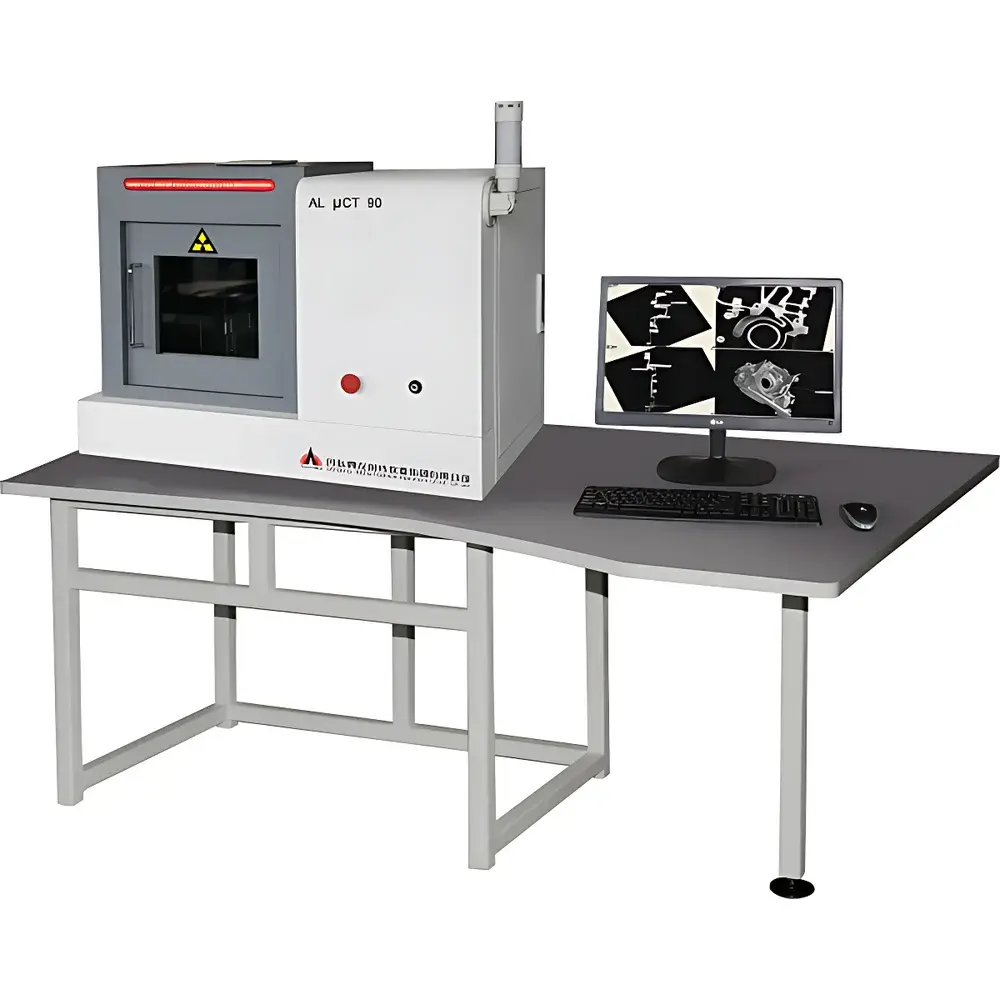
Aolong Benchtop Microfocus CT System for Cultural Heritage Analysis
| Brand | Aolong |
|---|---|
| Origin | Liaoning, China |
| Manufacturer Type | Direct Manufacturer |
| Country of Origin | China |
| Model | Benchtop Microfocus CT System for Cultural Heritage Analysis |
| Pricing | Upon Request |
Overview
The Aolong Benchtop Microfocus CT System for Cultural Heritage Analysis is a compact, high-resolution industrial micro-computed tomography (micro-CT) platform engineered specifically for non-destructive 3D internal inspection and metrological analysis of low-density archaeological artifacts, historical objects, and fragile cultural relics. Operating on the principle of cone-beam X-ray computed tomography, the system employs a microfocus X-ray source with a focal spot size of ≤5 µm to generate high-contrast, high-spatial-resolution volumetric datasets. Unlike conventional macro-CT systems, this benchtop configuration delivers sub-millimeter geometric magnification and micron-level effective voxel resolution—enabling precise visualization of fine structural features such as tool marks, corrosion layers, internal joins, lacquer stratigraphy, and casting porosity without physical contact or sample preparation. Designed for laboratory environments with space constraints, it supports both qualitative structural assessment and quantitative dimensional metrology in compliance with ASTM E1441 and ISO/IEC 17025–aligned workflows.
Key Features
- Microfocus X-ray source with ≤5 µm focal spot size, optimized for high-resolution imaging of low-Z materials (e.g., wood, ivory, ceramics, parchment, textile composites)
- Benchtop footprint (<800 × 600 × 750 mm) with integrated radiation shielding and interlocked safety enclosure meeting IEC 61000-6-3 EMC and IEC 62471 photobiological safety requirements
- Dual-mode acquisition: Real-time 2D radiography for rapid screening and full 360° helical or step-and-shoot 3D tomographic reconstruction
- High-fidelity detector with ≥12-bit dynamic range and pixel pitch ≤100 µm, supporting signal-to-noise ratio (SNR) optimization across varying object densities
- Motorized precision rotation stage with angular repeatability <0.01° and axial runout <2 µm, ensuring geometric fidelity in reconstructed volumes
- Onboard GPU-accelerated reconstruction engine delivering isotropic voxel datasets (typical resolution: 5–50 µm, dependent on object size and magnification)
Sample Compatibility & Compliance
The system accommodates specimens up to Ø150 mm × H120 mm and ≤2 kg, making it suitable for coins, jade pendants, bronze ritual vessels, ceramic shards, wooden figurines, and composite lacquerware. All components—including X-ray tube, detector, and motion control firmware—are CE-marked and compliant with EU Directive 2013/59/Euratom for radiation-emitting equipment. Data acquisition and reconstruction protocols support traceable calibration using NIST-traceable step wedges and sphere phantoms. The system architecture enables integration into GLP/GMP-regulated documentation environments via audit trail-enabled software logging (21 CFR Part 11 ready when deployed with validated software version).
Software & Data Management
Equipped with Aolong CT Suite v4.x, the platform provides end-to-end workflow management—from projection acquisition and beam-hardening correction to iterative reconstruction (SART/FDK), volume rendering, segmentation (thresholding, region-growing, deep-learning-assisted mask refinement), and GD&T-compliant dimensional metrology (ISO 1101). Export formats include DICOM-CT, TIFF stack, STL (for reverse engineering), and CSV-based measurement reports. All processing steps are logged with timestamps, user IDs, and parameter sets, supporting reproducibility and regulatory review. Raw projections and reconstructed volumes are stored in vendor-neutral HDF5 containers for long-term archival and third-party analysis (e.g., Avizo, Dragonfly, MATLAB).
Applications
- Non-invasive assessment of structural integrity in conservation labs—identifying cracks, delamination, filler distribution, and prior restoration interventions
- Quantitative analysis of manufacturing techniques: identifying joinery methods in wooden artifacts, core-pin geometry in lost-wax bronzes, or layer thickness in polychrome sculptures
- Reverse engineering for digital archiving and 3D-printed replication—generating watertight STL models with surface deviation <15 µm (RMS) relative to ground-truth geometry
- Density mapping for material differentiation—distinguishing bone from ivory, detecting moisture ingress in archaeological wood, or characterizing firing homogeneity in ancient ceramics
- Pre-treatment planning for laser cleaning or solvent application by visualizing subsurface contamination gradients and depth-resolved elemental distributions (when coupled with XRF or SEM-EDS)
FAQ
What is the minimum resolvable feature size for low-density organic artifacts?
Typical effective spatial resolution is 5–10 µm for objects ≤50 mm in diameter under optimal magnification and exposure conditions.
Does the system support phase-contrast or dark-field imaging modes?
No—this is a conventional absorption-contrast micro-CT platform; grating-based phase contrast is not implemented.
Can reconstructed volumes be exported for finite element analysis (FEA)?
Yes—segmented binary masks and material density maps can be exported as NURBS surfaces or voxel-based INP files compatible with ANSYS and Abaqus.
Is remote operation and monitoring supported?
Yes—via secure TLS-encrypted VNC interface with role-based access control and session logging.
What calibration standards are recommended for routine QA?
Aolong recommends quarterly verification using a tungsten carbide sphere phantom (Ø1 mm, certified sphericity ±0.1 µm) and aluminum step wedge (0.1–5 mm thickness increments).



