
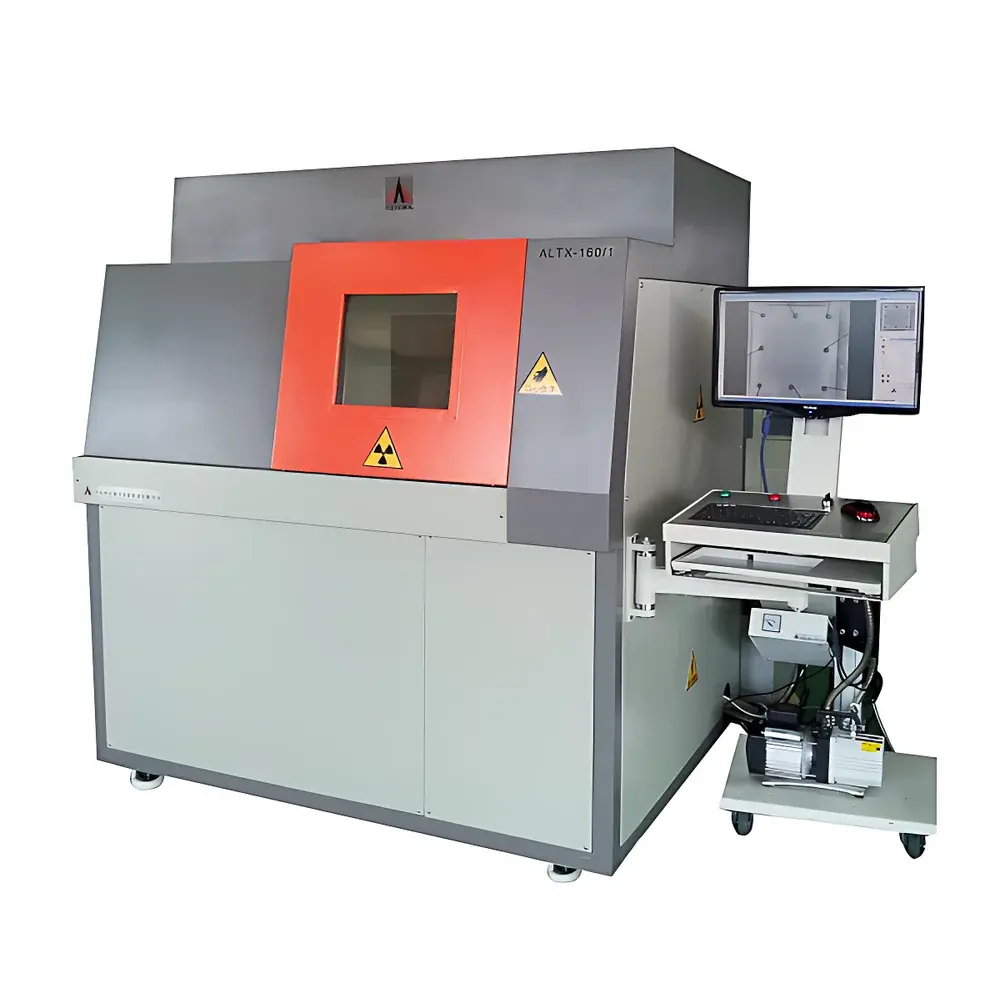
Aolong XYG-4503 High-Energy Industrial Micro-CT System with Dual-Mode DR/CT Imaging
| Brand | Aolong |
|---|---|
| Origin | Liaoning, China |
| Manufacturer Type | Direct Manufacturer |
| Regional Category | Domestic (China) |
| Model | XYG-4503 |
| Pricing | Upon Request |
| X-ray Tube Voltage | 20–450 kV |
| Focal Spot Size | 1 µm – 0.4 mm |
| Spatial Resolution | 0.5 µm |
| Density Resolution | 0.3–0.5% |
| Scan Geometry | Cone-Beam CT |
| Detector Options | Digital Flat-Panel Detector or Image Intensifier |
| Reconstruction Speed | ≤0.2 s per 1024×1024 pixel slice |
| Planar CT Mode Voltage Range | 20–225 kV |
| Planar CT Focal Spot | 1–5 µm |
| Planar CT Spatial Resolution | 0.6–50 µm |
Overview
The Aolong XYG-4503 is a high-energy industrial micro-computed tomography (micro-CT) system engineered for non-destructive evaluation (NDE) and dimensional metrology in demanding manufacturing and R&D environments. It integrates dual-mode imaging architecture—simultaneous cone-beam computed tomography (CBCT) and digital radiography (DR)—within a single compact gantry platform. The system employs a high-stability, high-frequency constant-potential X-ray source capable of continuous voltage modulation from 20 kV to 450 kV, enabling optimal penetration and contrast optimization across diverse material classes—from low-density polymer composites to high-Z alloys such as titanium and tungsten. Its core measurement principle relies on projection-based tomographic reconstruction (filtered backprojection and iterative algorithms), delivering isotropic voxel datasets with sub-micron spatial resolution. Unlike conventional 2D radiography systems, the XYG-4503 reconstructs volumetric data sets that preserve full geometric fidelity, allowing quantitative internal feature extraction—including porosity distribution, wall thickness mapping, and defect morphometry—without sectioning or destructive sampling.
Key Features
- Dual operational modes: Real-time DR imaging for rapid inspection and high-throughput CBCT scanning for volumetric analysis—both accessible without hardware reconfiguration.
- Modular X-ray source architecture supporting variable focal spot sizes (1 µm to 0.4 mm), balancing resolution and flux requirements across applications ranging from microelectronics to large castings.
- High-fidelity digital flat-panel detector (optional image intensifier) with >16-bit dynamic range and low-noise readout electronics, ensuring robust signal-to-noise ratio even at low-dose exposures.
- Automated defect segmentation engine with color-coded volumetric rendering: voids, inclusions, and cracks are classified by size, shape, and location; results exported as ISO-standardized defect reports (ASTM E2978, ISO 17025-compliant metadata).
- Quantitative wall thickness analysis module: generates false-color thickness maps with user-defined tolerance bands; supports GD&T-aligned reporting per ASME Y14.5.
- Integrated metrology suite compliant with VDI/VDE 2630 Part 1.2: traceable internal dimension measurement (e.g., bore diameters, cavity volumes, gap clearances) with uncertainty estimation based on voxel size, geometric calibration, and beam hardening correction.
- Reverse engineering pipeline: exports STL and point-cloud data directly to CAD platforms (SolidWorks, Siemens NX, Geomagic Control X); supports deviation analysis between scanned part and nominal CAD model.
Sample Compatibility & Compliance
The XYG-4503 accommodates samples up to Ø450 mm × 600 mm H (customizable turntable options available), with maximum mass capacity of 50 kg. It supports metallic, ceramic, composite, and electronic assemblies—including PCBs, BGA packages, MEMS devices, turbine blades, and additive-manufactured components. All imaging protocols adhere to ASTM E1441 (Standard Guide for Computed Tomography), ISO 15747 (Industrial CT safety and performance), and EN 13067 (NDT qualification). System calibration is traceable to NIST-certified phantoms (e.g., CT-100, QRM MicroCT Phantom). For regulated industries, audit trails, user access control, and electronic signature support align with FDA 21 CFR Part 11 and EU Annex 11 requirements when paired with optional validated software modules.
Software & Data Management
Control and reconstruction are executed via Aolong’s proprietary CT-Suite v4.x platform—a Windows-based application certified for IEC 62304 Class B medical device software development lifecycle (applicable to dual-use QA/QC workflows). The software includes DICOM 3.0 export, HDF5 dataset archiving, and Python API for custom algorithm integration (e.g., machine learning–based anomaly detection). Raw projections and reconstructed volumes are stored with embedded metadata: acquisition parameters, geometric calibration coefficients, dose metrics (Gy), and operator ID. Automated report generation supports PDF, HTML, and XML formats compliant with ISO/IEC 17025 clause 7.8.2 for test reporting.
Applications
- Aerospace: Porosity quantification in investment-cast turbine housings; verification of internal cooling channel integrity in additively manufactured heat exchangers.
- Automotive: Detection and volumetric sizing of shrinkage cavities in aluminum die-cast engine blocks; validation of adhesive bond line thickness in bonded EV battery enclosures.
- Electronics: Non-destructive inspection of solder joint voiding in QFN and flip-chip packages; layer alignment verification in multi-layer flexible PCBs.
- Medical Device Manufacturing: Dimensional validation of porous titanium scaffolds; coating thickness uniformity assessment on nitinol stents.
- Energy: Crack propagation monitoring in nuclear fuel cladding mock-ups; fiber orientation analysis in carbon-fiber wind turbine blade root sections.
FAQ
What is the minimum detectable defect size under standard operating conditions?
Detection limit depends on material density, sample geometry, and selected focal spot; for aluminum alloy samples scanned at 220 kV with 3 µm focus, sub-10 µm voids are reliably segmented with ≥95% recall at SNR > 8.
Does the system support automated batch scanning for production-line integration?
Yes—CT-Suite includes PLC interface (Modbus TCP, EtherNet/IP) and recipe-driven scan sequencing; cycle time for a full 360° scan with 1024 projections and reconstruction is ≤90 seconds.
Is the reconstruction engine GPU-accelerated?
Reconstruction leverages CUDA-enabled NVIDIA GPUs (RTX A6000 or equivalent); 1024³ volume reconstruction completes in <180 seconds using iterative SART with regularization.
Can the system perform in-situ mechanical testing during CT acquisition?
The XYG-4503 gantry supports third-party load frames (up to 50 kN) with synchronized trigger I/O; real-time 4D CT (3D + time) is achievable at frame rates up to 0.5 Hz for slow-deformation studies.
How is system calibration maintained over time?
Daily geometric calibration uses a stainless-steel ball grid phantom; annual traceable recalibration is performed using NIST-traceable step wedges and resolution bars, documented per ISO/IEC 17025.



