
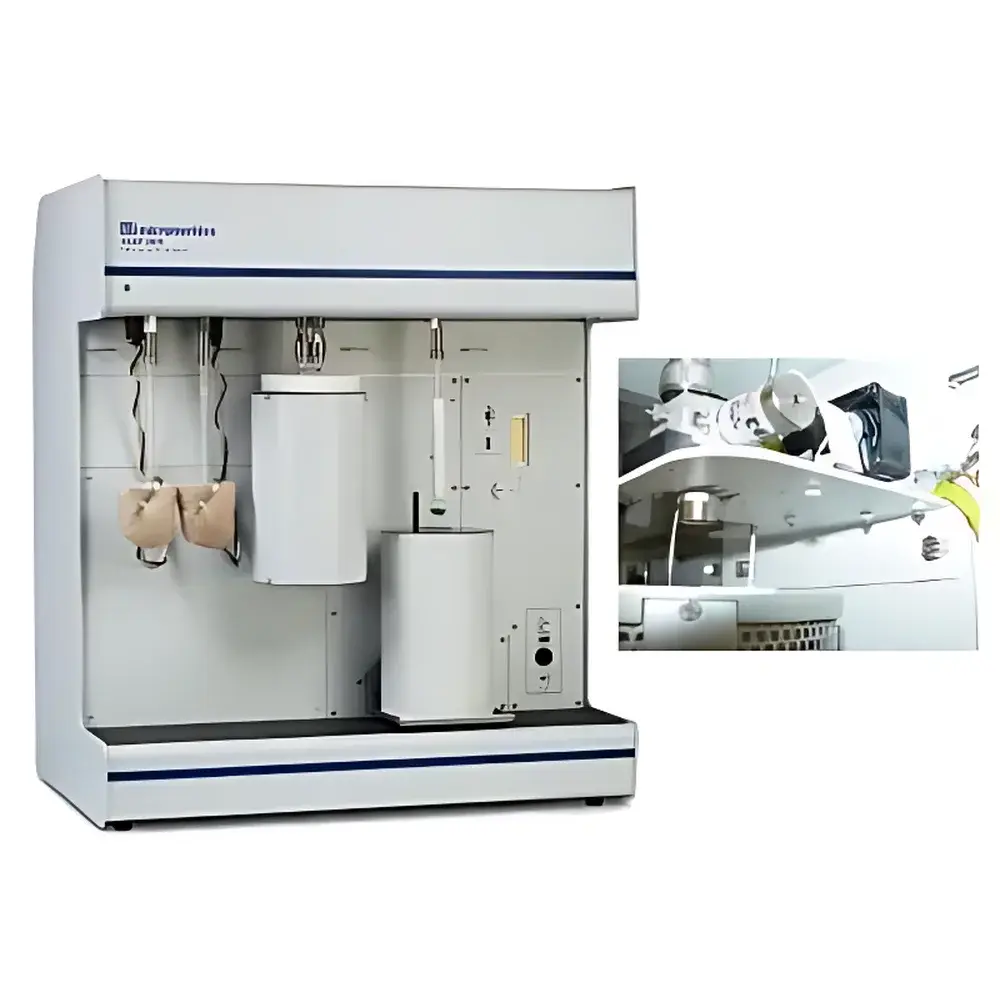
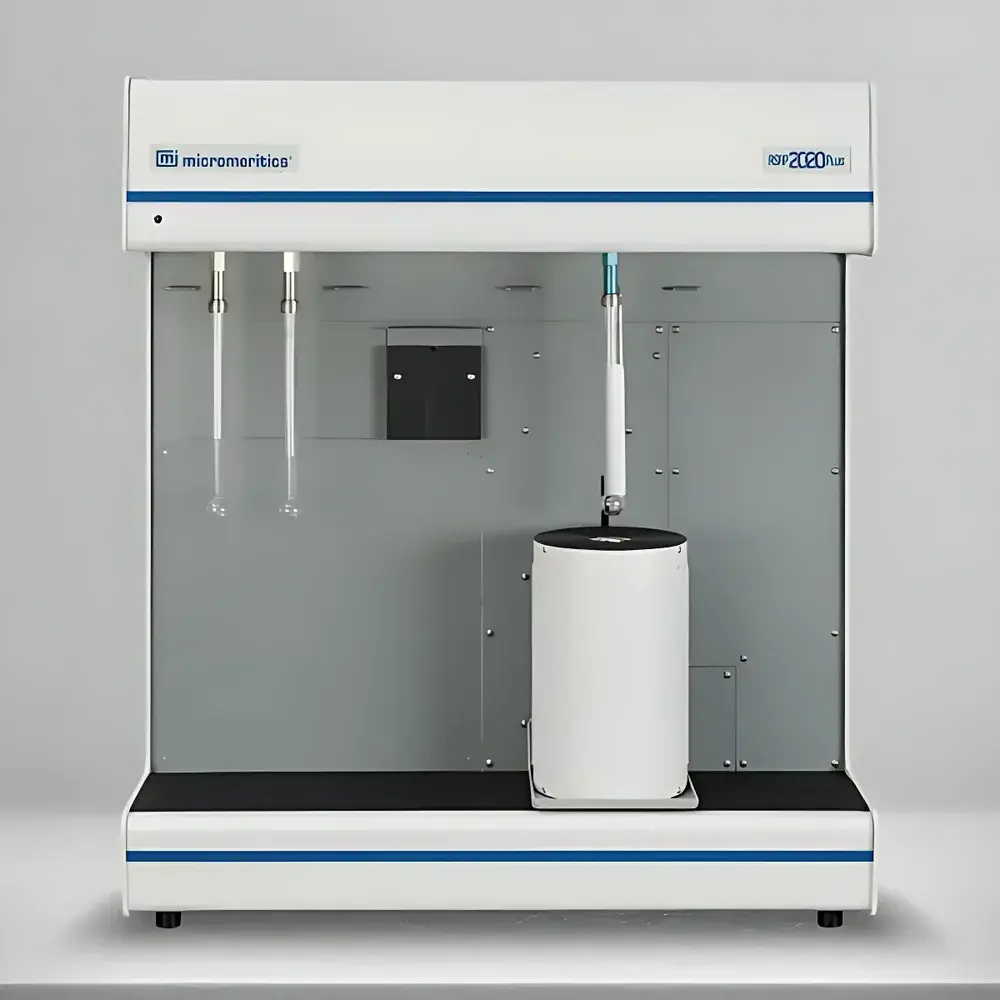
Micromeritics ASAP 2020 PLUS Automated Specific Surface Area and Micropore Analyzer
| Brand | Micromeritics |
|---|---|
| Origin | USA |
| Model | ASAP 2020 PLUS |
| Instrument Type | Specific Surface Area and Pore Size Analyzer |
| Principle | Static Volumetric Gas Adsorption |
| Analysis Stations | 1 |
| Pore Size Range | 0.35–500 nm |
| Relative Pressure Range | P/P₀ ≥ 10⁻⁸ |
| Theoretical Basis | Gas Adsorption Isotherm Analysis (BET, BJH, DFT, NLDFT, t-plot, αₛ-plot) |
Overview
The Micromeritics ASAP 2020 PLUS is a high-precision, fully automated surface area and porosity analyzer engineered for rigorous physical characterization of heterogeneous solid materials. It operates on the static volumetric gas adsorption principle—measuring the quantity of inert gas (typically N₂ at 77 K, or Ar at 87 K) adsorbed onto a solid surface as a function of relative pressure (P/P₀). This enables quantitative determination of specific surface area (via BET theory), total pore volume, pore size distribution (PSD) across microporous (0.35–2 nm), mesoporous (2–50 nm), and macroporous (>50 nm) regimes, and micropore-specific parameters such as micropore volume and surface area (via t-plot, αₛ-plot, and density functional theory [DFT/NLDFT] models). Designed for research laboratories and QC environments requiring traceable, reproducible data under GLP/GMP-aligned workflows, the system supports ASTM D3663, ISO 9277, ISO 15901, and IUPAC-recommended methodologies.
Key Features
- Single-analysis-station architecture with dual independent vacuum systems: while one sample undergoes adsorption/desorption analysis, up to two additional samples can be degassed simultaneously—maximizing throughput without compromising thermal stability or vacuum integrity.
- Real-time P₀ monitoring via integrated saturated vapor pressure sensor and thermostatically controlled isothermal jacketing—ensuring precise temperature uniformity (<±0.01 °C) between sample tube and reference P₀ tube during isotherm acquisition.
- Ultra-high sensitivity pressure transducers calibrated to 10⁻⁸ P/P₀, enabling reliable detection of monolayer formation and micropore filling in low-surface-area or highly microporous materials (e.g., MOFs, zeolites, activated carbons).
- Modular hardware design: field-upgradable configurations include low-surface-area measurement mode (extended integration time, enhanced signal-to-noise), cryostat-compatible operation for sub-ambient adsorbates (e.g., CO₂ at 273 K), corrosion-resistant gas handling pathways for acidic/basic vapors, and optional steam adsorption module for hydrophilicity/hydrophobicity assessment.
- Automated liquid nitrogen level control and auto-refill interface minimize operator intervention and ensure consistent cryogenic conditions over multi-hour isotherms.
Sample Compatibility & Compliance
The ASAP 2020 PLUS accommodates powders, granules, monoliths, and thin-film substrates across diverse material classes—including catalysts and catalyst supports (Al₂O₃, SiO₂, TiO₂, CeO₂), metal–organic frameworks (MOFs), covalent organic frameworks (COFs), activated carbons, silica gels, clays, pharmaceutical excipients, battery electrode materials (e.g., LiFePO₄, NMC), and geological samples. All measurements adhere to internationally recognized standards: surface area per ASTM D3663 and ISO 9277; pore size distribution per ISO 15901 Parts 1–3; and micropore analysis per IUPAC 2015 recommendations. Data audit trails, electronic signatures, and user-access-level controls align with FDA 21 CFR Part 11 requirements when deployed in regulated environments.
Software & Data Management
Instrument operation, method definition, and real-time data visualization are managed through Micromeritics’ proprietary TriStar™ software suite. The platform supports customizable isotherm acquisition protocols (stepwise or continuous), automated baseline correction, multi-model fitting (BET, Langmuir, DFT kernel libraries for carbon, silica, and alumina), and cross-validation of PSD results using complementary models (BJH, HK, DA, QSDFT). Raw data files (.asap) are stored in vendor-neutral ASCII format, exportable to CSV, Excel, or third-party analysis tools (e.g., Igor Pro, OriginLab). Software logs all instrument parameters, calibration events, and user actions with timestamped metadata—essential for regulatory documentation and method transfer.
Applications
- Catalysis R&D: Quantifying active surface area loss after thermal aging or sulfur poisoning; correlating micropore collapse with deactivation kinetics.
- Energy Materials: Characterizing pore accessibility in battery cathodes/anodes; evaluating electrolyte wetting behavior via argon adsorption at 87 K.
- Pharmaceutical Development: Assessing crystallinity impact on dissolution rate via surface area changes; verifying excipient porosity consistency across batches per USP .
- Environmental Engineering: Measuring adsorption capacity of biochars for heavy metal sequestration; mapping pore hierarchy in filtration membranes.
- Advanced Materials Synthesis: Validating synthetic control in MOF crystallinity (e.g., UiO-66, MIL-101) via DFT-derived micropore volume and narrow PSD width.
FAQ
What gases and temperatures are supported for adsorption analysis?
Standard operation uses N₂ at 77 K for surface area and meso/macro-porosity; Ar at 87 K for improved resolution in micropores; CO₂ at 273 K for ultra-micropore (<0.7 nm) characterization. Optional steam, ethanol, or toluene modules enable vapor-phase isotherms.
Can the system perform chemisorption measurements?
No—the ASAP 2020 PLUS is dedicated to physisorption. For chemisorption (e.g., H₂, CO, O₂ uptake), Micromeritics’ AutoChem™ series is recommended.
Is remote monitoring or unattended overnight operation possible?
Yes. The system supports scheduled runs, email alerts upon completion/failure, and secure remote desktop access via IT-approved protocols—subject to local network configuration.
How is calibration traceability maintained?
Pressure transducers are factory-calibrated against NIST-traceable deadweight testers; temperature sensors are certified to ±0.02 °C accuracy; certified reference materials (e.g., NIST SRM 1990a) are provided for routine performance verification.
Does the software support IQ/OQ/PQ documentation packages?
Yes—Micromeritics offers validated installation qualification (IQ), operational qualification (OQ), and performance qualification (PQ) templates compliant with ISO/IEC 17025 and GxP laboratory requirements.
Related Products



