
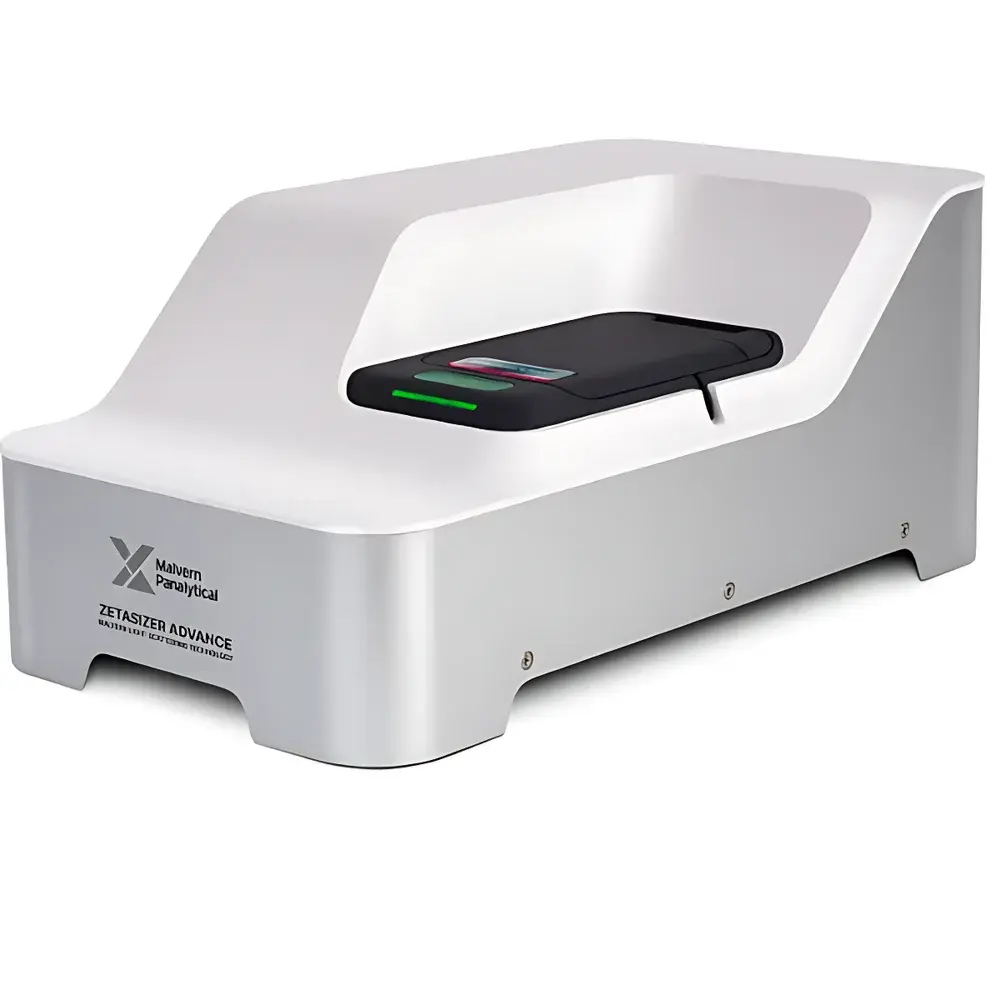
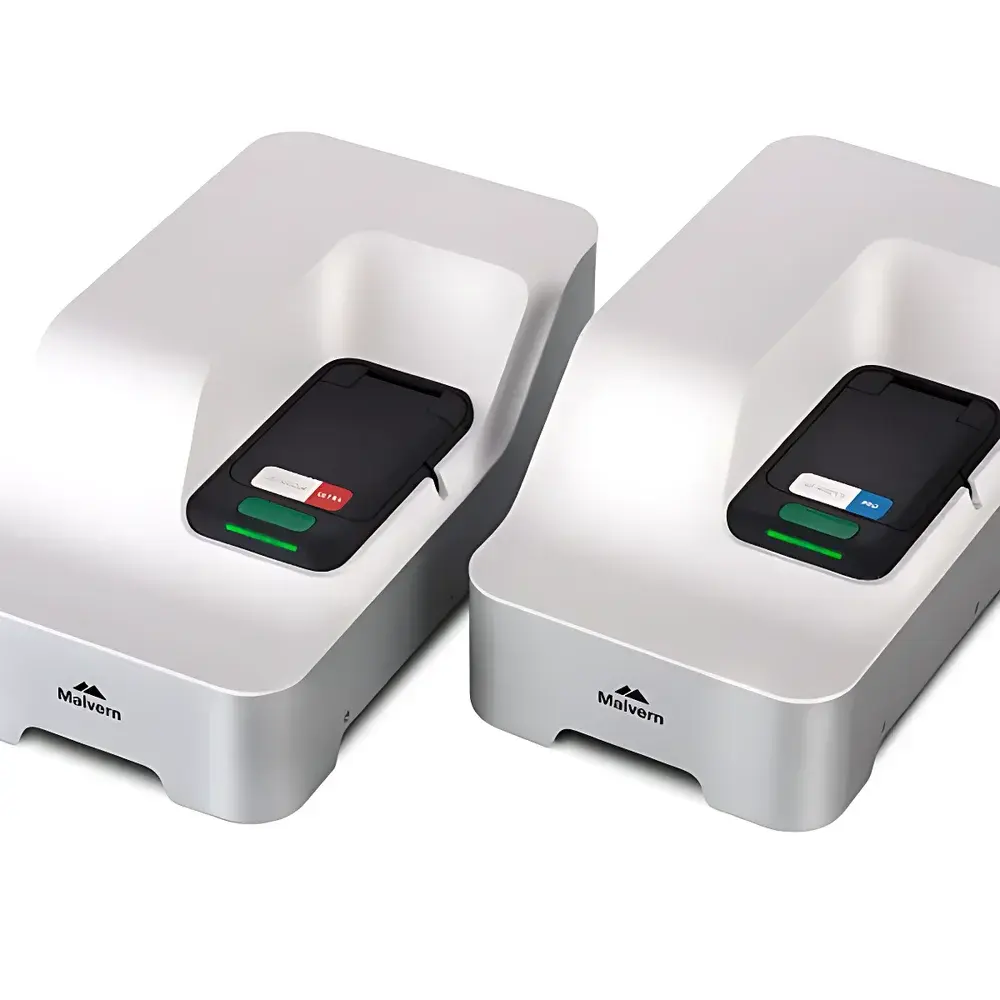
Malvern PANalytical Zetasizer Ultra Nanoparticle Size and Zeta Potential Analyzer
| Brand | Malvern PANalytical |
|---|---|
| Origin | United Kingdom |
| Model | Blue Label and Red Label variants |
| Particle Size Range | 0.3 nm – 15 µm |
| Size Reproducibility | ±2% |
| Temperature Control Range | 10–35 °C |
| Temperature Stability | ±0.1 °C |
| Zeta Potential Range | No effective limit |
| Measurement Time | 3–5 min |
| Molecular Weight Range | 980 Da – 20 MDa |
| Concentration Range | 0.1 mg/mL – 40% w/v |
| Minimum Sample Volume | 3 µL |
| Particle Sizing Method | Non-Invasive Back Scatter (NIBS) DLS and Multi-Angle Dynamic Light Scattering (MADLS®) |
| Zeta Potential Method | M3-PALS (Phase Analysis Light Scattering) with Constant Current Mode |
| Software Compliance | FDA 21 CFR Part 11, GLP/GMP-ready audit trail |
| Optional Accessories | MPT-3 Auto-Titrator, Polarization/Fluorescence Filter Wheel, Disposable Capillary Cells |
Overview
The Malvern PANalytical Zetasizer Ultra is a high-performance, research-grade nanoparticle characterization system engineered for simultaneous, high-resolution measurement of particle size, molecular size, zeta potential, and—on the Red Label configuration—particle concentration. It operates on the physical principles of dynamic light scattering (DLS), electrophoretic light scattering (ELS), and static light scattering (SLS), integrated within a single optical platform. The instrument leverages Non-Invasive Back Scatter (NIBS®) detection to enable robust sizing across an exceptionally broad concentration range without dilution artifacts, while its proprietary Multi-Angle Dynamic Light Scattering (MADLS®) technology eliminates angular dependence in intensity-weighted distributions, delivering angle-independent, high-fidelity particle size distributions (PSDs) with enhanced resolution and reproducibility. Designed for laboratories requiring regulatory compliance and method robustness, the Zetasizer Ultra supports both routine QC and advanced R&D workflows in biopharmaceuticals, nanomaterials science, colloid chemistry, and formulation development.
Key Features
- Multi-Angle Dynamic Light Scattering (MADLS®): Generates unified, angle-independent particle size distributions by correlating data from multiple detection angles—improving resolution and reducing ambiguity in polydisperse systems.
- NIBS® Detection Geometry: Enables high-sensitivity measurements of highly concentrated or turbid samples (up to 40% w/v) without dilution or filtration, minimizing preparation-induced artifacts.
- M3-PALS Technology with Constant Current Mode: Delivers stable, accurate zeta potential measurements in high-conductivity media (e.g., physiological buffers, cell culture supernatants), supporting reliable stability assessment under native conditions.
- Disposable Capillary Cell System: Requires only 3 µL sample volume, suppresses thermal convection, extends upper sizing limit to 15 µm, and ensures zero cross-contamination between runs.
- ZS Xplorer Software: A workflow-driven, user-configurable platform compliant with FDA 21 CFR Part 11, featuring full audit trail, electronic signatures, and customizable report templates for GLP/GMP environments.
- Adaptive Correlation Algorithm: Accelerates autocorrelation function analysis by >2× versus prior generations, improving throughput without compromising data fidelity or repeatability.
- AI-Enhanced Data Quality Engine: Applies trained models to evaluate correlation quality, baseline noise, and aggregation artifacts—providing actionable feedback to optimize measurement parameters.
- Integrated Static Light Scattering (90°): Enables absolute molecular weight determination for proteins, polymers, and synthetic macromolecules using Debye or Zimm analysis.
Sample Compatibility & Compliance
The Zetasizer Ultra accommodates diverse sample types—including proteins, monoclonal antibodies, viral vectors, VLPs, liposomes, polymeric nanoparticles, colloidal silica, quantum dots, and pigment dispersions—across physicochemical conditions relevant to real-world applications. Its NIBS geometry and MADLS capability allow direct analysis of undiluted biological formulations and complex emulsions, reducing method development time and preserving native aggregation states. All hardware and software components are designed to meet international standards including ISO 22412 (DLS), ISO 13099 (zeta potential), and ASTM E2490 (nanoparticle size distribution). The system supports full traceability per ICH Q5C, USP , and EU Pharmacopoeia 2.9.31 requirements, with optional IQ/OQ/PQ documentation packages available for regulated environments.
Software & Data Management
ZS Xplorer serves as the central analytical hub, combining intuitive guided workflows with advanced modeling flexibility. Users can define custom SOPs, apply batch processing across multi-parameter datasets, and generate export-ready reports in PDF, CSV, or XML formats. The software implements role-based access control, secure electronic signatures, and immutable audit trails aligned with FDA 21 CFR Part 11 and Annex 11 expectations. Raw correlation data, intermediate fitting results, and metadata are stored in a structured SQLite database, enabling retrospective reprocessing and version-controlled method validation. Integration with LIMS and ELN platforms is supported via standard APIs and OPC UA connectivity.
Applications
- Biopharmaceutical Development: Rapid assessment of protein aggregation kinetics, excipient screening, buffer optimization, and comparability studies during biosimilar development.
- Viral Vector Characterization: Size and charge profiling of AAV, lentivirus, and mRNA-LNPs—critical for potency, purity, and manufacturability assessments.
- Nanomaterial Safety & Functionality: Evaluation of dispersion stability, surface charge modulation, and environmental fate of engineered nanomaterials per OECD TG 125 and ISO/IEC 17025 frameworks.
- Food & Beverage Colloids: Monitoring droplet size evolution in emulsions, starch granule swelling, and casein micelle behavior under thermal or pH stress.
- Coatings & Inks: Quantifying pigment agglomeration, stabilizer efficacy, and shelf-life prediction via accelerated aging protocols.
- Academic Research: Supporting peer-reviewed publications in soft matter physics, polymer science, and interfacial engineering—cited in over 10,000 indexed studies.
FAQ
What distinguishes the Red Label from the Blue Label configuration?
The Red Label includes MADLS-enabled particle concentration quantification (particles/mL), automated titration compatibility via MPT-3, and extended software modules for advanced stability modeling and batch release reporting.
Can the Zetasizer Ultra measure samples in high-salt buffers?
Yes—M3-PALS with constant current mode enables reliable zeta potential measurements in conductivities up to 200 mS/cm, making it suitable for physiological saline, cell lysates, and fermentation broths.
Is calibration required before each measurement?
No routine calibration is needed; the system uses factory-characterized optics and temperature-controlled reference cells. Verification checks are performed automatically during startup and can be scheduled as part of preventive maintenance.
How does the instrument handle aggregated or heterogeneous samples?
The Adaptive Correlation algorithm detects multimodal decay profiles and applies constrained regularization to resolve distinct populations; users may also employ CONTIN or NNLS deconvolution methods within ZS Xplorer.
Does the software support automated pass/fail criteria for release testing?
Yes—users can define specification limits for size, PDI, zeta potential, and concentration, triggering visual alerts and auto-generated compliance summaries for GMP batch records.



