
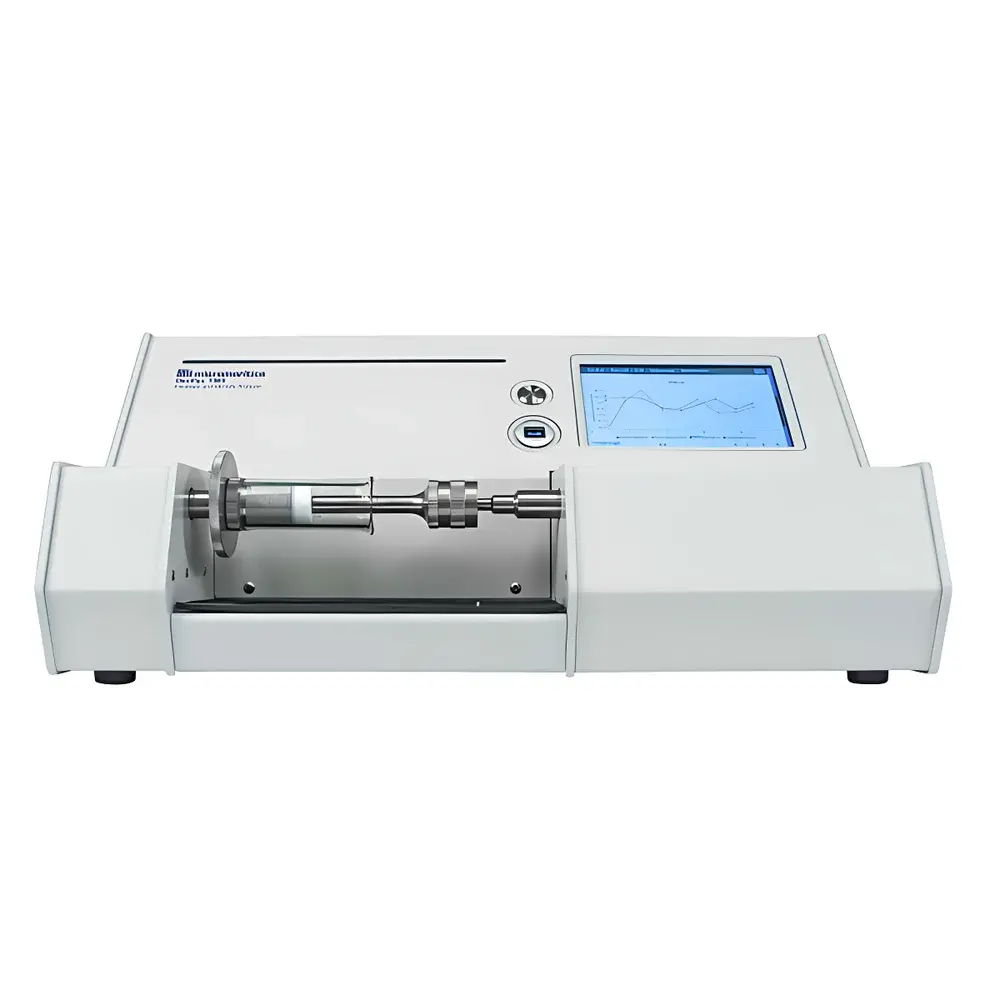
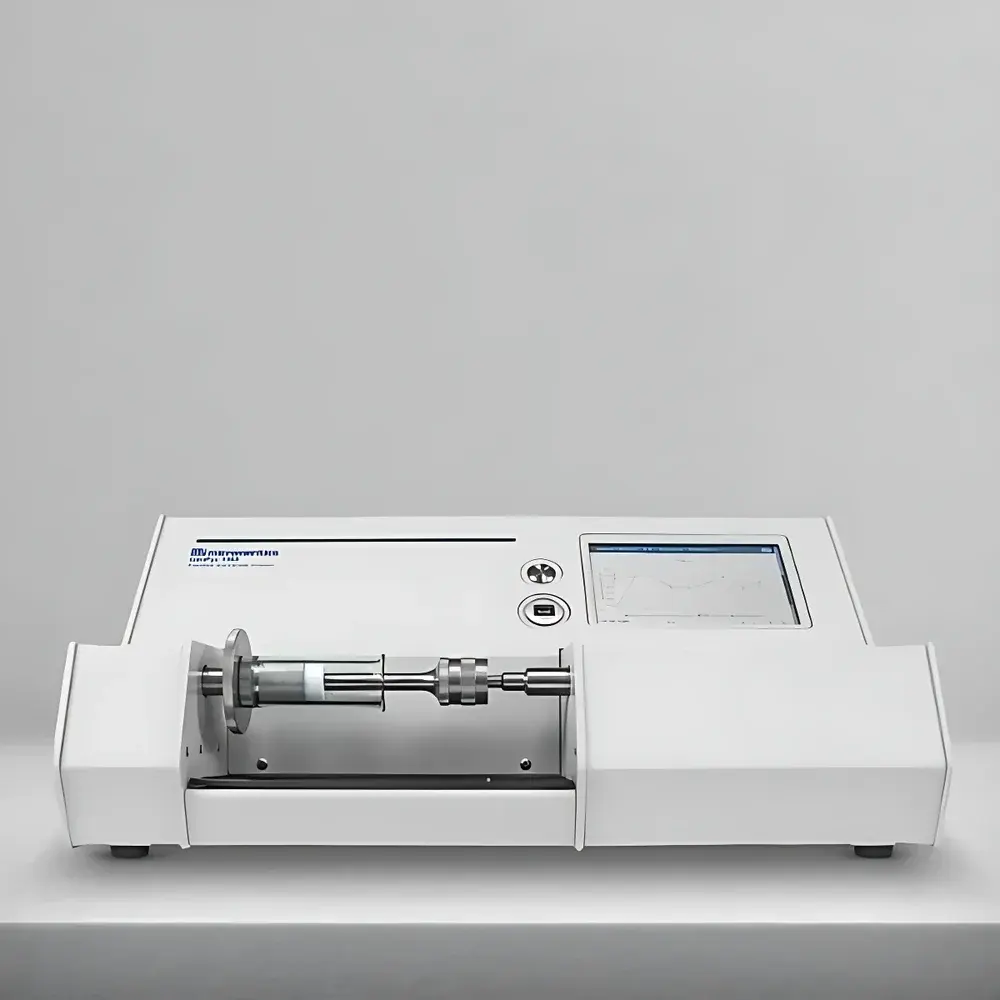
Micromeritics GeoPyc 1365 Automated Envelope Density Analyzer
| Brand | Micromeritics |
|---|---|
| Origin | USA |
| Model | GeoPyc 1365 |
| Instrument Type | Benchtop Envelope Density Analyzer |
| Sample Form | Solids (powders, granules, irregular solids, tablets, foams) |
| Measurement Principle | Solid displacement using Dry Flo™ quasi-fluid medium |
| Envelope Volume Range | 0.3–25 cm³ (via interchangeable sample cups) |
| Density Accuracy | <0.15% deviation vs. ASTM D1895, D6342, D7481 |
| Operating Temperature | 15–35 °C |
| Minimum Sample Requirement | ≥25% of selected cup volume |
| Compliance | ASTM D1895 (Type A), D6342, D7481, ISO 697, USP <699>, FDA 21 CFR Part 11 (with optional audit trail module) |
| Optional T.A.P. Density Module | Programmable consolidation force (0.5–10 N), stepwise compression cycles, real-time force & displacement monitoring |
Overview
The Micromeritics GeoPyc 1365 Automated Envelope Density Analyzer is an ASTM-compliant benchtop instrument engineered for precise, non-destructive determination of envelope (or apparent) density and volume of solid materials—including irregularly shaped particles, pharmaceutical tablets, battery electrode coatings, catalyst pellets, foams, and porous ceramics. Unlike gas pycnometry (e.g., AccuPyc), which measures skeletal or true density by helium displacement, the GeoPyc employs a solid displacement methodology based on a proprietary quasi-fluid medium: Dry Flo™. This medium consists of uniformly sized, rigid, spherical glass beads (diameter ≈ 40–60 µm) exhibiting high flowability and negligible compressibility. During analysis, the sample is placed atop a settled Dry Flo™ bed; controlled vibration induces gentle intermixing, allowing Dry Flo™ to conform precisely to the external surface contour—filling macro-voids between particles but excluding intraparticle pores and closed-cell voids. The resulting displaced volume corresponds directly to the envelope volume—the space occupied by the sample including all open and closed surface-accessible voids. This principle aligns with ASTM D1895 Type A and D6342 for plastics and powders, respectively, and supports regulatory reporting in GMP environments where envelope density informs dosage uniformity, tablet hardness prediction, and electrode coating consistency.
Key Features
- Automated envelope density measurement with <0.15% deviation from ASTM reference methods across diverse material classes
- Benchtop footprint (<50 cm W × 45 cm D × 40 cm H) optimized for QC labs and R&D workstations
- Interchangeable sample cups (0.3, 1, 5, 10, and 25 cm³ volumes) enabling analysis of sub-milligram to multi-gram samples while maintaining volumetric resolution ≤0.001 cm³
- Intuitive 7-inch capacitive touchscreen interface with preloaded SOPs, user-defined method templates, and password-protected access levels
- Dry Flo™ recovery system: post-analysis, minimal mechanical agitation removes >99.8% of medium, enabling full sample recovery for retesting or downstream characterization
- Optional T.A.P. (Tapped Apparent Density) module with integrated load cell (±0.02 N resolution) and rotary consolidation mechanism for dynamic packing studies under programmable force (0.5–10 N) and cycle count (1–99)
- Real-time process monitoring: live display of vibration profile, cup settling status, and intermediate volume calculation during each analysis cycle
Sample Compatibility & Compliance
The GeoPyc 1365 accommodates heterogeneous solids without size reduction or solvent exposure—critical for fragile, hygroscopic, or reactive materials. Validated applications include: free-flowing API powders (e.g., lactose, mannitol), coated granules, sintered metal parts, aerogels, carbon black agglomerates, and lithium-ion cathode composites. All measurements comply with ASTM D1895 (plastics), D6342 (pharmaceutical powders), D7481 (ceramics), ISO 697 (rubber), and USP (density of solids). When configured with the optional 21 CFR Part 11 compliance package, the system provides electronic signatures, immutable audit trails, and role-based data access control—meeting GLP/GMP documentation requirements for regulated pharmaceutical, medical device, and battery manufacturing facilities.
Software & Data Management
GeoPyc Control Software v4.x operates on Windows 10/11 and supports fully automated batch processing, customizable report generation (PDF, CSV, XML), and direct integration with LIMS via ASTM E1384-compliant export protocols. Each analysis stores raw displacement curves, environmental metadata (ambient temperature, humidity), operator ID, calibration history, and timestamped audit logs. Calibration routines include blank volume verification, cup volume mapping, and reference solid validation using NIST-traceable density standards (e.g., fused quartz, stainless steel spheres). Data integrity safeguards include automatic checksum validation, write-protected archival folders, and configurable backup intervals to network drives or cloud storage endpoints.
Applications
- Pharmaceutical: Tablet envelope density correlation with dissolution rate and mechanical strength per ICH Q5C guidelines
- Battery Materials: Anode/cathode powder packing density assessment prior to slurry formulation and calendering
- Polymers & Plastics: Quality control of pelletized resins per ASTM D1895 for extrusion consistency
- Catalysis: Monitoring pellet integrity and macro-porosity changes after thermal aging or sulfidation
- Advanced Ceramics: Quantifying green-body density uniformity prior to sintering to predict dimensional shrinkage
- Food Science: Measuring bulk density of cereal flakes, coffee grounds, or powdered dairy products for packaging optimization
FAQ
How does GeoPyc differ from gas pycnometry (e.g., AccuPyc)?
GeoPyc measures envelope density by solid displacement using Dry Flo™, capturing external geometry and interparticle voids. AccuPyc measures skeletal density via helium gas intrusion, excluding all pores. The two techniques are complementary—not interchangeable.
Can GeoPyc measure true density?
No. True (skeletal) density requires gas or liquid pycnometry. GeoPyc reports envelope density only—defined as mass divided by volume occupied, including surface-accessible voids.
Is Dry Flo™ reusable? How often must it be replaced?
Yes. Dry Flo™ is chemically inert, non-abrasive, and recoverable >200 times per batch. Replacement is recommended after 500 analyses or if visual contamination or flow degradation is observed.
What sample preparation is required?
None beyond ensuring the sample is dry and free of surface oils or static charge. No sieving, grinding, or degassing is necessary.
Does GeoPyc support IQ/OQ/PQ validation documentation?
Yes. Micromeritics provides full GxP validation kits—including protocol templates, test scripts, and summary reports aligned with ASTM E2500 and Annex 11.



