
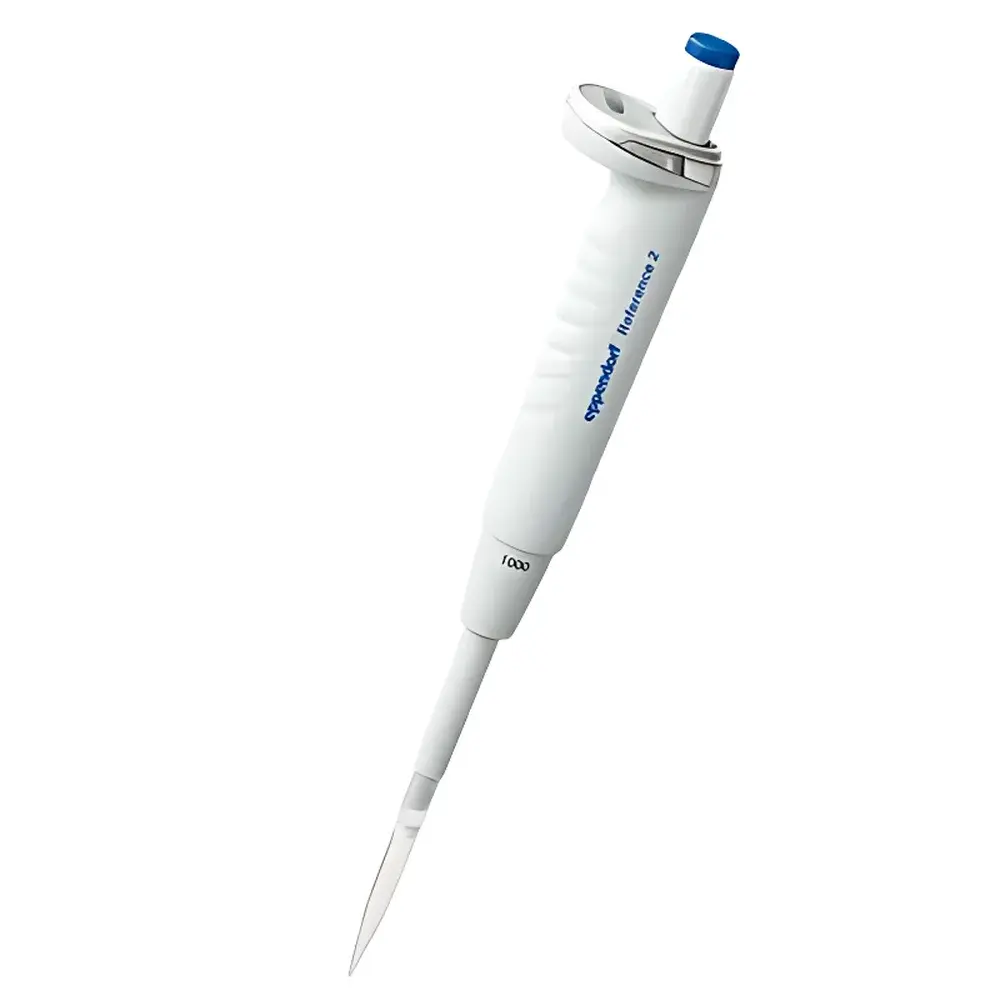
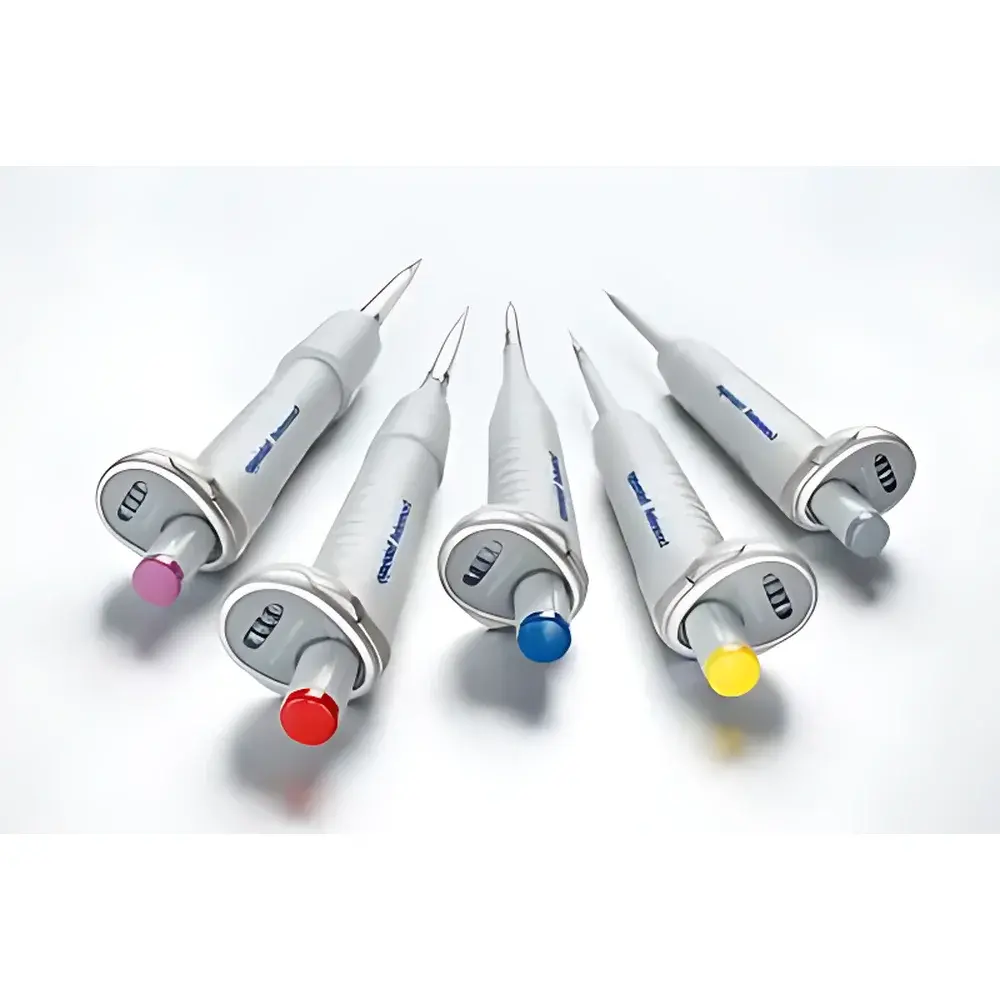
Eppendorf Reference 2 Single-Channel Adjustable Volume Pipette
| Brand | Eppendorf |
|---|---|
| Origin | Germany |
| Manufacturer | Eppendorf AG |
| Product Type | Imported |
| Model | Reference 2 Single-Channel |
| Instrument Category | Single-Channel Pipette |
| Automation Level | Manual |
| Channels | 1 |
| Volume Range | 0.1 µL – 10 mL |
| Maximum Capacity | 10 mL |
| Accuracy | ±0.6 % |
| Sterilization | Fully autoclavable (121 °C, 20 min) |
| RFID Integration | Yes (requires Eppendorf TrackIT reader) |
| Ergonomic Design | Thumb-actuated single-button operation with tactile feedback |
| Tip Ejection | Integrated tip ejection with pre-ejection resistance detection |
| Display | Four-digit volume display, omnidirectional readability |
| Volume Lock | Dual-side mechanical volume lock |
| Tip Compatibility | Universal low-retention and standard conical tips |
| Surface Finish | Electro-polished stainless steel upper housing with soft-touch polymer grip |
Overview
The Eppendorf Reference 2 Single-Channel Adjustable Volume Pipette is an engineered precision liquid handling instrument designed for laboratories requiring high reproducibility, traceability, and long-term reliability in manual pipetting workflows. Based on the proven Couette-flow principle of piston-driven air displacement, the Reference 2 delivers consistent volumetric delivery across its full range—from ultra-low volumes (0.1 µL) to high-capacity transfers (up to 10 mL)—while maintaining ISO 8655-compliant accuracy (±0.6 % at nominal volume) and precision (CV ≤ 0.3 %). Its fully autoclavable construction—validated per DIN EN 285 for 121 °C, 20 minutes—ensures compliance with GLP, GMP, and clinical laboratory standards where sterility and contamination control are critical. The pipette’s core architecture integrates a sealed, wear-resistant piston system with a thermally stable polymer body and electro-polished stainless-steel upper housing, minimizing thermal drift and mechanical hysteresis during repeated use.
Key Features
- Single-button operation with integrated tactile feedback prior to tip ejection—reducing aerosol generation and improving user safety.
- Ergonomic thumb-actuated mechanism requiring minimal force (≤1.2 N for aspiration, ≤1.5 N for ejection), significantly lowering risk of repetitive strain injury (RSI) during high-throughput tasks.
- Four-digit, omni-directional volume display with color-coded capacity indicators—enabling rapid visual verification from any angle without repositioning the hand.
- Dual-side mechanical volume lock prevents accidental adjustment; combined with top-edge stainless-steel reinforcement, it protects internal calibration integrity and external impact zones.
- RFID chip embedded in handle stores immutable device metadata—including serial number, catalog number, calibration history, and sterilization cycles—accessible via Eppendorf TrackIT hardware for audit-ready traceability (aligned with FDA 21 CFR Part 11 requirements).
- Elastomer-tipped nozzle ensures consistent tip seal formation and uniform aspiration/dispense kinetics across variable tip brands and lot batches.
- Smooth, seamless polymer grip surface—free of finger grooves—supports neutral wrist posture and facilitates cleaning between biosafety levels.
Sample Compatibility & Compliance
The Reference 2 supports universal conical tip formats (including low-retention, filtered, and sterile barrier tips) across all volume ranges. It is validated for aqueous solutions, buffers, cell suspensions, serum, and viscous reagents up to 50 cP viscosity (with appropriate technique adjustment). All materials contacting liquids comply with USP Class VI biocompatibility testing and EU Directive 2002/72/EC for food-contact plastics. Device certification includes ISO 9001:2015 manufacturing quality management, ISO 13485:2016 for medical device design controls, and conformity with IEC 61000-4 electromagnetic compatibility standards. Routine calibration intervals align with ISO/IEC 17025–accredited lab protocols and support full audit trails for regulatory submissions.
Software & Data Management
While the Reference 2 operates independently as a manual instrument, its embedded RFID enables integration into Eppendorf’s digital ecosystem. When paired with TrackIT readers and LabManager software, users can log sterilization events, track usage frequency, generate calibration reminders, and export device-specific metadata in CSV or XML format. Audit logs retain timestamps, operator IDs (via optional badge integration), and parameter changes—meeting ALCOA+ data integrity principles (Attributable, Legible, Contemporaneous, Original, Accurate) required under GxP frameworks.
Applications
- Quantitative sample preparation for qPCR, ELISA, and NGS library construction.
- Cell culture passaging and reagent dilution under aseptic conditions.
- Calibration standard preparation in analytical chemistry and reference material labs.
- Quality control testing in pharmaceutical manufacturing environments governed by Annex 1 and USP .
- Teaching laboratories requiring durable, intuitive instruments compliant with ISO/IEC 17025 pedagogical validation guidelines.
FAQ
Is the Reference 2 compatible with third-party pipette tips?
Yes—it accepts all standard conical tips meeting ISO 8655-2 dimensional tolerances, though optimal performance (especially below 10 µL) is achieved with Eppendorf Research plus or LoRetention tips.
Can the pipette be calibrated in-house?
Yes—mechanical calibration is possible using Eppendorf’s certified calibration kits and gravimetric procedures per ISO 8655-6; however, factory recalibration is recommended annually or after 10,000 autoclave cycles.
Does the RFID chip require battery power?
No—the passive RFID tag draws energy from the TrackIT reader’s RF field and retains data indefinitely without power.
What is the warranty coverage?
Eppendorf provides a 24-month limited warranty covering material and workmanship defects, extendable to 36 months with registration and annual TrackIT-linked maintenance reporting.
How does the volume lock prevent misalignment during transport?
The dual-lock mechanism physically immobilizes both the volume adjustment sleeve and the plunger gear train, eliminating drift even under centrifugal or vibrational stress encountered in mobile lab settings or automated storage systems.



