
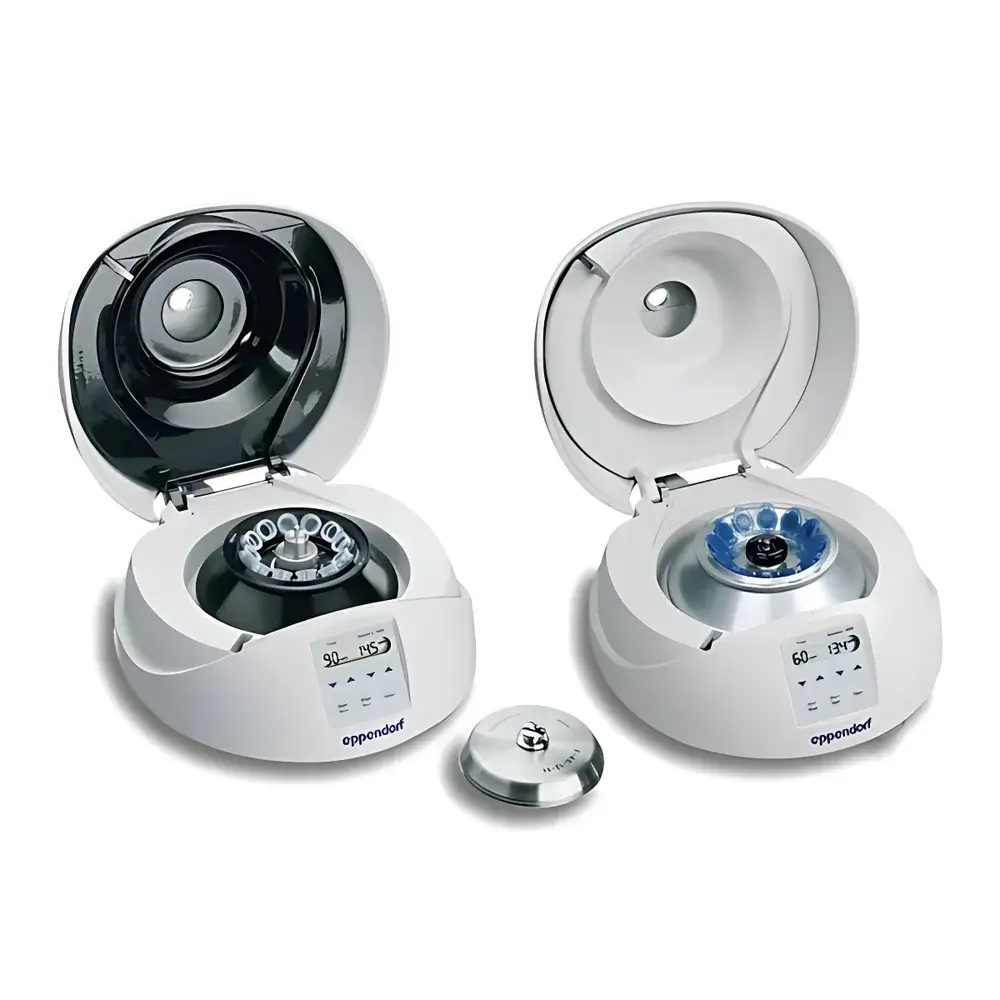
Eppendorf MiniSpin Plus Personal High-Speed Microcentrifuge
| Brand | Eppendorf |
|---|---|
| Origin | Germany |
| Manufacturer | Eppendorf AG |
| Product Type | Benchtop Microcentrifuge |
| Model | MiniSpin / MiniSpin Plus |
| Centrifugation Range | High-Speed (up to 14,500 rpm) |
| Max Rotor Capacity | 12 × 1.5/2.0 mL tubes + 2 × PCR strips |
| Max Speed | 14,500 rpm |
| Max RCF | 14,100 × g |
| Acceleration/Deceleration Time | <13 s (0 ↔ max speed) |
| Dimensions (W × D × H) | 22.6 × 23.9 × 12.0 cm |
| Rotor Material | Anodized Aluminum |
| Cooling Mechanism | Passive Airflow Optimization (No Active Refrigeration) |
| Timer Range | 10 s – 99 min (MiniSpin Plus only) |
| Instant Spin Function | Dedicated “Short Spin” Button |
| Lid Operation | Soft-close mechanism with automatic lid opening post-run |
| Compliance | IEC 61010-1, EN 61326-1 (EMC), CE Marked for Laboratory Use |
Overview
The Eppendorf MiniSpin Plus is a compact, high-performance personal microcentrifuge engineered for routine molecular biology workflows in space-constrained laboratory environments. Operating on the principle of sedimentation centrifugation—where differential particle migration under controlled gravitational force separates macromolecules, cellular organelles, and microbial cells—the MiniSpin Plus delivers reproducible RCF up to 14,100 × g at 14,500 rpm. Its design targets users requiring rapid, reliable, and intuitive sample processing without sacrificing precision or safety. Unlike refrigerated centrifuges, the MiniSpin Plus relies on optimized passive airflow architecture to minimize temperature rise during short-duration spins—a critical feature for preserving enzyme activity, nucleic acid integrity, and protein conformation in sensitive downstream applications such as PCR setup, plasmid purification, and RNA extraction.
Key Features
- Ultra-compact footprint (22.6 × 23.9 × 12.0 cm) enables placement directly beside biosafety cabinets, pipette stations, or benchtop workspaces—ideal for shared labs and mobile research units.
- High-speed performance with maximum rotational speed of 14,500 rpm and corresponding RCF of 14,100 × g ensures efficient pelleting of bacterial cells, mammalian nuclei, and precipitated nucleic acids within seconds.
- Dual-display digital interface shows real-time speed (rpm) and relative centrifugal force (RCF); MiniSpin Plus supports instant unit conversion between rpm and RCF for method transferability and protocol standardization.
- Integrated “Short Spin” button allows immediate centrifugation for ≤10 seconds without timer programming—essential for quick pellet collection prior to supernatant aspiration or buffer exchange.
- Anodized aluminum rotor and lid assembly provide chemical resistance against common lab reagents including ethanol, isopropanol, chloroform, and mild acidic/basic solutions—ensuring long-term mechanical stability and ease of decontamination.
- Soft-closing lid mechanism reduces operator fatigue and eliminates risk of impact damage; automatic lid release after run completion prevents thermal buildup and accelerates sample retrieval.
- Optimized internal airflow path dissipates heat generated by motor and rotor friction, maintaining ambient-temperature operation even during repeated 5–10 minute runs—validated per ISO 13485-aligned thermal profiling protocols.
Sample Compatibility & Compliance
The MiniSpin Plus accommodates standard microcentrifuge tube formats: twelve 1.5 mL or 2.0 mL conical tubes (including Eppendorf Safe-Lock™ tubes), plus two full 8-tube PCR strip positions. It is compatible with all Eppendorf-certified rotors and adapters meeting DIN 58953-2 specifications. The device complies with IEC 61010-1 (Safety Requirements for Electrical Equipment for Measurement, Control, and Laboratory Use) and EN 61326-1 (EMC requirements for laboratory equipment). While not a GLP/GMP-regulated instrument per se, its consistent performance, traceable calibration history (via optional service documentation), and stable RCF output support adherence to internal SOPs aligned with ISO/IEC 17025 quality management systems.
Software & Data Management
The MiniSpin Plus operates via embedded firmware with no external software dependency. All operational parameters—including speed, time, and acceleration profile—are stored locally in non-volatile memory. Though it lacks network connectivity or audit trail functionality, its deterministic behavior, fixed timer resolution (1-second increments), and absence of user-modifiable firmware make it suitable for regulated environments where simplicity, reliability, and minimal validation burden are prioritized. For laboratories implementing 21 CFR Part 11 compliance, the MiniSpin Plus may be deployed as a “low-risk” ancillary device when paired with electronic lab notebooks (ELNs) that capture centrifugation metadata manually or via barcode-scanned protocol templates.
Applications
- Routine nucleic acid purification (plasmid preps, gel extraction, column-based cleanups)
- Bacterial and yeast cell harvesting (OD600 normalization, lysate clarification)
- Protein precipitation and desalting steps in proteomics workflows
- Microfilter spin-column processing (e.g., DNA binding/elution, antibody cleanup)
- PCR/qPCR reaction assembly and plate centrifugation prior to thermal cycling
- Small-volume solvent extraction and phase separation (e.g., phenol-chloroform)
- Storage tube aliquoting and re-suspension of lyophilized reagents
FAQ
Is the MiniSpin Plus refrigerated?
No. It is an ambient-temperature microcentrifuge. Thermal management relies on passive airflow optimization—not active cooling—to limit sample warming during typical use cycles.
Can I use it with 0.5 mL tubes or PCR plates?
Yes—using Eppendorf’s optional adapter sets (e.g., FA-45-24-11 rotor with 0.5 mL tube inserts or PCR plate carriers), though maximum RCF remains governed by rotor geometry and mass distribution.
Does it support rotor imbalance detection or automatic shutdown?
Yes. Built-in vibration sensing triggers immediate deceleration if rotor imbalance exceeds safe thresholds, complying with IEC 61010-2-020 Annex B requirements for centrifuge safety.
What maintenance is required?
Routine cleaning of the rotor chamber and lid seal with 70% ethanol; annual inspection of rotor threads and lid latch mechanism recommended per Eppendorf Service Bulletin SB-MINISPIN-2023.
Is rotor lifetime tracked or logged?
No. Rotors are designated for unlimited use under normal operating conditions, provided they are inspected visually before each use for cracks, corrosion, or deformation—as specified in Eppendorf’s User Manual Rev. 5.2 (2022).
Related Products



