
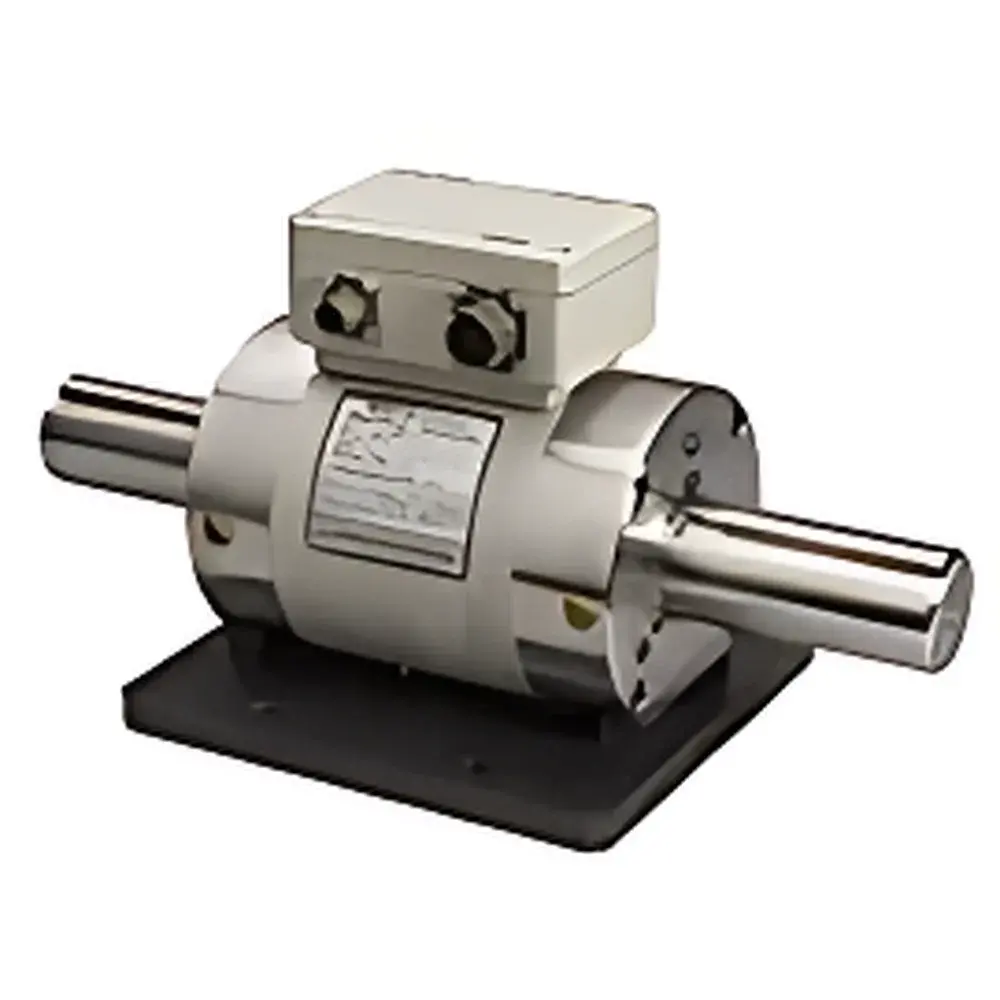
DynaSense 480/490 Non-Contact Power, Torque & Rotational Speed Measurement System
| Origin | USA |
|---|---|
| Manufacturer Type | Authorized Distributor |
| Origin Category | Imported |
| Model | 480/490 |
| Price | Upon Request |
| Power Range | 4.44 kW to 56,800 kW |
| Torque Range | 2.8 N·m to 452,000 N·m |
| Speed Accuracy (end-point) | ±0.01% FS |
| Combined Accuracy (Power/Torque) | ±0.08% FS |
| Temperature Compensation Range | +75 °F to +175 °F |
| Analog Output Options | ±5 V or ±10 V dc (user-selectable) |
| Digital Interface | RS232 with full unit-aware data streaming |
| Frequency Response | 0–2 kHz |
| System Resolution | 0.02% FS (14-bit equivalent with 50% overrange) |
| EMI Hardening | IGBT-drive compatible |
| Filter Options | 11 Bessel-type cutoff settings (0.1–200 Hz, 1–2–5 decade steps) |
Overview
The DynaSense 480/490 Non-Contact Power, Torque & Rotational Speed Measurement System is an engineered solution for high-fidelity, real-time mechanical power metrology in industrial drivetrain, engine test cell, and rotating machinery validation environments. Unlike conventional slip-ring or telemetry-based torque transducers, this system employs a non-contact strain gage architecture coupled with precision rotational speed sensing—enabling simultaneous, synchronized acquisition of shaft power (kW/hp), torque (N·m/lbf·in), rotational speed (rpm), and accumulated energy (kW·h). Its measurement principle relies on calibrated torsional deformation detection under dynamic load, with digital computation eliminating analog multiplication errors inherent in legacy analog power calculators. Designed for integration into ISO 17025-accredited test labs and OEM powertrain validation facilities, the system meets foundational metrological requirements for traceable mechanical power determination per ASTM E2657 (Standard Practice for Calibration of Torque Measuring Systems) and supports alignment with ISO 13087 (Energy Efficiency Testing of Rotating Machinery).
Key Features
- Non-contact, maintenance-free sensing architecture eliminates wear, signal drift, and electrical noise associated with slip rings or wireless telemetry modules.
- Digital computation of power (P = τ × ω) and energy (E = ∫P dt) ensures mathematically exact derivation—no analog multipliers or scaling-induced error accumulation.
- EMI-hardened design certified for stable operation adjacent to IGBT-based variable frequency drives (VFDs), inverters, and high-dv/dt motor controllers.
- 11 programmable Bessel-type low-pass filters (0.1–200 Hz, 1–2–5 decade steps) preserve phase integrity and suppress overshoot—critical for transient torque profiling and modal analysis.
- Non-volatile memory stores calibration coefficients, null offsets, scaling factors, and user-defined units—eliminating potentiometers, DIP switches, or recalibration dependency.
- 51 preconfigured engineering units (e.g., N·m, lbf·ft, kW, hp, rpm, rad/s, kW·h) selectable via software—no hardware reconfiguration or firmware reload required.
- RS232 interface delivers time-synchronized, unit-tagged ASCII data streams for torque, speed, power, and energy—compatible with LabVIEW, MATLAB, Python-based DAQ systems, and SCADA platforms.
Sample Compatibility & Compliance
The DynaSense 480/490 accommodates both flange-mounted and inline shaft-mount configurations across torque ranges from 2.8 N·m to 452,000 N·m and power capacities up to 56.8 MW. It interfaces directly with rotating shafts operating at speeds up to 30,000 rpm (dependent on mechanical coupling design). The system’s compensated thermal operating range (+75 °F to +175 °F) ensures stability under sustained engine dyno or turbine test conditions. Compliance documentation includes traceable NIST-traceable calibration certificates (optional), RoHS-compliant construction, and CE marking for EMC Directive 2014/30/EU. While not FDA-regulated, its audit-ready data logging and parameter persistence support GLP/GMP-aligned validation protocols where mechanical power verification is part of process qualification (e.g., pharmaceutical mixer torque profiling, bioreactor agitation validation).
Software & Data Management
The included Windows-native DynaView™ software provides full configuration, real-time visualization, and post-processing capability. Users configure analog output polarity (±5 V or ±10 V), filter selection, unit mapping, and scaling parameters through a validated GUI. Real-time plots display synchronized torque-speed-power waveforms with configurable timebase resolution down to 500 µs. All acquired data is timestamped and exported in CSV or HDF5 format—with embedded metadata including sensor ID, calibration date, units, and environmental compensation status. The software maintains full audit trails for parameter changes per 21 CFR Part 11 Annex 11 guidelines (electronic signature support available with optional license). Raw RS232 packet structure includes checksum validation and CRC-16 error detection—ensuring data integrity during long-duration endurance tests.
Applications
- Engine and motor dynamometer testing (steady-state and transient cycle validation per SAE J1349, ISO 1585)
- Wind turbine drivetrain efficiency mapping and gearbox loss quantification
- Marine propulsion shaft power monitoring under ISO 8528 compliance
- Industrial pump and compressor performance certification (API RP 11S5, ISO 5198)
- Electric vehicle inverter-motor system efficiency benchmarking (WLTP, UDDS cycles)
- Academic and government research on rotational energy conversion dynamics
FAQ
Does the system require physical contact with the rotating shaft?
No—the 480/490 utilizes non-contact strain sensing and optical or magnetic speed encoding, eliminating mechanical coupling, wear parts, or signal degradation from rotation.
Can it be integrated into existing PLC or SCADA architectures?
Yes—via RS232 ASCII protocol with user-definable polling intervals; Modbus RTU or Ethernet/IP gateways are supported through third-party protocol converters.
What is the maximum sampling rate supported?
The native acquisition engine supports up to 2 kHz bandwidth with full 14-bit-equivalent resolution; effective sample rate depends on selected filter setting and communication overhead.
Is calibration traceable to national standards?
Calibration certificates include NIST-traceable reference standards applied per ISO/IEC 17025 procedures; on-site recalibration services are available globally.
How is temperature drift compensated during extended testing?
Dual-coefficient thermal compensation (zero and span) is applied in real time using internal thermistors, with specified drift limits of ±0.0015% FS/°F for torque span and ±0.003% FS/°F for zero.



