
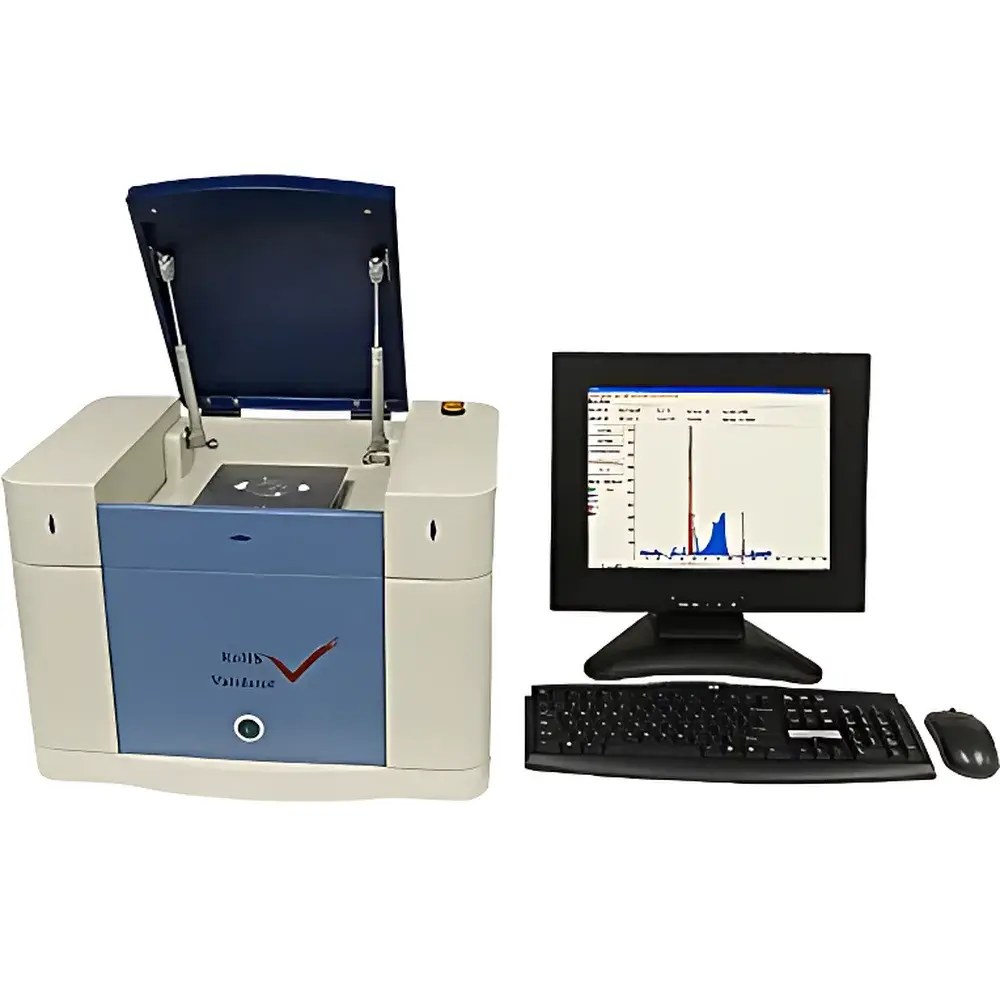
RoHS II Energy Dispersive X-Ray Fluorescence Spectrometer
| Origin | China |
|---|---|
| Manufacturer Type | Authorized Distributor |
| Model | RoHS II |
| Pricing | Available Upon Request |
Overview
The RoHS II Energy Dispersive X-Ray Fluorescence (ED-XRF) Spectrometer is a benchtop analytical instrument engineered for rapid, non-destructive elemental quantification in compliance with Directive 2011/65/EU (RoHS II) and its amendments. It operates on the principle of energy-dispersive X-ray fluorescence: a primary X-ray beam excites atoms in the sample, inducing emission of characteristic secondary (fluorescent) X-rays whose energies are element-specific and intensities proportional to concentration. The system employs a high-resolution silicon drift detector (SDD) coupled with optimized X-ray tube excitation (typically Pd or Rh anode, 50 kV max) to deliver precise, trace-level detection of regulated substances—specifically lead (Pb), cadmium (Cd), mercury (Hg), hexavalent chromium (Cr(VI)), polybrominated biphenyls (PBB), and polybrominated diphenyl ethers (PBDE)—across solid, liquid, and coated substrates. Designed for routine screening in quality control laboratories, it meets the analytical requirements of IEC 62321-5:2013 (ED-XRF method for Pb, Cd, Hg, Cr, Br) and supports method validation per ISO/IEC 17025.
Key Features
- Non-destructive analysis: No sample digestion, grinding, or chemical reagents required—preserves sample integrity and enables repeat measurement.
- Multi-element capability: Simultaneous detection and quantification of up to 25 elements (Z ≥ 11, Na to U) in a single acquisition cycle.
- High throughput: Typical measurement time of 30–120 seconds per spot, configurable by matrix and required detection limits.
- Integrated optical camera and motorized stage: Enables real-time visual targeting, area mapping, and automated multi-point scanning with user-defined grid patterns.
- Pre-calibrated RoHS-specific quantification modes: Factory-loaded calibration curves for plastics, metals, ceramics, and printed circuit boards—traceable to NIST SRM reference materials.
- Robust hardware architecture: Shielded X-ray chamber with interlocked safety door, automatic beam collimation (φ0.5–5 mm), and thermoelectrically cooled SDD ensuring long-term spectral stability.
Sample Compatibility & Compliance
The RoHS II ED-XRF accommodates heterogeneous samples up to 300 × 300 × 100 mm (L × W × H), including molded plastic housings, solder joints, metal alloys, PCB laminates, plating layers, and liquid standards in quartz cuvettes. Sample presentation requires no preparation beyond surface cleaning and flat placement; irregular geometries are compensated via height-sensing Z-axis auto-focus. All measurements adhere to regulatory reporting thresholds: Pb ≤ 1000 ppm, Cd ≤ 100 ppm, Hg ≤ 1000 ppm, Cr(VI) ≤ 1000 ppm (via Cr total + speciation correlation), and total bromine (Br) as proxy for PBB/PBDE screening. Instrument performance is verified per ASTM E1621–22 (Standard Guide for XRF Analysis of Environmental Samples) and supports audit-ready documentation for ISO 9001, IATF 16949, and EU Declaration of Conformity workflows.
Software & Data Management
Controlled via Windows-based SpectraQuant™ v4.x software, the system provides intuitive workflow navigation, live spectrum visualization, and automated peak deconvolution using fundamental parameter (FP) algorithms. Quantitative results include uncertainty estimates (k = 2), matrix-matched standard deviation, and detection limit calculation per ISO 11843-1. Reporting modules generate PDF and Excel-compatible outputs with embedded metadata (operator ID, timestamp, instrument serial, calibration version). Barcode/QR code scanning integration enables direct sample ID association, batch tracking, and LIMS compatibility via CSV export or optional OPC UA interface. Audit trail functionality complies with FDA 21 CFR Part 11 requirements—including electronic signatures, user access levels, and immutable log records of all method changes and result modifications.
Applications
- Electronics manufacturing: Incoming material inspection of connectors, cables, enclosures, and PCB assemblies prior to assembly.
- Recycling & scrap sorting: Rapid identification of restricted elements in e-waste streams for compliance-driven material segregation.
- R&D laboratories: Formulation screening of flame retardants, pigment batches, and polymer composites during product development.
- Third-party testing labs: Accredited RoHS verification services supporting CE marking and customs clearance documentation.
- Supplier qualification programs: On-site verification of supplier CoC (Certificate of Conformance) claims across global supply chains.
FAQ
Does this instrument directly measure Cr(VI), or is it inferred from total chromium?
The RoHS II ED-XRF measures total chromium. Cr(VI) quantification requires complementary wet-chemical analysis (e.g., EN ISO 3613 or EPA 3060A) per IEC 62321-7-2. The instrument flags elevated Cr + Br signals as risk indicators requiring confirmatory testing.
Can it analyze liquids and powders without pelletization?
Yes—liquids are measured in sealed XRF cells; loose powders may be analyzed in sample cups with Mylar film windows. Homogeneity and particle size distribution influence precision; certified liquid standards are recommended for calibration validation.
Is method validation support included?
Yes—the system ships with validation protocols aligned with ISO/IEC 17025 Annex B, including linearity, repeatability, intermediate precision, and limit of detection (LOD) assessment templates.
What maintenance is required?
Annual SDD energy calibration and X-ray tube output verification are recommended. No consumables beyond standard lab-grade argon purge gas (for optional vacuum mode) or replacement Mylar films.
Is remote diagnostics available?
Yes—secure TLS-encrypted remote access enables technical support teams to perform firmware updates, spectral diagnostics, and method troubleshooting without onsite visits.




