
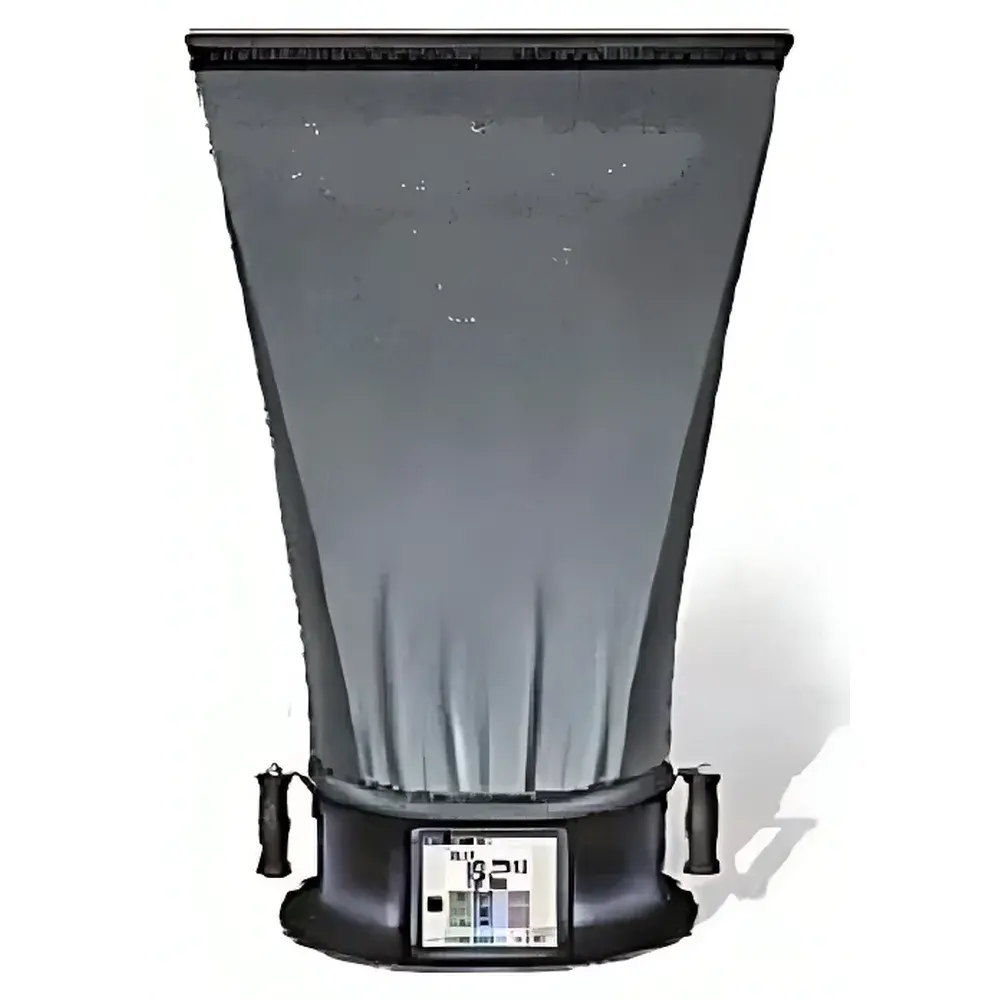
Electronic Air Flow Hood Series / Electronic Air Volume Testers
| Origin | USA |
|---|---|
| Manufacturer Type | Distributor |
| Origin Category | Imported |
| Model | EBT 721 / 150 / 151 / 8371 / 8372 / 8373 |
| Price | Upon Request |
Overview
The Electronic Air Flow Hood Series—comprising the EBT 721, EBT 150/151, and 8371/8372/8373 models—is a family of handheld, portable airflow measurement instruments engineered for precision volumetric flow quantification in HVAC commissioning, indoor air quality (IAQ) assessment, and building performance verification. These devices operate on the principle of thermal anemometry (hot-wire or hot-film sensing), where convective heat transfer from a heated element is correlated to local air velocity. Integrated with calibrated capture hoods of standardized dimensions (e.g., 610 mm × 610 mm), the system computes real-time volumetric flow rates (m³/h, L/s, CFM) by multiplying average face velocity by effective hood cross-sectional area. Unlike pitot-static or orifice-based methods requiring duct access or system shutdown, this approach enables non-intrusive, in-situ measurement at diffusers, grilles, registers, and exhaust outlets—directly supporting ASHRAE Standard 111, ISO 16813, and EN 12599 compliance protocols.
Key Features
- Thermal anemometer–based velocity sensing with multi-point averaging across hood inlet plane for high spatial reproducibility
- Modular hood architecture: Interchangeable capture hoods (610×610 mm, 610×1220 mm, 305×1220 mm, 915×915 mm, and custom configurations) enable adaptation to diverse grille geometries and airflow profiles
- High-resolution digital display: 4- to 6-digit LCD with 0.75-inch character height; units selectable for m³/h, L/s, CFM, °C/°F, and %RH
- Onboard non-volatile memory: Stores up to 1,000 measurement records—including timestamp, flow rate, temperature, humidity (where equipped), and user-defined identifiers
- RS-232C serial interface (EBT 721, 8372, 8373) for data export to PC-based analysis software; compatible with standard terminal emulators and custom CSV loggers
- Ergonomic single-hand operation: Balanced center-of-gravity design, integrated handle, and lightweight construction (3.4–4.0 kg depending on hood configuration)
- Extended battery life: Up to 40 hours continuous operation on four AA alkaline cells (837x series) or rechargeable equivalents; low-battery indicator and auto-shutdown
Sample Compatibility & Compliance
The EBT series accommodates standard and non-standard air terminal devices—including supply diffusers (square, round, linear), return grilles, exhaust hoods, and VAV box outlets—without requiring duct modification or system isolation. All models meet ANSI/ASHRAE Guideline 12-2020 requirements for airflow verification during HVAC startup and recommissioning. The EBT 721 and 8373 variants support optional humidity and temperature probes (e.g., Model 220B) enabling simultaneous psychrometric data acquisition per ISO 7726 and ASTM D5465. Firmware and hardware design align with GLP documentation practices: each stored reading includes date/time stamp, operator ID field (user-entered), and instrument serial number. Data export logs are time-stamped and uneditable—supporting audit readiness under FDA 21 CFR Part 11 when paired with validated software workflows.
Software & Data Management
While no proprietary software is bundled, the RS-232C interface supports integration with third-party data acquisition platforms compliant with Modbus RTU or ASCII protocol conventions. Exported datasets include ASCII-formatted rows with columns for: Timestamp (YYYY-MM-DD HH:MM:SS), Flow Rate (m³/h), Temperature (°C), Relative Humidity (%RH), Hood ID, and Measurement Mode (Supply/Exhaust). For regulated environments, users may implement traceable calibration management via external LIMS or ELN systems that accept CSV imports. Optional 8925 thermal printer provides hard-copy field reports with real-time printout capability at 0.8 lines/sec—ideal for on-site sign-off documentation. All firmware versions maintain backward compatibility with legacy calibration certificates issued per NIST-traceable standards.
Applications
- HVAC system balancing and TAB (Testing, Adjusting, and Balancing) per NEBB Procedural Standards
- Commissioning and retrocommissioning of commercial and institutional buildings (LEED EA Credit 1, BREEAM Hea 02)
- Occupant comfort evaluation through supply/exhaust air balance verification
- Filter efficiency monitoring via upstream/downstream airflow comparison
- Lab ventilation safety checks (fume hood face velocity, room air changes per hour)
- Energy audit baseline measurements for ASHRAE Level I–III assessments
- Post-renovation IAQ validation in healthcare facilities (per FGI Guidelines and HTM 03-01)
FAQ
What standards does the EBT series comply with for airflow measurement accuracy?
The EBT 721 and 837x models conform to ASHRAE Standard 111–2013 Annex A for hood-based airflow measurement uncertainty, with stated accuracy of ±3–5% of reading plus fixed offset (e.g., ±12 m³/h), validated against NIST-traceable wind tunnel calibrations.
Can the same instrument measure both supply and exhaust airflow?
Yes—each model supports bidirectional flow mode selection; exhaust measurements apply a +4% full-scale correction factor per manufacturer’s calibration protocol to account for turbulence-induced underestimation.
Is probe calibration required before each use?
No routine recalibration is needed between certified intervals; however, daily zero-check using ambient still-air verification is recommended per ISO/IEC 17025 clause 7.7.2.
How is data integrity ensured during field deployment?
All stored readings are write-protected in non-volatile memory; timestamps are generated by internal real-time clock (RTC) with ±2 sec/month drift; no user-editable fields exist within the instrument’s native data structure.
Are replacement hoods and accessories available with NIST-traceable calibration certificates?
Yes—custom hood assemblies and optional probes (e.g., Models 175, 275, 220B) ship with individual calibration reports referencing NIST SRM 1559b and ISO/IEC 17025-accredited laboratories.




