
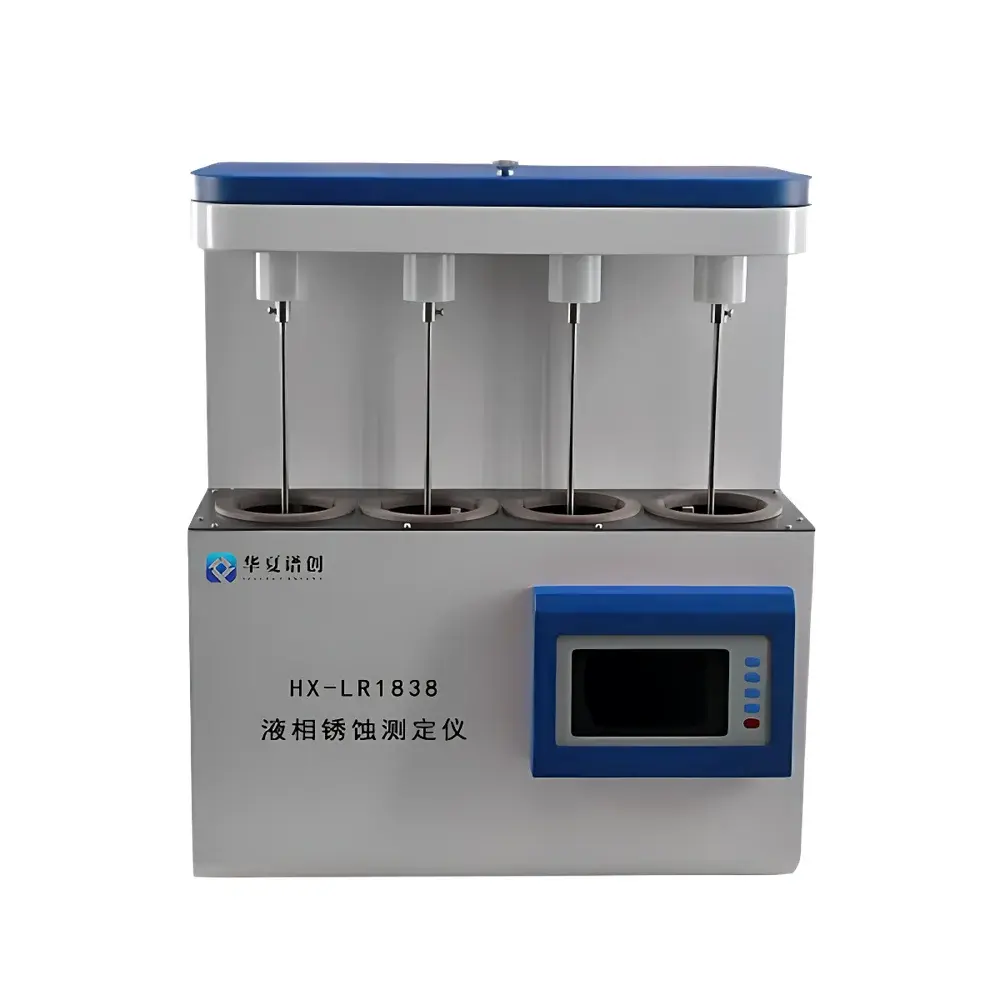
HX-LR1838 Spectra Invent Liquid-Phase Rust Corrosion Tester
| Brand | Spectra Invent |
|---|---|
| Origin | Beijing, China |
| Manufacturer Type | Authorized Distributor |
| Country of Origin | China |
| Model | HX-LR1838 |
| Temperature Control Range | Ambient to 100 °C |
| Temperature Stability | ±0.5 °C |
| Power Supply | AC 220 V ±10%, 50 Hz |
| Dimensions (W×D×H) | 520 mm × 330 mm × 570 mm |
| Net Weight | 9.5 kg |
Overview
The HX-LR1838 Spectra Invent Liquid-Phase Rust Corrosion Tester is a precision-engineered instrument designed in strict accordance with ASTM D665 (Standard Test Method for Rust-Preventing Characteristics of Inhibited Mineral Oil in the Presence of Water) and ISO 7120:2015 (Petroleum products — Determination of rust-inhibiting properties of lubricants). It evaluates the ability of inhibited mineral oils—including turbine oils, hydraulic fluids, and circulating system oils—to prevent rust formation on ferrous metal surfaces when exposed to water under controlled thermal and immersion conditions. The instrument operates on the principle of standardized immersion testing: polished steel test specimens (typically ASTM 1010 or equivalent low-carbon steel coupons) are immersed in a defined mixture of test oil and synthetic seawater (or distilled water with added NaCl), then subjected to continuous agitation and precise temperature regulation for a prescribed duration (commonly 24 h or 48 h per ASTM D665 Procedure A or B). Visual assessment of rust staining—performed against ASTM D665-defined rating scales—is the primary pass/fail criterion, supporting compliance-driven quality control in lubricant formulation, refinery QC labs, and third-party certification facilities.
Key Features
- Programmable digital temperature controller with PID algorithm ensures stable thermal regulation across the full operating range (ambient to 100 °C) at ±0.5 °C accuracy—critical for reproducible corrosion kinetics.
- Integrated mechanical stirrer with adjustable speed and uniform shaft coupling maintains consistent fluid dynamics around immersed specimens, minimizing boundary-layer effects that could skew rust initiation patterns.
- Corrosion-resistant stainless-steel test chamber and specimen holder assembly prevent cross-contamination and ensure long-term dimensional stability of test fixtures.
- Compact benchtop footprint (520 × 330 × 570 mm) and lightweight design (9.5 kg) facilitate deployment in space-constrained QC laboratories without compromising structural rigidity or thermal isolation.
- Compliance-ready electrical architecture: CE-marked power supply module (AC 220 V ±10%, 50 Hz) with overcurrent and thermal cutoff protection meets IEC 61010-1 safety requirements for laboratory equipment.
Sample Compatibility & Compliance
The HX-LR1838 supports standardized test protocols for a broad spectrum of petroleum-based fluids, including but not limited to: steam turbine oils (ISO L-TSA), hydraulic oils (ISO L-HM, L-HV), gear oils (ISO L-CKB), and rust-inhibited circulating oils. It accommodates standard ASTM D665-compliant steel coupons (38 mm × 19 mm × 1.6 mm), as well as optional coupon holders for parallel multi-specimen evaluation. All test procedures align with globally recognized specifications: ASTM D665 (Procedures A and B), ISO 7120, and GB/T 11143 (Chinese national standard, technically equivalent to ASTM D665). The instrument’s operational parameters and documentation framework support audit readiness for GLP (Good Laboratory Practice) and ISO/IEC 17025-accredited laboratories; raw test logs—including timestamped temperature profiles and operator entries—can be exported for traceability in FDA 21 CFR Part 11–compliant environments when paired with validated LIMS integration.
Software & Data Management
While the HX-LR1838 operates as a hardware-controlled standalone unit, its analog/digital hybrid interface enables seamless integration with external data acquisition systems. Temperature setpoints, real-time bath readings, and elapsed test time are displayed on a backlit LCD panel with non-volatile memory retention. Optional RS-232 or USB-to-serial adapter modules (sold separately) allow connection to PC-based logging software for automated recording of thermal profiles at user-defined intervals (e.g., every 30 seconds). Exported CSV files contain calibrated timestamps, mean temperature values, and deviation metrics—enabling statistical process control (SPC) analysis per ISO 22514-2. Audit trails generated during manual test initiation and conclusion comply with ALCOA+ principles (Attributable, Legible, Contemporaneous, Original, Accurate, Complete, Consistent, Enduring, Available) when documented alongside laboratory notebooks or electronic lab notebooks (ELN).
Applications
- Quality assurance of rust-inhibited turbine oils prior to turbine commissioning or scheduled maintenance intervals.
- Formulation screening of additive packages containing amine-based or carboxylate rust inhibitors in R&D laboratories.
- Batch release testing for hydraulic fluids used in offshore drilling equipment, where saltwater exposure risk is elevated.
- Third-party verification of lubricant performance claims submitted for OEM approvals (e.g., GEK 32568, Siemens TLV 9013).
- Educational use in university tribology and petroleum engineering curricula for hands-on corrosion mechanism studies.
FAQ
What standards does the HX-LR1838 explicitly support?
ASTM D665 (Procedures A and B), ISO 7120:2015, and GB/T 11143.
Can the instrument accommodate custom test durations beyond 48 hours?
Yes—the timer function supports up to 99 hours and 59 minutes; extended tests require adherence to modified validation protocols per internal SOPs.
Is calibration traceable to NIST or other national metrology institutes?
Temperature sensor calibration certificates (traceable to CNAS-accredited labs in China) are provided with each unit; end-user re-calibration using certified RTD probes is recommended annually.
What maintenance is required for long-term reliability?
Quarterly inspection of stirrer coupling integrity, biannual cleaning of heater block contacts, and annual verification of thermal sensor linearity using reference baths.
Does the system include test coupons or synthetic seawater reagents?
No—standardized ASTM 1010 steel coupons and ASTM D1141 synthetic seawater concentrate must be procured separately to maintain protocol fidelity.






