
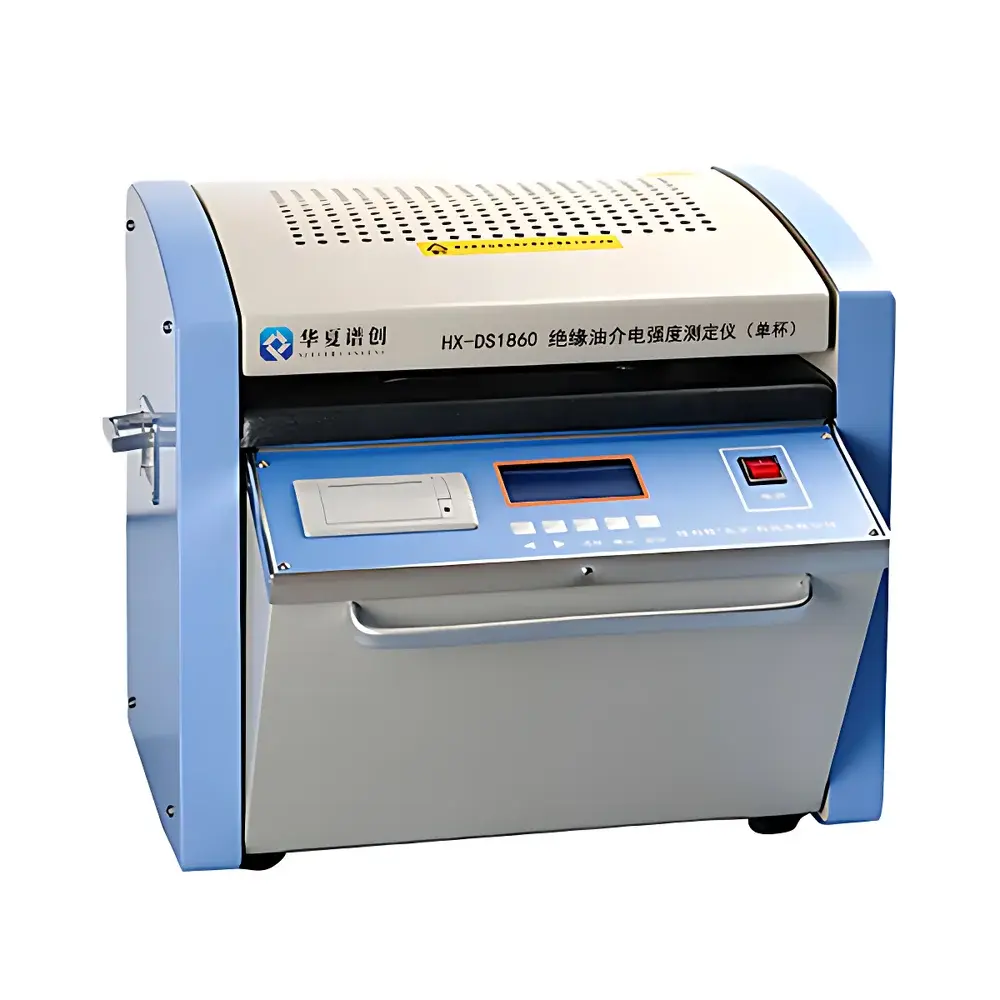
Spectra Invent HX-DS1860 Single-Cup Insulating Oil Dielectric Strength Tester
| Brand | Spectra Invent |
|---|---|
| Origin | Beijing, China |
| Manufacturer Type | Authorized Distributor |
| Country of Origin | China |
| Model | HX-DS1860 |
| Price Range | USD 150–15,000 |
| Test Cup Count | 1 |
| Display | LCD |
| Measurement Range | 0–80 kV or 0–100 kV (selectable) |
| Voltage Distortion Rate | <3% |
| Ramp Rate | 0.5–5 kV/s (adjustable) |
| Accuracy | ±2% |
| Resolution | 0.01 kV |
| Standby Time | 0–15 min (adjustable) |
| Inter-test Interval | 0–5 min (adjustable) |
| Number of Breakdown Tests per Sample | 1–9 |
| Transformer Capacity | 1.5 kVA |
| Overall Measurement Precision | ±3% |
| Power Supply | AC 220 V ±10%, 50 Hz ±1 Hz |
| Power Consumption | 200 W |
| Operating Temperature | 0–45 °C |
| Operating Humidity | <75% RH |
| Dimensions | 490 × 430 × 420 mm |
| Weight | 25.7 kg |
Overview
The Spectra Invent HX-DS1860 Single-Cup Insulating Oil Dielectric Strength Tester is an automated, microprocessor-controlled instrument engineered for precise determination of the dielectric breakdown voltage (BDV) of transformer oils and other insulating liquids. It operates on the principle of controlled AC voltage ramping across a standardized test gap (per IEC 60156 and ASTM D877/D1816 methodologies), where the applied electric field increases at a defined linear rate until electrical breakdown occurs—manifested as a conductive arc between electrodes immersed in the oil sample. The measured BDV serves as a critical quality indicator for detecting water ingress, particulate contamination, and aging byproducts that compromise insulation integrity in high-voltage equipment. Designed for routine laboratory and field-based testing, the HX-DS1860 delivers repeatable, traceable results aligned with international regulatory expectations for power system maintenance.
Key Features
- Dual-CPU architecture ensures robust real-time control of voltage ramping, electrode stirring, timing sequences, and safety interlocks.
- Automated test cycle: fully integrated sequence including sample static settling, electrode stirring (to homogenize contaminants), programmable voltage ramp initiation, breakdown detection, automatic voltage reset, and result calculation.
- Isolation-grade dry-type step-up transformer (1.5 kVA capacity) provides stable sinusoidal output with <3% total harmonic distortion—critical for compliance with GB/T 507 and DL/T 846.7 waveform fidelity requirements.
- Continuous adjustable ramp rate (0.5–5 kV/s) enables method-specific execution per standard: e.g., 2 kV/s for GB/T 507, 3 kV/s for DL/T 429.9.
- Comprehensive hardware protection: overvoltage cutoff, overcurrent shutdown, forced zero-return after breakdown, and grounded chassis design meeting IEC 61010-1 safety class II requirements.
- LCD interface with intuitive menu navigation supports parameter configuration, real-time voltage display, and on-device data review without external software.
Sample Compatibility & Compliance
The HX-DS1860 is validated for use with mineral-based transformer oils, synthetic esters, silicone fluids, and other non-aqueous insulating liquids conforming to ASTM D3487, IEC 60296, and GB 2536 specifications. Its single-cup geometry adheres strictly to the 2.5 mm electrode gap and 40 mm oil depth defined in GB/T 507 and IEC 60156. The instrument satisfies mandatory technical clauses of Chinese national standards GB/T 507 (Method for Determination of Dielectric Strength of Insulating Oil), DL/T 846.7 (High-Voltage Test Equipment Specifications), and DL/T 429.9 (Test Methods for Electrical Properties of Insulating Oil). While not certified to UL or CE for direct EU/US market placement, its electrical architecture and documentation support validation under GLP and internal QA/QC frameworks compliant with ISO/IEC 17025 clause 5.5.
Software & Data Management
All test parameters—including ramp rate, standby time (0–15 min), inter-test interval (0–5 min), number of consecutive breakdowns (1–9), and voltage range selection—are configurable via front-panel keypad. Results (individual breakdown voltages, arithmetic mean, standard deviation) are stored in non-volatile memory (capacity: ≥200 test records) with timestamp and operator ID fields. Data export is supported via RS-232 serial interface for integration into LIMS or custom CSV logging systems. The embedded firmware implements audit-trail logic: each parameter change and test execution is logged with date/time stamp—facilitating traceability during internal audits or regulatory reviews under ISO 9001 or power utility maintenance SOPs.
Applications
This tester is routinely deployed in substation maintenance labs, transformer manufacturing QC departments, third-party calibration centers, and petrochemical R&D facilities. Typical use cases include incoming inspection of new oil batches, periodic condition monitoring of in-service transformer oil (per IEEE C57.106 recommendations), root-cause analysis of failed insulation systems, and verification of oil reclamation effectiveness post-filtration or vacuum dehydration. Its compact footprint (490 × 430 × 420 mm) and 25.7 kg mass enable deployment in mobile diagnostic vans used by railway traction power divisions and remote grid operators.
FAQ
What standards does the HX-DS1860 comply with?
It is designed and verified against GB/T 507, DL/T 846.7, and DL/T 429.9. Its operational parameters align with the measurement principles of IEC 60156 and ASTM D877.
Can the instrument perform multiple breakdown tests on a single sample?
Yes—users can configure 1 to 9 sequential breakdowns per oil specimen, with programmable rest periods between tests to allow bubble dissipation and thermal stabilization.
Is external PC software required for operation?
No—the instrument is fully autonomous. PC connectivity is optional and limited to data export; no driver installation or proprietary software is needed for core functionality.
What safety certifications apply to this device?
It conforms to IEC 61010-1:2010 for electrical safety in measurement equipment, including double insulation, protective earthing, and overvoltage category II rating.
How is measurement traceability ensured?
Voltage output is calibrated using NIST-traceable high-voltage dividers prior to shipment. Certificate of Calibration (with uncertainty budget) is provided, and internal self-diagnostic routines verify sensor linearity before each test sequence.






