
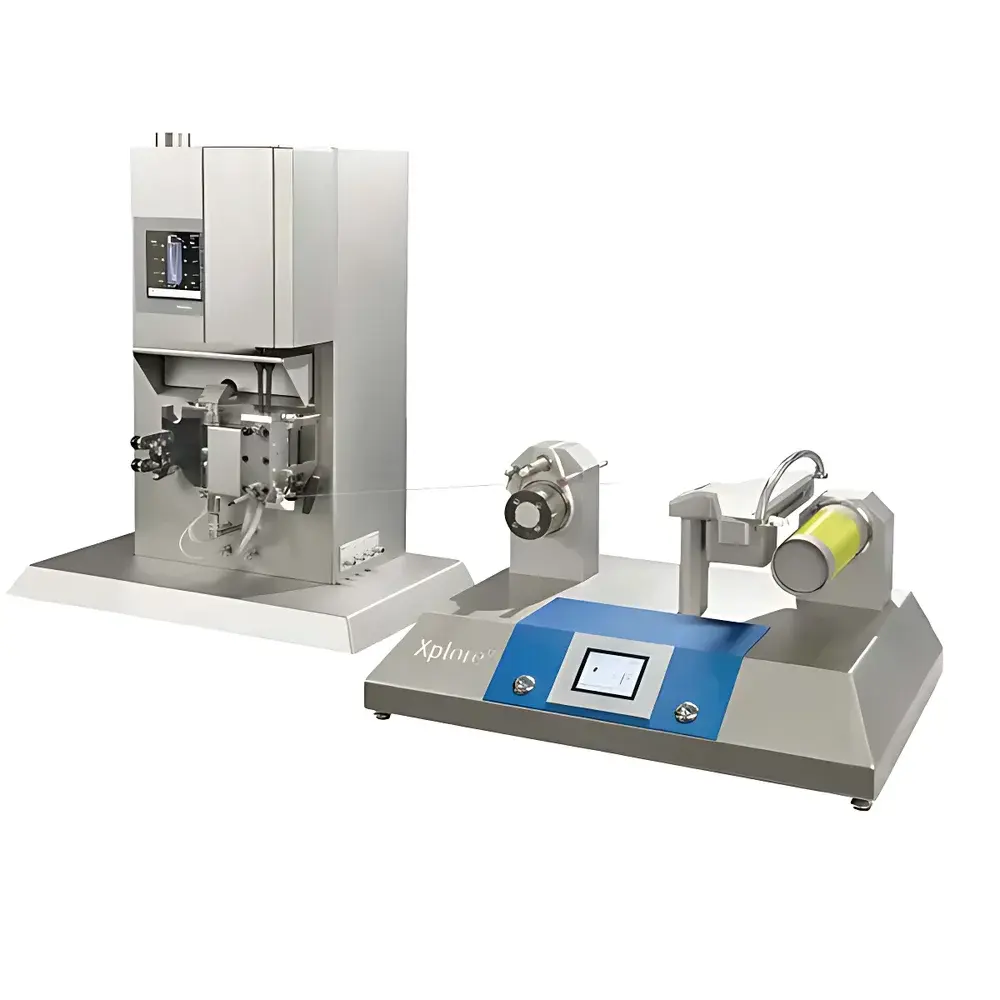
Xplore FL Fiber Spinning Line
| Brand | Xplore (Netherlands) |
|---|---|
| Origin | Netherlands |
| Model | FL Fiber Spinning Line |
| Feedstock Consumption | < 5 g per test |
| Sample Production Time | < 5 min |
| Take-up Speed (High-Speed Unit) | 5–200 m/min |
| Winding Width | 10–150 mm (1 mm increments) |
| Traverse Pitch | 0.1–4.0 mm (0.1 mm increments) |
| Spinneret Diameter Options | 0.25–1.50 mm (0.25 mm increments) |
| Drawing Ratio Adjustable | 1:1 to 1:10 |
| Hot Shoe Temperature Range | Ambient to 300 °C (1 °C resolution) |
| Hot Shoe Length | 300 mm |
| Tension Control Range | ±250 N·mm (0.05 N·mm resolution) |
| Low-Speed Unit Speed | 0.5–90 m/min (0.01 m/min resolution) |
| Guiding Roll Diameter | 75 mm (both units) |
| Control Interface | Integrated industrial touchscreen with graphical HMI |
Overview
The Xplore FL Fiber Spinning Line is a benchtop-scale, modular filament extrusion and drawing system engineered for rapid prototyping and structure–property correlation of synthetic and bio-based polymeric fibers. Unlike conventional pilot-scale spinning lines requiring kilograms of material and hours of setup, the FL system operates on micro-to-milligram feedstock volumes—enabling statistically representative fiber samples in under five minutes. Its core architecture integrates a precision micro-compounder with continuous metering capability and a dual-stage winding unit: a high-speed take-up module (up to 200 m/min) and a low-speed draw-and-tension control module. This configuration supports both melt spinning and solution spinning workflows, with optional nitrogen purging for oxygen-sensitive polymers (e.g., conjugated polymers or polyphosphazenes). The system implements Couette-driven flow principles within its miniaturized die assembly and employs closed-loop torque feedback during drawing to maintain constant linear velocity and tensile stress profiles—critical for reproducible crystallinity development and orientation analysis via WAXS or Raman spectroscopy.
Key Features
- Dual-mode winding architecture: Independent high-speed (5–200 m/min) and low-speed (0.5–90 m/min) units enable precise decoupling of extrusion rate, draw ratio (1:1 to 1:10), and winding tension (±250 N·mm, 0.05 N·mm resolution).
- Micro-optimized spinneret selection: Interchangeable dies with diameters from 0.25 mm to 1.50 mm (0.25 mm increments) support systematic study of capillary number effects on fiber morphology.
- Programmable slow-start routine: Mitigates initial filament breakage during transition from extrusion to drawing by ramping take-up speed over user-defined time intervals.
- Thermally stabilized hot shoe: 300 mm heated zone with ±0.5 °C stability across 25–300 °C range (1 °C setpoint resolution); compatible with differential thermomechanical profiling during solidification.
- Full digital HMI: Industrial-grade touchscreen interface with real-time plotting of torque, speed, temperature, and traverse position; supports recipe storage, parameter logging, and audit-trail export compliant with GLP documentation requirements.
- Nitrogen purge integration: Standard inert gas manifold with flow regulation ensures controlled atmosphere processing for oxidation-prone systems (e.g., polyacrylonitrile precursors or conductive polymer blends).
Sample Compatibility & Compliance
The FL Fiber Spinning Line accommodates thermoplastics (e.g., PET, PP, PLA, PEEK), thermoplastic elastomers, polymer solutions (e.g., cellulose acetate in acetone, PAN in DMF), and reactive melt systems (e.g., lactide-based oligomers). All wetted components are constructed from AISI 316 stainless steel or hardened tool steel with electropolished surfaces to prevent catalytic degradation. The system conforms to CE machinery directive 2006/42/EC and electromagnetic compatibility standard EN 61326-1. Data acquisition meets ALCOA+ principles when operated with validated software configurations; full electronic records—including parameter timestamps, operator ID, and calibration logs—are exportable in CSV or PDF/A format for FDA 21 CFR Part 11–aligned review.
Software & Data Management
The embedded control firmware provides synchronized multi-channel data acquisition at 100 Hz sampling rate across all critical axes: extruder torque, die pressure, hot shoe thermocouple zones, take-up encoder position, and traverse actuator displacement. User-defined experiment protocols—including ramped draw ratios, stepped temperature gradients, or cyclic tension profiles—can be saved as reusable templates. Raw sensor streams are stored locally on encrypted SD card and mirrored via Ethernet to networked NAS or LIMS endpoints. Optional Xplore SpinSuite™ add-on enables automated post-processing of fiber diameter distributions (via integrated laser micrometer interface), tensile modulus estimation from load–elongation curves, and ASTM D3822-compliant reporting.
Applications
- Rapid screening of polymer formulation effects on spinnability, fibrillation onset, and skin–core heterogeneity.
- Correlating rheological signatures (from parallel-plate small-amplitude oscillatory shear) with solid-state fiber properties (tenacity, elongation-at-break, birefringence).
- Development of functional fibers: embedding nanoparticles, drug carriers, or conductive fillers without agglomeration using low-shear compounding prior to extrusion.
- Teaching laboratory implementation: Demonstrating viscoelastic melt fracture, necking behavior, and strain-induced crystallization in undergraduate polymer engineering curricula.
- Regulatory pre-validation: Generating GMP-relevant fiber batches for extractables/leachables testing or biocompatibility assessment per ISO 10993-12.
FAQ
Can the FL system produce continuous filaments longer than 100 meters?
Yes—continuous operation up to 500 meters is achievable using the high-speed unit at stable 150 m/min with appropriate thermal stabilization and nitrogen purge.
Is die-swapping possible without recalibration?
All spinnerets are pre-characterized for pressure drop vs. throughput; automatic compensation is applied upon selection via the HMI’s die database.
Does the system support solvent recovery integration?
While not included as standard, the exhaust port is rated for connection to external condensation traps or scrubbers (vacuum-rated up to −0.8 bar).
What maintenance intervals are recommended for the traverse mechanism?
Lubrication-free ceramic linear guides require no scheduled maintenance; positional accuracy is verified annually using traceable step-gauge calibration.
Can raw torque and speed data be exported for third-party rheological modeling?
Yes—full-resolution binary telemetry files (.xplog) include SI-unit metadata and are directly importable into MATLAB, Python (NumPy/Pandas), or COMSOL Multiphysics for transient flow simulation.





