
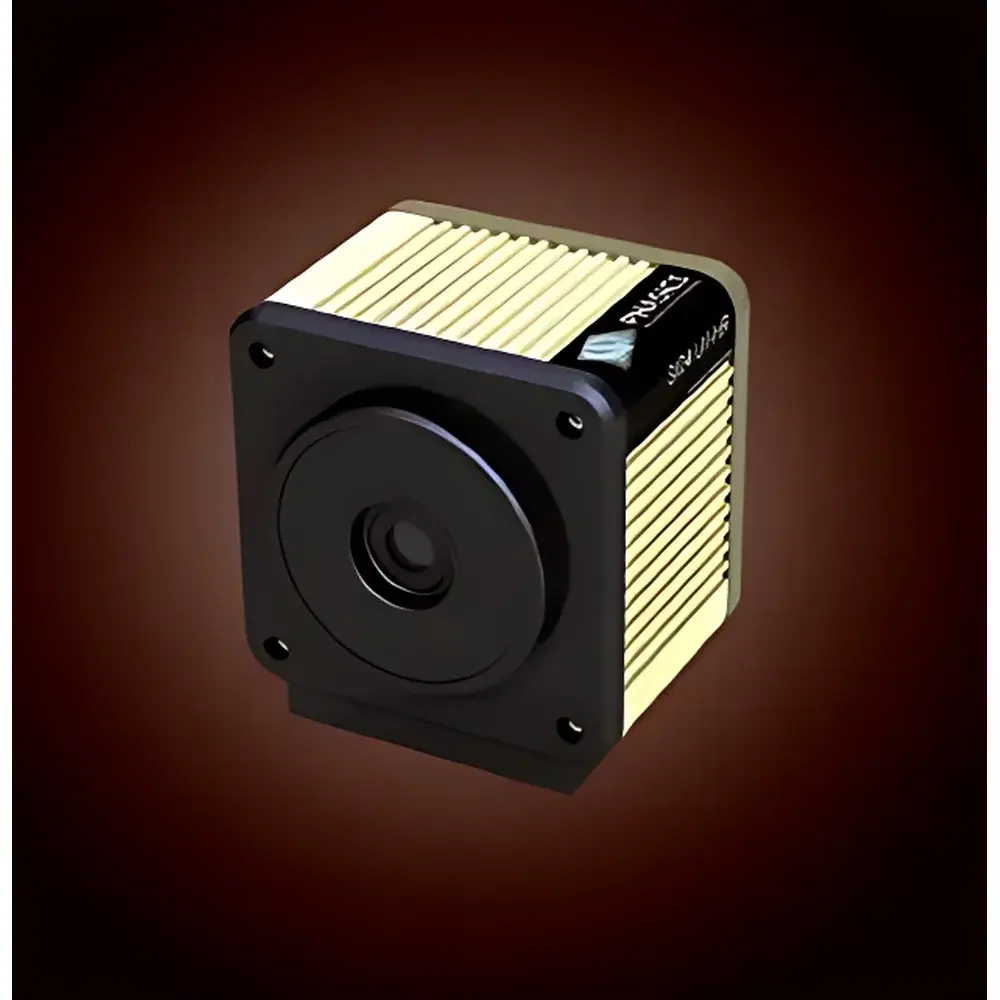
Phasics SID4 UV-HR High-Resolution Wavefront Sensor
| Brand | Phasics |
|---|---|
| Origin | France |
| Model | SID4 UV-HR |
| Aperture | 8.0 × 8.0 mm² |
| Spatial Resolution | 32 µm |
| Sampling Points | 250 × 250 |
| Wavelength Range | 190–400 nm |
| Dynamic Range | > 200 µm |
| Accuracy | 10 nm RMS |
| Sensitivity | 2 nm RMS @ 250 nm, 2 µJ/cm² |
| Frame Rate | 30 fps |
| Processing Frequency | 1 Hz (high-resolution mode) |
| Dimensions | 95 × 105 × 84 mm |
| Weight | 900 g |
Overview
The Phasics SID4 UV-HR is a high-resolution, quantitative wavefront sensor engineered for precision optical metrology in the deep-ultraviolet (DUV) and near-ultraviolet (NUV) spectral ranges. Based on Phasics’ proprietary four-wave lateral shearing interferometry (LTSI) principle, the sensor delivers direct, single-shot phase measurements without iterative reconstruction or assumptions about wavefront shape. Unlike Shack–Hartmann sensors—which rely on centroid detection of focal spot arrays—the SID4 UV-HR captures full-field phase gradients simultaneously across its active aperture, enabling accurate characterization of highly divergent, aberrated, or low-SNR beams common in UV laser systems, synchrotron beamlines, and EUV lithography R&D environments. Its monolithic, alignment-free optical design eliminates sensitivity to mechanical drift and thermal instability, ensuring long-term measurement repeatability essential for GLP-compliant optical qualification and process monitoring.
Key Features
- UV-optimized optical path with broadband anti-reflection coatings (190–400 nm), enabling direct operation without external wavelength-specific calibration
- 250 × 250 sampling points over an 8.0 × 8.0 mm² active area—highest spatial resolution among Phasics’ UV-capable sensors at 32 µm pixel pitch
- Single-shot, non-iterative wavefront reconstruction with <10 nm RMS accuracy and 2 nm RMS sensitivity at 250 nm under typical illumination (2 µJ/cm²)
- Robust dynamic range exceeding ±200 µm optical path difference (OPD), supporting analysis of strongly curved or astigmatic UV wavefronts
- Real-time acquisition at 30 fps with hardware-triggered synchronization; processing frequency configurable up to 1 Hz in high-resolution mode for optimal noise suppression
- Compact, rigid aluminum housing (95 × 105 × 84 mm, 900 g) with integrated USB 3.0 interface and passive thermal management—designed for integration into vacuum-compatible or space-constrained UV setups
Sample Compatibility & Compliance
The SID4 UV-HR is compatible with continuous-wave (CW) and pulsed UV sources—including excimer lasers (e.g., ArF at 193 nm, KrF at 248 nm), frequency-tripled Nd:YAG (355 nm), and synchrotron undulator beams—provided minimum fluence thresholds are met. Its CCD-matched, achromatic design eliminates chromatic error across the 190–400 nm band, eliminating recalibration when switching between wavelengths. The sensor conforms to ISO 10110-5 (surface irregularity specification), ISO 21254 (laser damage threshold testing), and supports traceable calibration via NIST-traceable reference flats. For regulated environments, raw data export formats (HDF5, TIFF, ASCII) and metadata logging comply with FDA 21 CFR Part 11 requirements when used with Phasics’ optional audit-trail-enabled software package.
Software & Data Management
The sensor operates with Phasics’ proprietary QWLS 360° software suite (v6.2+), which provides real-time Zernike decomposition, PV/RMS wavefront error reporting, M² estimation, Strehl ratio calculation, and ISO-compliant surface irregularity mapping. All processing modules support batch analysis, scripting via Python API (pyPhasics), and automated report generation in PDF/HTML with embedded timestamps, operator ID, and instrument configuration logs. Raw interferograms and reconstructed phase maps are stored with full metadata (exposure time, gain, wavelength, temperature) in vendor-neutral HDF5 containers—ensuring long-term archival integrity and third-party interoperability with MATLAB, Python (SciPy, OpenCV), and LabVIEW.
Applications
- Laser beam quality assessment for DUV lithography tools and ultrafast UV amplifiers
- In-situ wavefront monitoring during EUV mirror coating development and ion-beam figuring validation
- Quantitative surface topography of fused silica optics, CaF₂ lenses, and multilayer EUV mirrors
- Adaptive optics correction loop feedback for UV astronomy instrumentation and free-space quantum communication terminals
- Phase-contrast microscopy enhancement in label-free biological imaging using UV-excited autofluorescence
- Plasma diagnostics via UV interferometry in fusion research (e.g., tokamak edge plasma density profiling at 30.4 nm He II line)
FAQ
What is the minimum required irradiance for reliable operation at 193 nm?
At 193 nm, stable operation requires ≥5 µJ/cm² per frame for optimal SNR; lower fluences are supported with frame averaging or extended exposure (software-limited to 1 s max).
Can the SID4 UV-HR be mounted inside a UHV chamber?
Yes—the sensor housing is vacuum-compatible up to 10⁻⁶ mbar; optional CF-35 flange mounting kit and fiber-coupled UV illumination ports are available.
Does it support real-time Zernike fitting at full frame rate?
Zernike decomposition is performed offline or at ≤1 Hz in high-resolution mode; real-time centroid-based metrics (e.g., RMS, PV) are computed at 30 fps.
Is calibration transferable between different UV wavelengths?
Yes—achromatic design ensures calibration validity across 190–400 nm without re-characterization; only wavelength input must be updated in software.
How is thermal drift compensated during extended measurements?
Built-in temperature sensor feeds real-time corrections to the LTSI algorithm; long-term stability is validated at <0.5 nm/°C RMS phase drift over 8-hour sessions.



