
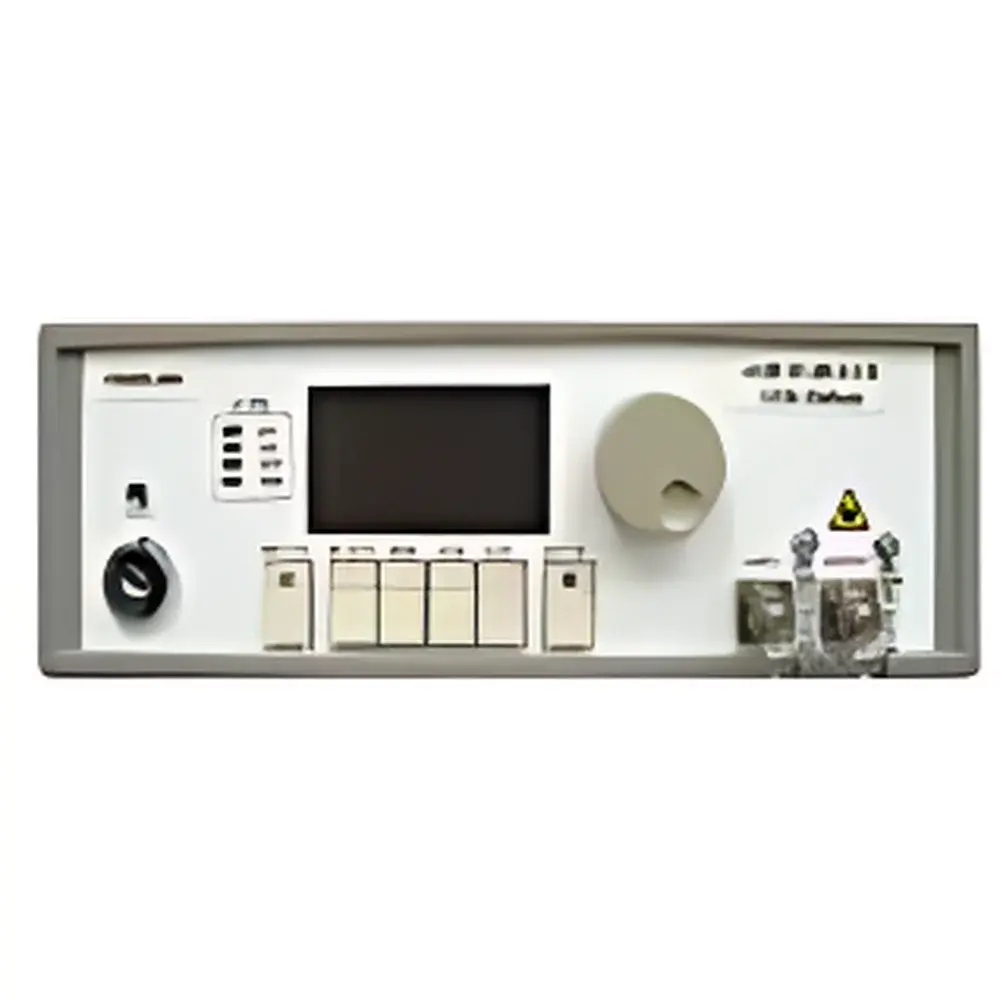
Fiberlabs AMP-FL8611-OB Series O-Band Fiber Amplifier
| Brand | Fiberlabs |
|---|---|
| Origin | Japan |
| Model | AMP-FL8611-OB-XX |
| Gain | up to 35 dB |
| Max. Output Power | +20 dBm (100 mW) |
| Operating Wavelength | 1310 nm (O-band) |
| Pump Source | Praseodymium-doped Fluoride Fiber |
| Control Modes | ACC / ALC |
| Monitoring Parameters | Input Power, Output Power, LD Current, LD Temperature, Chassis Temperature |
| Remote Interface | RS-232C or GPIB |
| Input Protection | Auto-Lock Function with User-Configurable Thresholds |
| Form Factor | Benchtop or Compact Module Options |
| Compliance | CE, RoHS |
Overview
The Fiberlabs AMP-FL8611-OB Series is a high-performance, polarization-insensitive optical fiber amplifier engineered specifically for the O-band (1260–1360 nm), with peak gain centered at 1310 nm. Unlike conventional erbium-doped fiber amplifiers (EDFAs) optimized for C- or L-bands, this amplifier employs praseodymium-doped fluoride glass fiber (PDFF) as the active medium—a material system uniquely suited to efficient 1310 nm signal amplification due to its favorable absorption and emission cross-sections in the O-band. The device operates on a dual-pump configuration (typically 1017 nm and/or 1047 nm) to achieve high quantum efficiency and low noise figure (< 6 dB typical). Designed for demanding applications requiring stable, low-noise amplification of weak signals—such as passive optical network (PON) test benches, time-domain reflectometry (OTDR) source enhancement, and quantum optics experiments—the AMP-FL8611-OB delivers up to 35 dB small-signal gain and +20 dBm saturated output power. Its thermal management architecture ensures long-term stability under continuous operation, with internal thermoelectric coolers (TECs) maintaining precise control over laser diode junction temperature.
Key Features
- High-gain O-band amplification: Up to 35 dB small-signal gain at 1310 nm with < ±0.5 dB gain flatness across 1290–1330 nm
- Flexible control architecture: Selectable Automatic Current Control (ACC) or Automatic Light Control (ALC) modes for optimized dynamic range and linearity
- Comprehensive real-time monitoring: Simultaneous readout of input power, output power, pump LD current, LD junction temperature, and chassis temperature via front-panel display or remote interface
- Robust protection logic: Programmable input power lockout function prevents damage from overdrive or misalignment; threshold configurable from –40 dBm to –10 dBm
- Standard industrial interfaces: RS-232C (TTL/RS-422 compatible) and IEEE-488 (GPIB) for integration into automated test systems and LabVIEW-based platforms
- Modular scalability: Available in both benchtop (2U 19″ rack-mountable) and compact OEM module formats (e.g., 120 × 80 × 25 mm) with FC/APC or SC/APC input/output connectors
Sample Compatibility & Compliance
The AMP-FL8611-OB is compatible with standard single-mode fiber (ITU-T G.652.D) and supports both continuous-wave (CW) and modulated (NRZ, PAM4) signals up to 28 Gbaud without measurable pattern-dependent distortion. It meets IEC 60825-1:2014 Class 1M laser safety requirements when operated within specified input power limits. Electrical compliance includes EN 61326-1 (EMC for laboratory equipment) and EN 61000-6-3 (radiated emissions). All units undergo factory calibration traceable to NIST-traceable optical power standards and are supplied with calibration certificates valid for 12 months. For regulated environments, the amplifier supports audit-ready logging (via GPIB/RS-232C) compliant with GLP and ISO/IEC 17025 documentation requirements.
Software & Data Management
Fiberlabs provides the optional “FL-AMP Control Suite” — a Windows-based application enabling full parameter configuration, real-time waveform logging, alarm event history export (CSV/Excel), and script-driven sequencing via SCPI command set. The software supports multi-device synchronization for cascaded amplifier setups and integrates with third-party platforms through DLL APIs (C/C++, Python bindings available). All configuration changes and operational events—including automatic lockouts, temperature excursions, and power deviations—are timestamped and stored in non-volatile memory with retention >10,000 entries. Data export complies with FDA 21 CFR Part 11 requirements when used with validated system configurations and electronic signature modules.
Applications
- Optical time-domain reflectometry (OTDR) source boosting for extended fiber fault detection range
- Pre-amplification stage in 1310 nm coherent receivers and interferometric sensors
- Signal conditioning in metro-access network emulation testbeds (e.g., GPON, XG-PON)
- Low-noise pre-amplification for quantum key distribution (QKD) systems operating at 1310 nm
- Lab-scale characterization of O-band photonic integrated circuits (PICs) and silicon photonics devices
- Calibration reference source in metrology-grade optical power measurement chains
FAQ
What is the minimum detectable input power before automatic lockout activates?
The lockout threshold is fully user-programmable between –40 dBm and –10 dBm; default factory setting is –30 dBm.
Can the amplifier be operated in constant-gain mode?
Yes—ALC mode maintains constant output power; ACC mode maintains constant pump current; neither mode implements closed-loop gain stabilization, but gain drift remains < ±0.05 dB/°C over 15–35 °C ambient.
Is the unit compatible with polarization-maintaining (PM) fiber inputs?
While not polarization-sensitive, the standard version uses non-PM pigtails; PM-fiber versions (e.g., Panda PM1300) are available as custom orders with alignment verification report.
Does the amplifier support analog modulation of the pump diodes?
No—pump diodes are DC-operated only; external modulation must be applied to the signal path prior to amplification.
What is the typical noise figure at 1310 nm and –20 dBm input?
Measured noise figure is 5.8 dB ± 0.3 dB (typ.) under ALC mode at 1310 nm, –20 dBm input, 25 °C.




