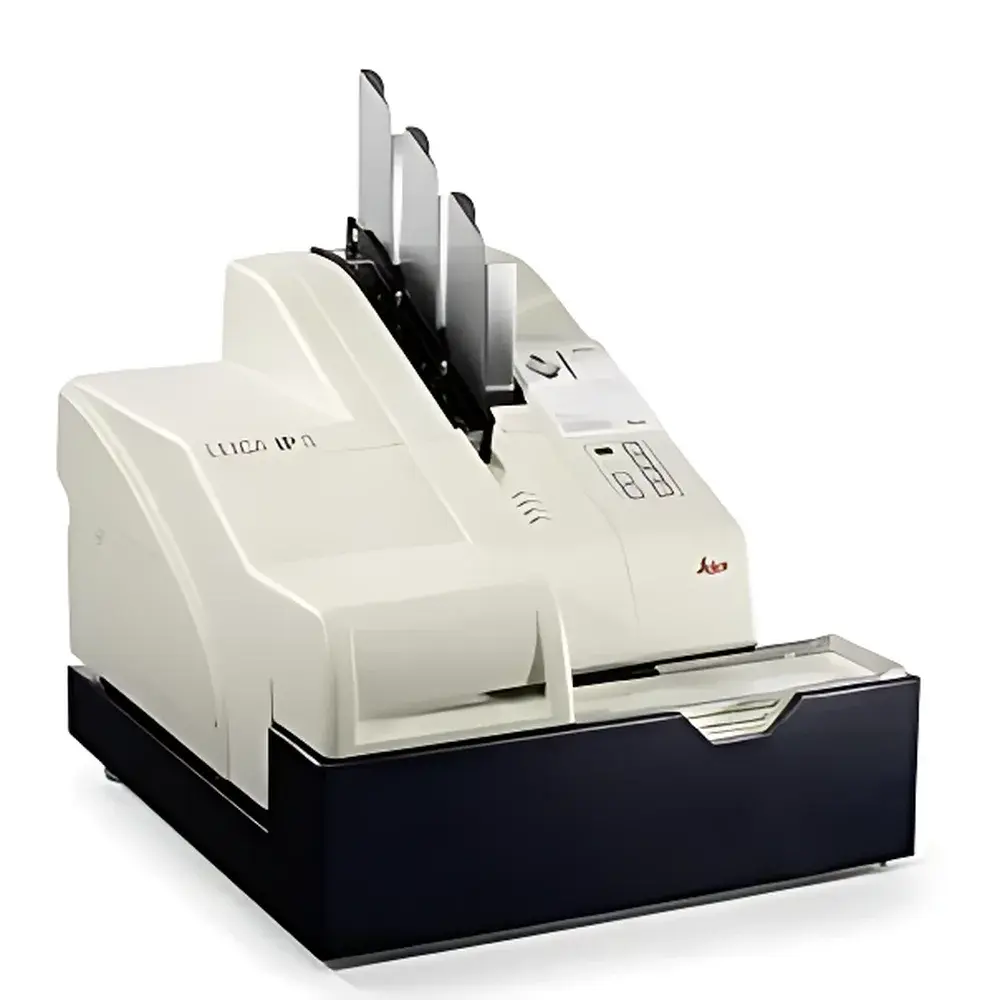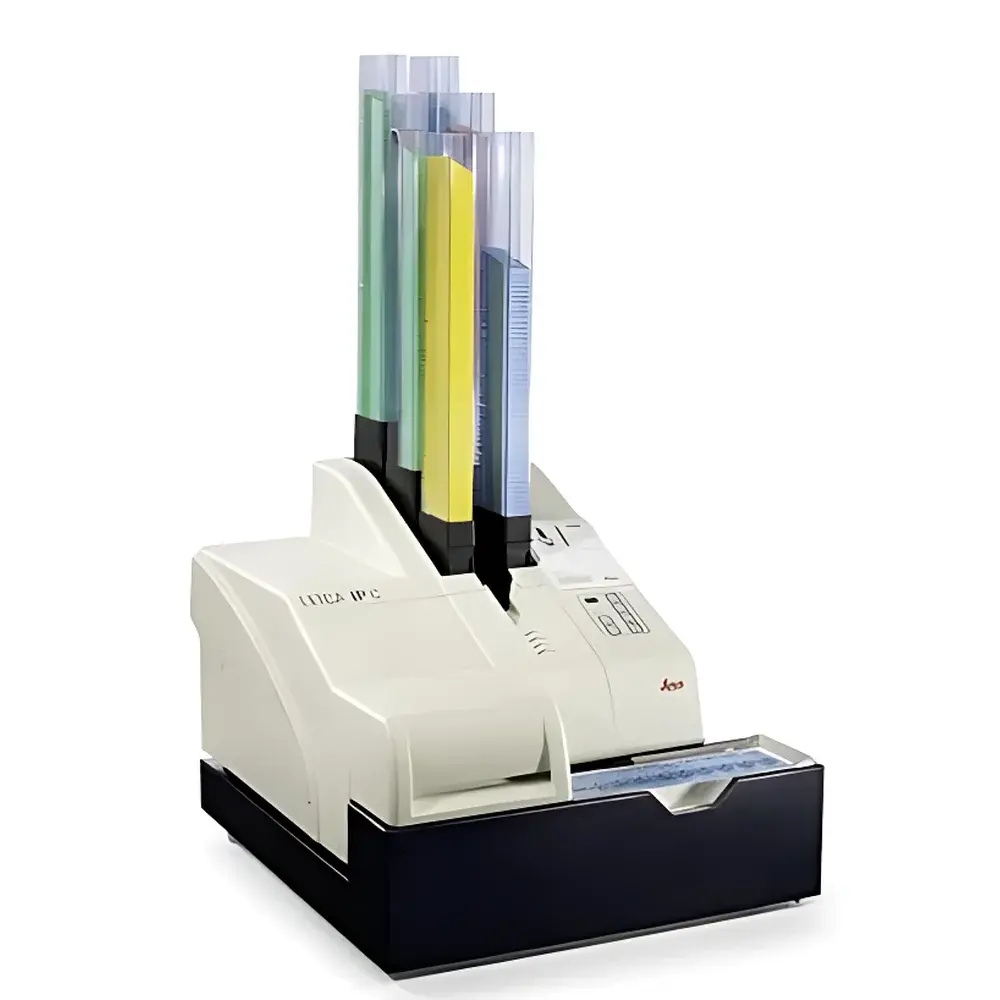
Leica IP C Inkjet Cassette Labeling System
| Origin | Germany |
|---|---|
| Manufacturer Type | Authorized Distributor |
| Origin Category | Imported |
| Model | IP C |
| Pricing | Upon Request |
Overview
The Leica IP C Inkjet Cassette Labeling System is a precision-engineered, benchtop medical device designed for high-integrity alphanumeric, barcode, and graphic labeling of histological tissue cassettes in clinical pathology and research laboratories. Operating on non-contact piezoelectric inkjet printing technology, the IP C deposits proprietary Leica-certified solvent-resistant ink directly onto cassette surfaces—including standard flat-bottom, hinged-lid, and dual-angle beveled-edge cassettes—ensuring legibility throughout full histopathological processing workflows. Unlike thermal transfer or laser marking systems, this inkjet platform avoids surface ablation or heat-induced distortion, preserving cassette structural integrity and compatibility with downstream automated embedding and sectioning equipment. The system is engineered to meet the traceability requirements of ISO 15189-accredited laboratories and supports compliance with CAP (College of American Pathologists) checklist ANP.42500 (specimen identification) and CLIA ’88 §493.1253 (laboratory information system integration).
Key Features
- Patented Leica ink formulation resistant to xylene, ethanol, formalin, chloroform, and paraffin wax immersion—maintains optical readability after >12 hours of standard tissue processing cycles
- Support for multiple cassette geometries: flat-surface, hinged-lid, and two distinct bevel angles (15° and 30°), accommodating legacy and next-generation cassette designs
- Throughput-optimized operation: batch mode at 15 cassettes/minute; single-cassette mode at ≤10 seconds per label—enabling synchronization with routine embedding line pacing
- Optional automatic cassette ejection module with 10-position stackable collection trays (10 cassettes/tray), eliminating manual stacking errors and maintaining sequence fidelity
- Modular connectivity architecture supporting standalone use, serial RS-232/LAN-based multi-unit control, or seamless LIS/HIS integration via HL7 v2.x or ASTM E1384 message protocols
Sample Compatibility & Compliance
The IP C accepts all standard polycarbonate and polypropylene cassettes conforming to ANSI/CLSI GP22-A3 dimensions (25 × 25 × 10 mm nominal). It accommodates both pre-assembled cassettes (with tissue already loaded) and empty cassettes prior to fixation—enabling flexible workflow insertion points. All printed labels comply with ISO/IEC 15416 (linear barcode print quality) and ISO/IEC 15415 (2D symbol verification) standards when used with Leica-supplied barcodes (Code 128, DataMatrix ECC200). The ink’s chemical resistance has been validated per ASTM D2563 (solvent rub test) and DIN EN ISO 105-X12 (crocking resistance), ensuring label retention through dehydration, clearing, infiltration, and embedding stages.
Software & Data Management
The embedded firmware supports Unicode UTF-8 character encoding, enabling multilingual label templates (including Chinese, Arabic, Cyrillic, and Latin scripts) without external font dependencies. Label design is managed via Leica IP C Control Software (v3.2+), which provides audit-trail logging compliant with FDA 21 CFR Part 11 requirements—including user authentication, electronic signatures, and immutable timestamped records of all print jobs, template modifications, and ink level alerts. Data export options include CSV, XML, and direct ODBC connection to LIMS databases. Optional DICOM-SR (Structured Reporting) integration enables embedding of cassette-level metadata into PACS archives for longitudinal case tracking.
Applications
- Primary specimen identification in surgical pathology labs, reducing mislabeling incidents during grossing and accessioning
- Automated chain-of-custody documentation for forensic and transplant tissue banking
- High-volume academic core facilities requiring reproducible, auditable labeling across multi-user shifts
- GLP-compliant toxicology studies where cassette-level traceability must persist from dosing through histopathologic evaluation
- Biobank sample management systems integrating with ISO 20387 biobanking standards for donor-tissue-cassette linkage
FAQ
Is the Leica IP C compatible with third-party cassettes?
Yes—provided they meet ANSI/CLSI GP22-A3 dimensional tolerances and possess a non-porous, solvent-resistant surface (e.g., medical-grade PP or PC). Leica recommends validation testing using your specific cassette lot.
Can the system print QR codes or 2D DataMatrix symbols?
Yes—the firmware natively supports DataMatrix ECC200 generation with configurable error correction levels (L, M, Q, H) and cell sizes down to 0.25 mm, verified per ISO/IEC 15415.
Does the IP C require regular printhead cleaning or calibration?
No scheduled maintenance is required; the system performs automatic nozzle self-checks before each print job and initiates purge cycles only upon detection of flow inconsistency—minimizing consumable waste and downtime.
How is user access controlled in multi-operator environments?
Role-based permissions (Operator, Supervisor, Administrator) are enforced via Windows Active Directory integration or local credential database, with session timeouts and password complexity policies aligned with NIST SP 800-63B.
What documentation is provided for regulatory submissions?
Leica supplies a complete Technical File per IEC 62304 (Class IIa medical device), including risk analysis (ISO 14971), software validation report (IEC 62304 Annex C), and Declaration of Conformity to EU MDR 2017/745 and FDA 510(k) clearance K201293.