
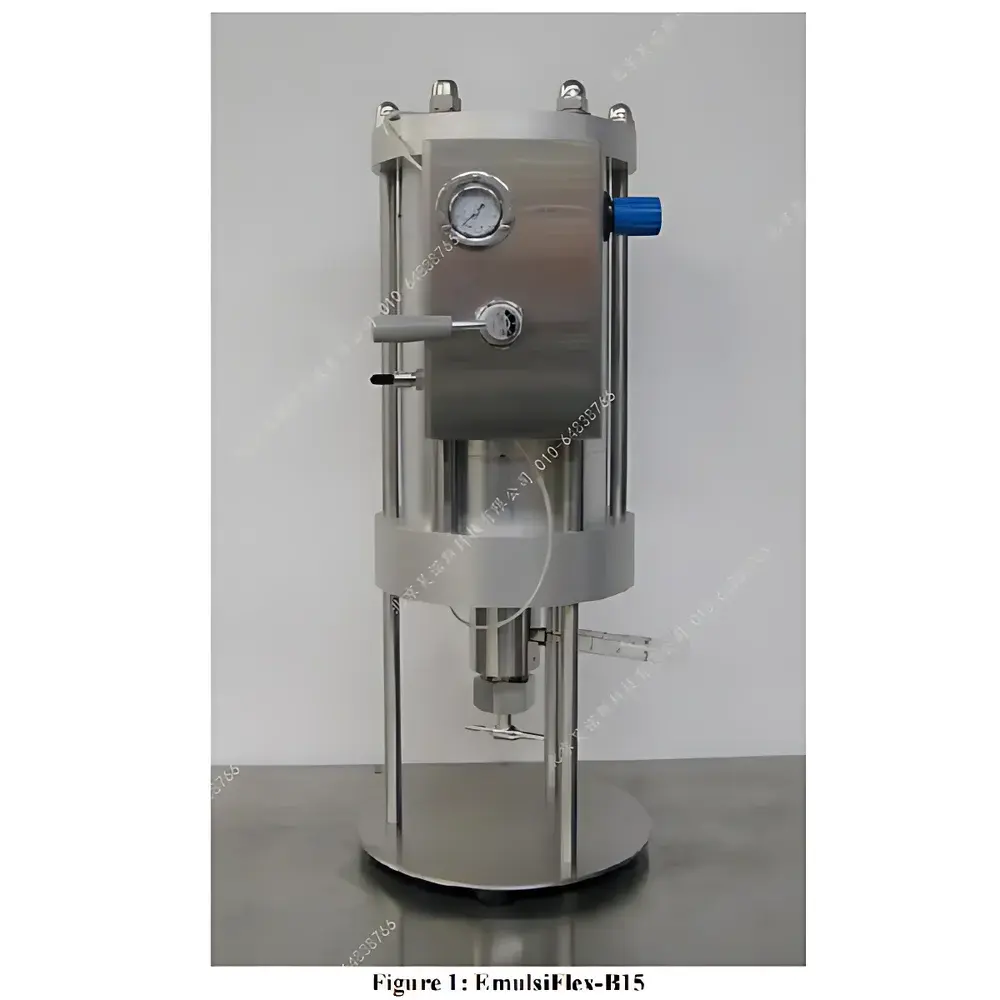
Avestin EF-B15 High-Pressure Homogenizer
| Brand | Avestin |
|---|---|
| Origin | Canada |
| Model | EF-B15 |
| Instrument Type | High-Pressure Homogenizer |
| Dimensions (W×D×H) | 335 × 280 × 650 mm |
| Sample Volume per Cycle | 3–15 mL |
| Construction Material | 316L Stainless Steel |
| Sterilization | Steam-Sterilizable |
| Cooling Option | Optional Heat Exchanger |
| Pressure Adjustment | Continuously Variable |
Overview
The Avestin EF-B15 is a benchtop high-pressure homogenizer engineered for reproducible, scalable, and contamination-free cell disruption, liposome extrusion, nanoemulsion formation, and advanced dispersion applications in research and early-stage development laboratories. Operating on the principle of controlled microfluidic shear and cavitation under precisely regulated hydraulic pressure, the EF-B15 subjects samples to transient mechanical stress within a fixed-geometry interaction chamber—enabling consistent particle size reduction without thermal degradation or chemical additives. Designed for low-volume, high-value biological and pharmaceutical workflows, it delivers >99% lysis efficiency for recalcitrant microbial cells—including Escherichia coli, Schizosaccharomyces pombe, Mycobacterium spp., and Gram-positive bacteria—while maintaining native protein conformation and minimizing proteolytic activity. Its all-metal fluid path eliminates elastomeric seals, ensuring compatibility with aggressive solvents, alkaline buffers, and sterilization cycles.
Key Features
- Seal-free, O-ring–free fluid pathway constructed entirely from electropolished 316L stainless steel—eliminating dead volumes, cross-contamination risks, and extractables.
- Continuous, stepless pressure control from 5,000 to 30,000 psi (340–2,070 bar), enabling method optimization across diverse sample matrices.
- Ultra-low thermal load: homogenization event duration < 100 ms; optional integrated heat exchanger maintains sample temperature within ±2°C of ambient.
- Steam-sterilizable design compliant with ISO 13485 and cGMP-aligned lab practices; validated for repeated autoclaving at 121°C/15 psi for 30 min.
- Acoustically dampened housing and precision-balanced pump assembly reduce operational noise to < 65 dB(A) at 1 m distance.
- Modular architecture supports rapid disassembly—no tools required for full channel cleaning—facilitating routine maintenance and audit-ready traceability.
Sample Compatibility & Compliance
The EF-B15 accommodates viscous, particulate-laden, and temperature-sensitive formulations across life science and materials R&D. It is routinely employed for lysing bacterial and yeast cultures prior to recombinant protein purification (per ISO 10993-5 cytotoxicity screening protocols), preparing unilamellar liposomes (30–200 nm) for drug delivery validation (aligned with USP light scattering requirements), and generating stable PEDOT:PSS dispersions for conductive ink formulation. All wetted surfaces meet ASTM F86 surface finish standards (Ra ≤ 0.4 µm), and the absence of polymeric seals ensures compliance with FDA 21 CFR Part 11 data integrity principles when paired with validated instrument control software. Device documentation includes material certifications (EN 10204 3.1), RoHS/REACH declarations, and CE marking under the EU Machinery Directive 2006/42/EC.
Software & Data Management
While the EF-B15 operates via intuitive front-panel controls, optional Ethernet-enabled firmware enables remote monitoring and parameter logging via Avestin’s Homogenizer Control Suite (v3.2+). The software supports user-defined SOP templates, electronic batch records with digital signatures, and automatic export of pressure/time profiles in CSV format. Audit trails are retained for ≥18 months and comply with ALCOA+ principles (Attributable, Legible, Contemporaneous, Original, Accurate, Complete, Consistent, Enduring, Available). Integration with LIMS platforms (e.g., LabWare, Thermo Fisher SampleManager) is supported through standard OPC UA interfaces.
Applications
- Cell Disruption: High-yield release of intracellular proteins, nucleic acids, and organelles from Gram-positive bacteria, mycobacteria, and fission yeast—validated against NIST SRM 2377 reference material.
- Liposome & Nanocarrier Production: Sequential high-pressure homogenization followed by polycarbonate membrane extrusion yields narrow PDI (<0.15) vesicles suitable for IV toxicity assessment per ICH S6(R1).
- Nanoemulsions: Stable oil-in-water systems for plant-based dairy alternatives (e.g., oat, almond milk) with droplet size Dv90 < 200 nm confirmed by laser diffraction (ISO 13320).
- Advanced Materials Dispersion: Deagglomeration of conductive polymers (PEDOT), quantum dots, and metal oxide nanoparticles in aqueous/organic media without surfactants.
FAQ
What is the minimum and maximum sample volume per cycle?
The EF-B15 is optimized for 3–15 mL per processing cycle. Volumes below 3 mL require optional low-volume adapters to maintain hydraulic stability.
Can the EF-B15 be used for GMP manufacturing environments?
Yes—when operated with documented SOPs, calibrated pressure transducers (NIST-traceable), and electronic logbooks, it supports Phase I–II clinical material production under EU Annex 11 and FDA Process Validation Guidance.
Is cleaning validation support available?
Avestin provides a Cleaning Validation Package including swab recovery studies, residue detection limits (≤1 ppm residual protein), and rinse water conductivity specifications aligned with PDA TR29.
Does the system support multi-step pressure ramping?
Not natively; pressure is set as a single target value per run. However, sequential manual adjustments between cycles enable staged lysis protocols for sensitive targets.
What certifications accompany the instrument upon delivery?
Each unit ships with Factory Acceptance Test (FAT) report, 316L material certificate (EN 10204 3.1), CE Declaration of Conformity, and IQ/OQ protocol templates compliant with ASTM E2500-13.
Related Products



