
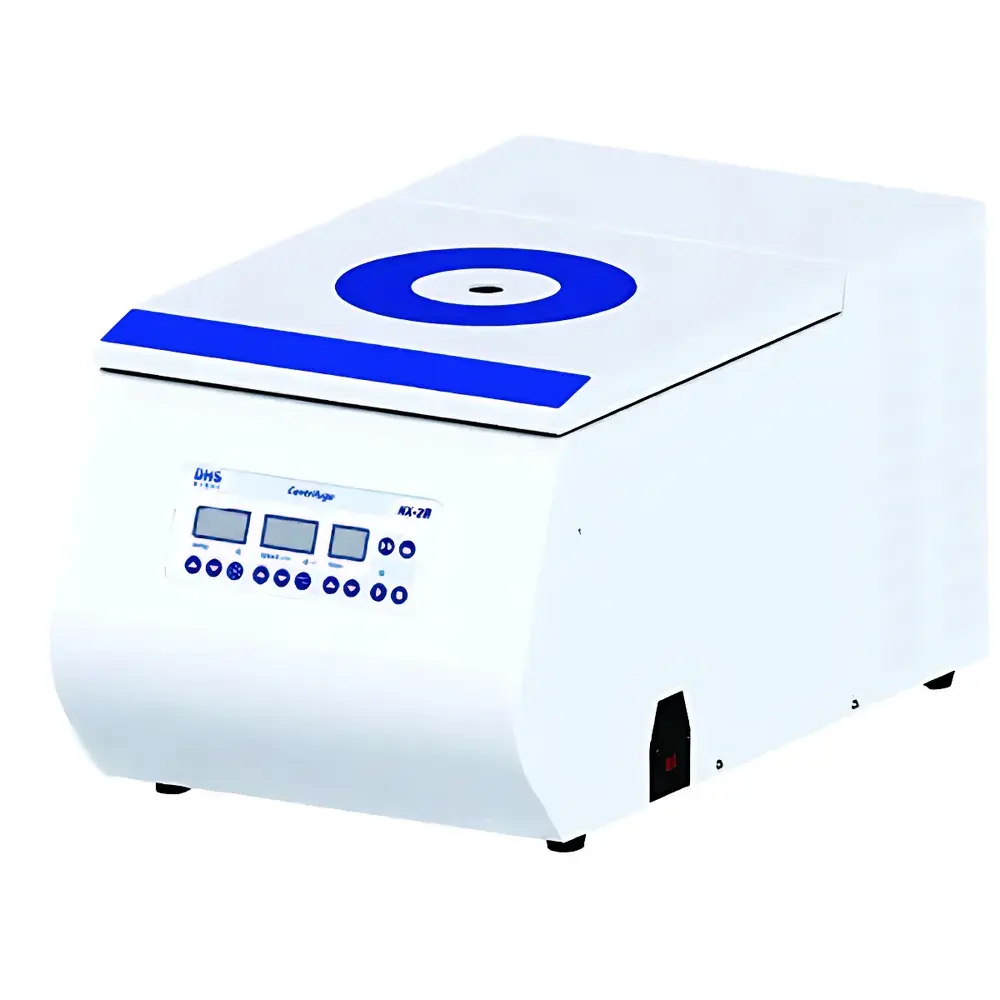
DHS NX-2R High-Speed Refrigerated Benchtop Centrifuge
| Brand | DHS |
|---|---|
| Origin | Tianjin, China |
| Model | NX-2R |
| Instrument Type | Benchtop Centrifuge |
| Category | High-Speed Refrigerated Centrifuge (10,000–30,000 rpm) |
| Max. Speed | 18,500 rpm |
| Max. RCF | 26,000 × g |
| Max. Capacity | 4 × 100 mL |
| Temperature Range | –20 °C to +40 °C |
| Dimensions (W×D×H) | 360 × 330 × 630 mm |
| Rotor Compatibility | 10 interchangeable rotors (including fixed-angle and PCR strip rotors) |
| Tube Compatibility | 0.2, 1.5, 2.0, 5.0, 15, and 50 mL tubes |
| Safety Features | Electronic lid lock, rotor auto-recognition, overtemperature shutdown, reinforced stainless-steel chamber, thickened metal housing |
Overview
The DHS NX-2R is a high-performance refrigerated benchtop centrifuge engineered for precision separation of biological macromolecules under controlled thermal conditions. Utilizing a dual-stage, eco-friendly refrigerant compression system, it achieves rapid cooling to –20 °C and maintains sample temperature ≤4 °C even at maximum rotational speed—critical for preserving labile biomolecules such as plasmid DNA, RNA, enzymes, and subcellular organelles. Its compact footprint (360 × 330 × 630 mm) and lightweight architecture reduce benchtop space requirements by up to 30% compared with conventional high-speed units, without compromising structural rigidity or thermal stability. Designed for routine use in regulated environments, the NX-2R complies with IEC 61010-1 (Safety Requirements for Electrical Equipment for Measurement, Control, and Laboratory Use) and incorporates mechanical and electronic safeguards aligned with GLP-compliant workflow expectations.
Key Features
- High-efficiency refrigeration system using imported environmentally compliant compressors, enabling ≤15-minute cooldown from ambient to –20 °C
- Quiet operation architecture: noise level <58 dB(A) at 18,500 rpm, achieved via balanced rotor dynamics, vibration-dampening suspension, and acoustic insulation
- Five-layer safety protocol: (1) motorized electronic lid lock with interlock verification, (2) automatic rotor identification via embedded RFID tags, (3) real-time temperature monitoring with thermal cutoff at >45 °C, (4) reinforced 304 stainless-steel centrifuge chamber with 3.2 mm wall thickness, (5) overload current protection and emergency deceleration algorithm
- Intuitive 7-inch capacitive touchscreen interface with multi-language support (English, Spanish, French, German), programmable storage for ≥99 user-defined protocols
- Full-metal chassis with piano-black electrostatic coating: corrosion-resistant, non-porous, and compatible with common laboratory disinfectants (e.g., 70% ethanol, 0.5% sodium hypochlorite)
Sample Compatibility & Compliance
The NX-2R supports standardized centrifugation formats across life science and clinical applications. It accommodates conical and round-bottom tubes (0.2–50 mL), microcentrifuge tubes, PCR strip carriers, and custom 100 mL angle rotors (optional). All rotors are certified to ISO 15195:2018 (Calibration of centrifuges) and undergo individual balancing validation prior to shipment. The instrument meets essential requirements for biosafety Level 2 (BSL-2) laboratories per CDC/NIH guidelines and is suitable for use in environments adhering to CLIA, CAP, and ISO 15189 quality standards. While not FDA 510(k)-cleared as a medical device, its operational parameters align with USP Analytical Instrument Qualification criteria for laboratory equipment used in pharmaceutical QC testing.
Software & Data Management
The embedded control firmware enables audit-ready data handling: all run logs—including time stamps, rotor ID, speed, RCF, temperature setpoint, actual chamber temperature, acceleration/deceleration profiles, and error codes—are stored locally in non-volatile memory for ≥12 months. Optional USB export supports CSV-formatted reports compatible with LIMS integration. No proprietary software installation is required for basic operation; however, optional PC-based DHS CentriLink™ software (v3.2+) provides remote monitoring, trend analysis, electronic signature capability, and 21 CFR Part 11-compliant audit trail generation—including user authentication, action logging, and immutable record retention.
Applications
- Isolation of nucleic acids (genomic DNA, total RNA, miRNA) from mammalian, plant, and microbial lysates
- Purification of extracellular vesicles (exosomes, microvesicles) via differential ultracentrifugation protocols
- Clarification of bacterial and yeast cell lysates prior to protein chromatography or electrophoresis
- Preparation of platelet-poor plasma (PPP) and platelet-rich plasma (PRP) in clinical and translational research settings
- Concentration of viral vectors (lentivirus, AAV) and vaccine candidates during upstream bioprocessing development
- Routine sedimentation of foodborne pathogen suspensions (e.g., Salmonella, Listeria) in food safety QA/QC workflows
FAQ
What is the minimum achievable temperature, and how quickly is it reached?
The NX-2R reaches –20 °C within 15 minutes from room temperature (25 °C), verified per ISO 21647:2021 thermal performance testing protocols.
Does the instrument support rotor calibration traceability?
Yes—each rotor carries a unique serial number and is supplied with a calibration certificate referencing NIST-traceable torque and imbalance measurements.
Can the centrifuge be integrated into a networked laboratory environment?
Local USB data export is standard; Ethernet or Wi-Fi connectivity requires optional CentriLink™ Network Module (sold separately) and is validated for secure TLS 1.2 communication.
Is rotor imbalance detection automated?
Yes—the system performs dynamic imbalance sensing during acceleration and will halt operation if vibration exceeds ISO 1940-1 G2.5 tolerance thresholds.
What maintenance intervals are recommended for long-term reliability?
Compressor oil inspection every 24 months; refrigerant pressure check annually; full rotor inspection and balancing every 500 operating hours or biannually—whichever occurs first.
Related Products



