
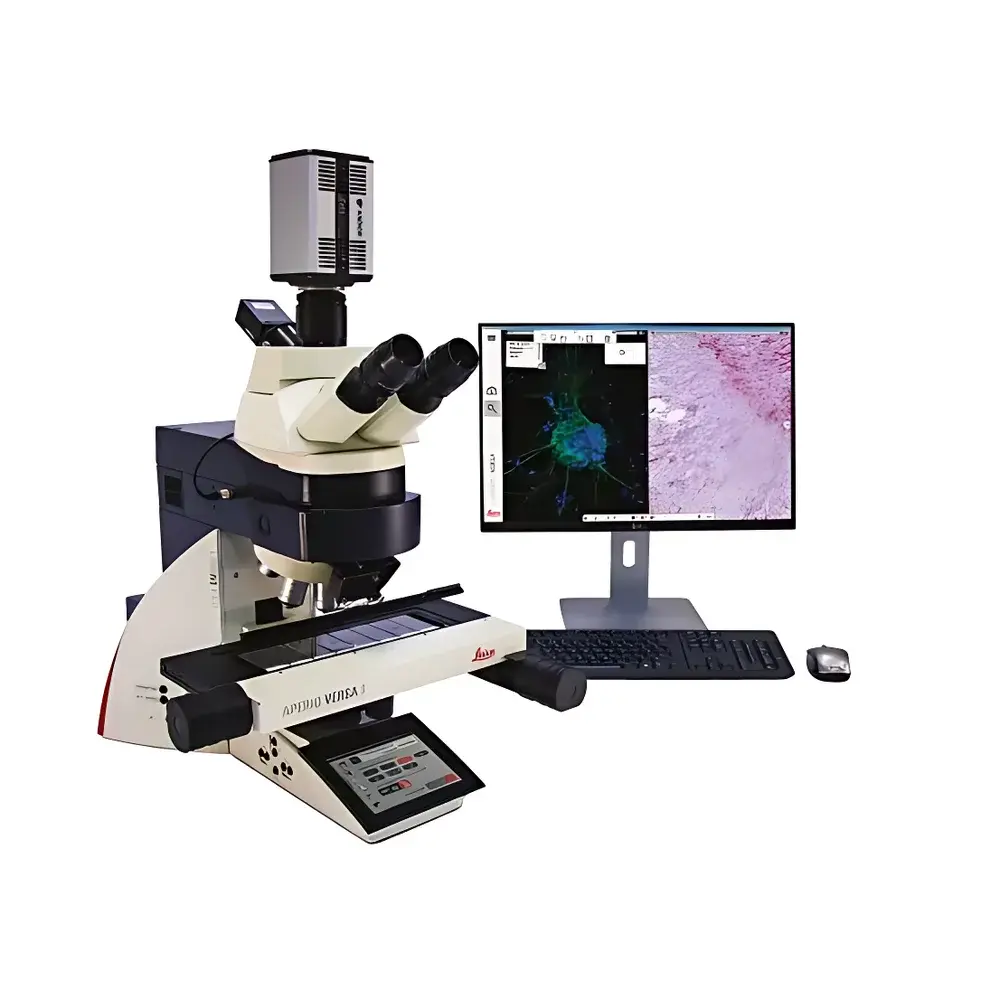
Leica Aperio VERSA Multimodal Digital Pathology Scanner
| Brand | Leica |
|---|---|
| Origin | Germany |
| Model | Aperio VERSA |
| Application Domain | Research |
| Technology Type | Fluorescence & Brightfield Whole-Slide Imaging |
| Scanning Capability | Panoramic + 3D Z-stack |
| Throughput | High-throughput |
| Operation Mode | Fully Automated |
| Form Factor | Benchtop |
| Resolution | High-resolution (sub-micron pixel sampling) |
| Slide Capacity | 8–200 slides (field-upgradeable) |
| Motion Control | Positioning accuracy < 0.1 µm (static), dynamic localization precision ≤ ±0.3 µm |
Overview
The Leica Aperio VERSA is a benchtop multimodal digital pathology scanner engineered for rigorous translational and basic research environments. It integrates brightfield, fluorescence, and fluorescence in situ hybridization (FISH) whole-slide imaging (WSI) into a single, unified platform—eliminating the need for multiple dedicated scanners while preserving assay integrity across modalities. Built upon Leica’s proven optical architecture and precision motion control system, the VERSA employs dual-camera acquisition: a high-sensitivity monochrome sCMOS sensor optimized for low-light fluorescence and FISH signal capture, and a color RGB sensor calibrated for histopathological fidelity in H&E, IHC, and special stains. Its core imaging principle relies on motorized stage navigation with sub-micron positional repeatability, coupled with objective-based optical sectioning for true 3D volumetric reconstruction via automated Z-stack acquisition. Designed for GLP-aligned laboratories, the system supports traceable scanning protocols, metadata-rich image export (DICOM-SR, SVS, NDPI), and seamless integration into secure institutional PACS or LIMS infrastructures.
Key Features
- Fully automated, walk-away scanning workflow with configurable batch processing and unattended overnight operation
- Dual-sensor imaging engine: separate monochrome sCMOS (for fluorescence/FISH) and RGB CMOS (for brightfield) to maximize quantum efficiency and color fidelity per modality
- Z-stack acquisition capability for thick sections (up to 100 µm), enabling 3D reconstruction and focus stacking at 40× and 63× oil-immersion objectives with integrated auto-oiling module
- Scalable slide capacity—from 8-slide entry configuration to 200-slide high-throughput mode—via field-installable hardware expansion kits
- Sub-micron motion control: static positioning accuracy < 0.1 µm; dynamic localization precision ≤ ±0.3 µm, ensuring pixel-perfect registration across multi-channel and multi-z acquisitions
- Advanced low-signal enhancement algorithms for weakly stained brightfield and dim fluorophore-labeled specimens, maintaining linearity and minimizing background amplification
- Intuitive web-based user interface compatible with touch-enabled monitors; supports role-based access control and audit trail logging per FDA 21 CFR Part 11 requirements
Sample Compatibility & Compliance
The Aperio VERSA accommodates standard 1″ × 3″ glass slides (including charged, APES-coated, and PEN membrane slides) and supports common mounting media—including aqueous (e.g., ProLong Diamond), glycerol-based, and xylene-based formulations—without optical distortion or evaporation artifacts during extended scans. It is validated for use with FDA-cleared and CE-IVD labeled IHC assays (e.g., HER2, PD-L1), clinical-grade FISH probes (e.g., UroVysion, Vysis), and multiplex immunofluorescence panels (up to 6-plex). System compliance includes adherence to ISO 13485 design controls, IEC 61000-6-3 EMC standards, and alignment with CAP/CLIA pre-analytical validation guidelines for digital pathology. All image metadata conforms to DICOM Supplement 145 (Whole Slide Imaging) and supports structured reporting via DICOM Structured Reporting (SR).
Software & Data Management
Acquisition and management are handled by Leica Biosystems’ Aperio eSlide Manager software—deployable as standalone workstation or enterprise-scale server installation. The software enforces version-controlled scanning protocols, time-stamped audit logs, and electronic signatures compliant with 21 CFR Part 11 and EU Annex 11. Export formats include pyramid TIFF, SVS, NDPI, and DICOM WSI, all embedded with EXIF and DICOM header metadata (slide ID, staining protocol, objective magnification, exposure settings, z-depth index). Native compatibility extends to third-party analysis platforms including HALO (Indica Labs), Visiopharm, QuPath, and MATLAB-based custom pipelines via OpenSlide API. Encrypted AES-256 data-at-rest and TLS 1.2+ data-in-transit ensure HIPAA- and GDPR-compliant deployment in hybrid cloud or on-premise configurations.
Applications
- Biomarker expression quantification across tissue microarrays (TMA) and whole-tissue sections
- Neurodegenerative disease research: amyloid-β plaque distribution mapping in Alzheimer’s models; axonal injury assessment in traumatic brain injury cohorts
- Transplant rejection monitoring: spatial analysis of immune infiltrates (CD3/CD20/FOXP3) in graft biopsies
- Toxicologic pathology: dose-dependent morphometric evaluation of hepatocyte vacuolization, tubular necrosis, or cardiomyocyte hypertrophy
- Multiplexed FISH/CISH co-detection: gene amplification (HER2), translocation (ALK, ROS1), and copy number variation in solid tumor profiling
- Co-localization studies using 2D spectral unmixing and 3D voxel correlation analysis for protein–nucleic acid interactions
- Longitudinal archival digitization of legacy slide collections under ISO 15189-accredited storage protocols
FAQ
Does the Aperio VERSA support both manual and automated scanning modes?
Yes—the system operates exclusively in automated mode but allows full operator intervention at any stage via the eSlide Manager interface, including real-time focus adjustment, ROI re-scan initiation, and protocol override.
Can Z-stack data be exported as individual focal planes or fused 2D projections?
Both options are supported: users may export raw Z-series stacks (as multi-page TIFF or OME-TIFF) or generate maximum-intensity, average-intensity, or deconvolved 2D projections with user-defined depth weighting.
Is remote system monitoring and diagnostic telemetry available?
Yes—Leica Remote Support Services provide encrypted, opt-in telemetry for predictive maintenance alerts, firmware update notifications, and service case pre-diagnosis without accessing image content.
What is the minimum recommended IT infrastructure for enterprise deployment?
A minimum of 10 GbE network connectivity, RAID-6 storage array (≥50 TB raw), and Windows Server 2019/2022 or RHEL 8.5+ for eSlide Manager Server; client workstations require ≥32 GB RAM and OpenGL 4.6-compatible GPU for real-time navigation.
Are scanning protocols exportable and transferable between instruments?
Yes—protocol files (.aps) are portable across Aperio VERSA units of the same firmware revision and can be version-controlled using Git or institutional configuration management systems.



